24 March 2007

"B" is for Birds


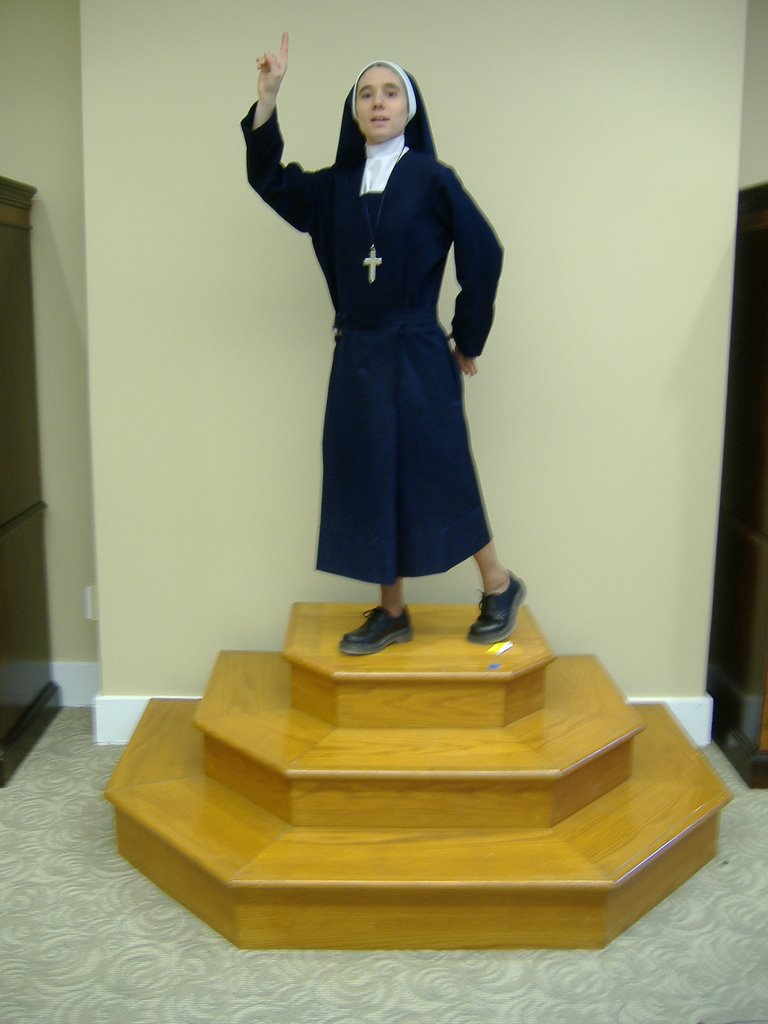
In keeping with our effort to spotlight St. Francis de Sales on the 24th of each month, we are treated to a word from our resident sacristan (and zookeeper), Sister Leonie Therese. Sister Leonie is pictured above with St. Francis de Sales – and Soltico the canary is in her hands. Here she shares with us her delight at how St. Francis de Sales writes about creation:

“I like how St. Francis de Sales was very protective of God’s creation and all things in nature – animals and plants alike. He uses them to tell stories and give examples which reveal God’s love for us and his goodness. In writings about him we are told that the birds used to fly into his hands while he was praying the Divine Office. He saw in each creature the potential to give glory to God simply by its existence. From the birds that sing to the cows that give milk (and cheese and butter) St. Francis de Sales saw creation as reflecting the beauty of its creator.”


“It is a sin to harm animals’ lives for the sole satisfaction of injuring them because it robs them of the joy of mere existence which is bestowed upon them by God for his glory.”
St. Francis de Sales

19 March 2007

Coming Soon to a Chapel Near You: Jesus!

We realize that the violet vestments at Mass indicate that we are in Lent - not Advent - but we can still say that Jesus is "coming soon" to our Chapel of St. Joseph in the retreat passage of our newly renovated monastery.

As we celebrate the Solemnity of St. Joseph, we will have a procession up to the 4th floor chapel to dedicate it and repose the Blessed Sacrament. Below is a photo of the picture of St. Joseph on the east wall of the chapel.


Pictured below is the altar, awaiting the arrival of the tabernacle (pictures forthcoming). In the foreground of the picture is a prie dieu which was used by the first sister, Mother Josephine Teresa "Alice" Lalor, who began our monastery in 1799 with Archbishop Leonard Neale.


The Chapel of St. Joseph is such a beautiful place to pray, we suspect that our own sisters may be lining up to spend a weekend in the retreat passage!

"Saint Joseph had a very great share in the treasure, Our Lord and Master, which he guarded in his house!"

St. Francis de Sales


15 March 2007

Ouch!

In today's first reading from the prophet Jeremiah, we hear a harsh report about the Lord's chosen people: "This is the nation that does not listen to the voice of the Lord, its God, or take correction." Accepting correction graciously is a challenge for anyone. It can be very difficult to listen to someone delineate our faults accurately and it is even more difficult if we perceive that the correction is unmerited. Be it an accurate or inaccurate reproof, the Lord will bless us for listening patiently to one who seeks to correct us. If a correction is issued kindly as a gesture of love it is much easier to try to accept it graciously -- a grace in itself! Though we should be slow to correct our neighbors, let us pray for the grace to accept correction in a spirit of gratitude.
"It seems a great thing when we accept correction from our Superiors. But from equals, one cannot bear it: the heart swells and reacts because this one who is my equal has no authority to admonish me . . . . it is here that we find one of the principal points of humility and perfection of the Christian life."
St. Francis de Sales

10 March 2007

Save the Baby Humans!

Recently, as our Visi moms have been working diligently to prepare for our annual dollars-for-scholars fund-raising gala, they received the offer of a golden retriever puppy to be included among the items for the auction. This seemed to be a wonderfully lively addition to the 100+ items for the auction until early this past week. Our school administration as well as our gala chairperson were inundated with hundreds of emails from animal rights activists clamoring that this was an unethical manner of treating a puppy. Among the 300+ emails that our Sister Mary Berchmans received was a surly reproach suggesting that having the puppy as part of the fund raiser was tantamount to having homeless people as part of the live auction. In response to the uproar, our administration issued a very well-stated response and withdrew the puppy from the auction. As we pondered this situation, many of us wondered if those who became angry over this well-intentioned auction item are as passionate about saving baby humans as they are about puppies. Below is a very touching rap-video which is pro-life, (pro-baby humans!). Do share it with others if you like it. It may speak to our young people in ways that we cannot imagine. If it does not appear at the bottom of this post, click here to view it.

07 March 2007

Irksome Temptations

It is a consolation, in one way, to read in today's Gospel that even the disciples themselves were not above the temptation of resentment. As the mother of James and John asks Jesus to reserve for them places of honor in his kingdom, Jesus hints at the suffering which awaits him. One can almost imagine the early-Church grapevine as news of Zebedee's wife and her request filtered down to the rest of the group. Matthew tells us that, "When the ten heard this, they became indignant at the two brothers." Surely we can all relate to how the ten were feeling. Perhaps we have been passed over for a promotion or a special assignment at work; perhaps we have watched as someone whom we estimate to be unqualified or inexperienced is given an opportunity to move ahead at work or in school. Negotiating a variety of different emotions in the face of such an experience is very natural, as the apostles show us. Irksome

Even though the Gospel does not provide us with an insider account into how each of the ten apostles felt about the two whose mother asked that they have places of honor, it might be safe to guess that their emotions ranged from anger and resentment to envy and jealousy. And knowing that such strong reactions, especially envy and resentment -- within a small group such as the apostles -- are are recipe for discord and unrest, Jesus is quick to respond. Urging the disciples to seek to be servants instead of lords, he paints a very different picture of places of honor in his kingdom. When we notice, in the depths of our hearts, a stirring of these unsettling emotions, let us be encouraged that many before us have battled these temptations.
"It is an easy thing to abstain from murder, but it is very difficult to avoid those angry outbursts which are incessantly aroused within us. . . .In short, these lesser temptations -- anger, suspicion, jealousy, envy, levity, folly, vanity, deception, impure thoughts -- are the continual trials of the most fervent and devout persons."
St. Francis de Sales

03 March 2007

Via Crucis - part II

This is a continutation of our previous post about the symbols which are etched into our crosses. The front side, pictured above, has the first three letters of the name of Jesus in Greek. (Click here for a prior post with some more information.) The double cross above the "H" symbolizes union: our union with Christ and the union of Christ with His Church. The two flames (on either side of the cross piece) represent the living fire of love that animates our lives. The three nails represent the vows of poverty, chastity and obedience. The olive branch eminating from Mt. Sinai, which is found on both sides of the cross, reminds us daily of God's peace and his mercy.

"The Everlasting God has, in His wisdom, foreseen from eternity the cross He now presents to you as a gift from His inmost Heart."
St. Francis de Sales

27 February 2007

Let it Snow, Let it Snow, Let it Snow . . .

On Sunday afternoon we had a rather unexpected snowfall. Pictured above, Sister Mary Berchmans interests Nicholas in a game of catch with a snowball.


The view from the second floor porch. A winter wonderland, indeed!

24 February 2007

"A" is for Archivist

Preparations for our 400th anniversary have begun and as we approach 2010 our Religious Assistant to the Holy See, Father Valentin Viguera, has suggested that the years leading up to this great jubilee be marked by a theme. For 2007 he proposes our Holy Founder, Saint Francis de Sales. In a letter from his feast, 24 January 2007, Father Viguera suggests that we disseminate the spirituality of Saint Francis de Sales in a variety of ways. In the spirit of this request, our blog will post a feature about Saint Francis on the 24th of every month. In this first post, our archivist, Sister Mada-anne, reflects upon one of her favorite quotations:

"St. Francis de Sales wrote frequently about work.Here's a favorite: 'Flies trouble us by their numbers,not their strength; in the same way, little things trouble us more than great things by their very number. Accept the duties that come to you peacefully, taking them one by one . . .' The Georgetown Visitation Monastery Archives contain--literally--millions of manuscripts and papers, some important, some not. All of them must be preserved and catalogued so that the information they contain will be accessible to researchers and scholars. Even more important to the community is the archivist's duty to make sure that the traditions of the monastery itself are handed down from generation to generation intact, and that's a challenge, but also, fun! The office of Archivist is a dream job, especially since it also involves keeping track of the art works in the community. This is a favorite: (note the statue she is touching ... right next to the mouse pad featuring our Holy Founders) a marvelous woodcarving of St. Francis de Sales done in1985 and presented to the sisters by its creator, artist Nancy Hanel. This wonderfully lively statue presides over the archives, with occasional forays into the chapel, or the choir, or the schoolroom--a most important reminder of our living heritage, and, incidentally, the all time favorite of the archivist. "


Coming soon (coming eventually...) a video tour of the new monastery archives.

23 February 2007

Via Crucis - part I

Often we are asked about the symbols on the pectoral cross that we wear. We thought Lent might be an appropriate time to share some of this. Pictures above is one side of our cross. We wear a cross (and not a crucifix) because those who wear it are expected to supply the corpus through our own lives of sacrifice. "MA" are the first two letters of the name "Mary." The three flames (on either side of the "MA" and below the heart) symbolize faith, hope and charity. The mountain at the very bottom is Mt. Sinai, representing the old covenant and the Olive branch emanating from the mountain is the symbol of the Lord's peace and mercy. The double cross and heart out of which it is etched is somewhat unclear to us since we have recorded the words of St. Francis de Sales to St. Jane de Chantal: "Let us take for our coat of arms a single heart surmounted by a crown of thorns."

"Crosses of our invention are never worth much; we make them ourselves. The crosses we encounter in the streets are excellent but still better are those we find at home."
St. Francis de Sales

20 February 2007

Like a Good Neighbor . . .

No, it's not an insurance company -- even better, it's our very own Sister Mary Raphael, pictured at left with Sister Leonie Therese. Sister Raphael, at 94 years young has a sharp mind and a keen sense of humor and just yesterday she added yet another hat (veil??) to the many different responsibilities and jobs she has enjoyed in her 60 plus years as a Visitandine: "Crimebuster!"

This is not a joke -- this really happened: Sister was looking out her window and noticed two suspicious figures climbing the lattice work of a nearby house. Not visible from the street, but visible from her third-floor window, the two figures appeared to be breaking into the house. The police arrived shortly thereafter.

Although we're not yet using the new blogger's label feature, if this post had a label it would be "Life in the monastery is never boring" (part III).

15 February 2007

St. Claude de la Columbiere

To the left is a photo (courtesy of Michael Hoyt) of our chapel's stained glass window of St. Claude de la Columbiere and the Sacred Heart of Our Lord.

St. Claude's early life and formative years have some common threads with our Holy Founders, having spent some of his time in studying in Lyon and completed his training at the College of Clermont in Paris.

In 1675, after pronouncing his Solemn vows as a Jesuit, St. Claude became rector of the college at Paray-le-monial and, later, the spiritual director of our Holy Sister, St. Margaret Mary.
This devout apostle of the Sacred Heart was sent to London less than two years after his arrival in Pary-le-monial. Just two short years into his time in London he was arrested on false charges and spent three weeks in prison after which he returned to France -- after being exiled from England. St. Claude died at the age of 41 in Paray-le-monial.

Interestingly, the Church has made him the patron saint of toy-makers. (Does anybody know why? We sure don't!)


In the Heart of Jesus God shows that he wants to be understood in his absolute desire to love, forgive and save; in the Heart of Jesus God teaches that the Church, in her ministry and Magisterium, must always be loving and sensitive, never aggressive or oppressive, although she must always condemn evil and correct error; in the Heart of Jesus God has us understand that it is necessary to share in his work of salvation through the "apostolate of prayer'' and "commitment to reparation."

Pope John Paul II - On the canonization of St. Claude in 1992

13 February 2007

Wow!


As most readers probably know: this week is Catholic Blog Awards Week. Thanks to some faithful readers who nominated Live + Jesus! in several different categories. Wow! Don't forget to stop by the cyber-voting booth and vote for your favorite blogs; there are lots to choose from in many different categories. For those who are new to voting, you register to create a login by providing your email address and then cybercatholic emails you a link to log into the site.

11 February 2007

From the Mailbag

This is a bit of false advertising: it's not exactly a mailbag, it's a postal container we use for our mail and this "reader question" didn't exactly arrive in the postal container, it came via E-mail. Taking a picture of the computer and saying, "From the community E-mail inbox" just didn't have the same ring to it!

A reader wrote in asking how, in the Salesian tradition, we reconcile a docility to the will of God with the "liberty of spirit" which is found in the writings of St. Francis de Sales. A fabulous question!

To clarify, St. Francis de Sales speaks of the two wills of God. He suggests that we refer to those things which we know the Lord wants us to do as His "signified will" and those things which the Lord permits (but does not necessarily desire) as His "permissive" will. Amid the Lord's permissive will (such as finding the copy machine jammed when we are in a hurry -- to use an everyday example) we are encouraged to remember and observe the Lord's signified will. Surely the Lord did not desire the copy machine to jam; he did, however, permit it to become jammed. As we struggle to accept this, we are encouraged to remember the precepts of good Christian behavior ... such as refraining from the temptation to dismember the person whom we suspect may have caused such a mini-disaster.

Within this context of striving to accept the circumstances in which we find ourselves, how does "liberty of spirit" fit? An example or two of this spiritual gift:

There are suggested methods of introducing a Visitandine novice to a deeper method of prayer when she begins her formation. There is, however, a note in our constitutions that if some other method of prayer seems to work more effectively for one particular novice, the novice mistress, using her judgment, should have a great liberty of spirit to encourage this.

An everyday example: in our rule of life, we are obliged to make one hour of meditation prior to the first community exercise of the day and one half hour in the afternoon. In addition, we are to make one half hour of spiritual reading at some time during the day. Perhaps a sister intended to make her spiritual reading at 4.30pm in the Chapel. If, shortly into her reading, she discovered a guest entering the chapel who needed to be consoled, we hope she would have the liberty of spirit to approach the visitor and ask if she could be of help. And more so, that she would have the liberty of spirit to see her response to circumstances which the Lord permitted as a service, a prayer pleasing to the Lord. Surely one would not plan to do spiritual reading at a time when we expect a visitor -- but, rather, we would try to have the inner freedom to accept the circumstances which we cannot control and allow the Lord to use us as He pleases.

Liberty of spirit is a freedom of heart that allows us to detach ourselves from the "outcome" that we would like to see in a given situation. Perhaps the sister, setting out to do her spiritual reading at 4.30pm, had imagined herself finishing a certain chapter in her book by the time the bell for Vespers is rung. Through the grace of liberty of spirit, however, she is detached from that "outcome" and open to whatever the Lord's permissive will has in store.

"Walk in the presence of God in a holy and absolute liberty of spirit."
St. Jane de Chantal

07 February 2007

St. Francis de Sales on Creation

And then God created . . . the pilgrim.

We have been reading the creation account in Genesis this week and the last two days, in particular, we have read the creation of man. In his own exegesis of the creation account (Genesis ch. 1 in particular), Saint Francis de Sales links the use of reason -- the distinguished wisdom -- of man to our status as pilgrims.
" . . . God has not only bestowed th[is favor of dominion] upon man, but He has also given him full power over all sorts of accidents and events . . . . by the use of reason, he will remain firm and constant amid all the various events and accidents of this mortal life. Let the weather be fine of let it rain, let the air be calm or let the wind blow, the wise man pays no attention to it, knowing well that nothing in this life is lasting, and that this is not a place of rest."
It may be easy to pay little attention to the wind or rain (or snow!) but when the winds blow sand in our eyes and we are faced with difficult circumstances, it is more difficult to "pay no attention." In fact, it may seem foolish, at times, to pay no attention to a situation or circumstance which is troubling to us. This is when the reminder of our "status" as pilgrims will serve us well.

04 February 2007

Homecoming!

Yesterday afternoon we welcomed home the last of the "exiles" as our Sister Rosemarie returned from an extended visit to her village in Africa. In fact, we thought that perhaps Sister brought the entire village home with her, in her luggage, which was so heavy (see photo) that it took four sisters (one standing IN the trunk, two helping and one standing nearby ... laughing) to unload the car!


It was a thrill to watch Sister look around the "new" monastery after we deposited her luggage in her new room. Below, she is pictured with Mother Philomena and Sister Mary Roberta in the background.
While she was visiting her village in Lare, Kenya, Sister Rosemarie was able to see, firsthand, the progress of the Mercy Center Project which she, an ocean away from her home, initiated through the generous benefactors who helped her.

Stay tuned for a tour of the new archives and more "new monastery" photos -- coming this week!

31 January 2007

Our Saintly Cousin

John Bosco and the many religious, priests and laity who take him as their patron are some of our favorite relatives here in the Salesian family. Most people associate the adjective "Salesian" with this great saint who cared deeply for young people -- and rightly so. For Saint John Bosco put his humble catechetical program under the patronage of Saint Francis de Sales and thereby gave root to an esteemed and valued branch of our Salesian family tree.

Perhaps one of the more humorous (and human) anecdotes that comes down to us about this saint, fondly referred to as "Don Bosco" is his escapade at the abandoned church near the mill. Having taken his motley group of boys to the local parish Church, Bosco was soon "unwelcome" by the pastor due to the shenanigans that one can expect when gathering young men. Finding an empty Church near a mill, Bosco moved his group and soon enough the mill workers were complaining about the youngsters. The bishop sent two priests to visit St. John Bosco and to invite him to take a "ride" in a carriage which would be arriving shortly. Bosco suspected a plot and graciously agreed. When the carriage arrived he carefully suggested that the two priests precede him into the carriage and, slamming the door, instructed the driver to take them to the local asylum -- the very place they intended to send him! In the days before email, faxes, digital images and text messages, the asylum had no idea which priest they were expecting and the two who arrived at the institution were a long time talking themselves out of an extended stay. With a wink and a smile this cheerful friend of young people narrowly escaped an unexpected "vacation."

A few words from from his own pen regarding youth:

"Give them ample liberty to jump, run, make a din as much as they please. Gymnastics, music, theatrics, hikes, are very effective methods for getting discipline; they favor good living and good health."
St. John Bosco

28 January 2007

And Sew on and Sew forth

Yesterday, our Visi moms held a sew-a-thon to complete curtains for most of the rooms in the monastery. They had an amazing crew of "cutters," "sewers," and "runners" who cut, stitched and delivered the finished curtains to several "stations" in the monastery. (We'll have pictures of the fruits of their labors as soon as they're hung -- a great improvement over the bedsheets we used to use as curtains.)

Little by little, as pictures are returning and statues appearing (to say nothing of curtains made with love) the monastery is beginning to feel like home again. Amid the inevitable inconveniences such as not being able to use the dishwasher or washing machines (calling for very creative solutions!), we are grateful for the many kindnesses shown to us by our benefactors. And it is in the spirit of our Holy Father's exhortation that we strive accept the blessings and (the hopefully temporary) challenges which we discover daily:

"Do you ask what I desire should remain most deeply engraved upon your mind, so that you may put it in practice? Desire nothing, refuse nothing. . . let us receive with perfect evenness of mind all that the Providence of God may permit. May God give us the grace to do this."

St. Francis de Sales

24 January 2007

Solemnity of St. Francis de Sales

This year's Solemnity of St. Francis de Sales is a very different sort of Feast for us; for it finds us settling into our newly renovated Monastery. Despite the little inconveniences to which we need to attend, the joy of being home in the monastery far outweighs any of the unfinished details. And, once again, at risk of boring our readers, we share some pictures from this great event.

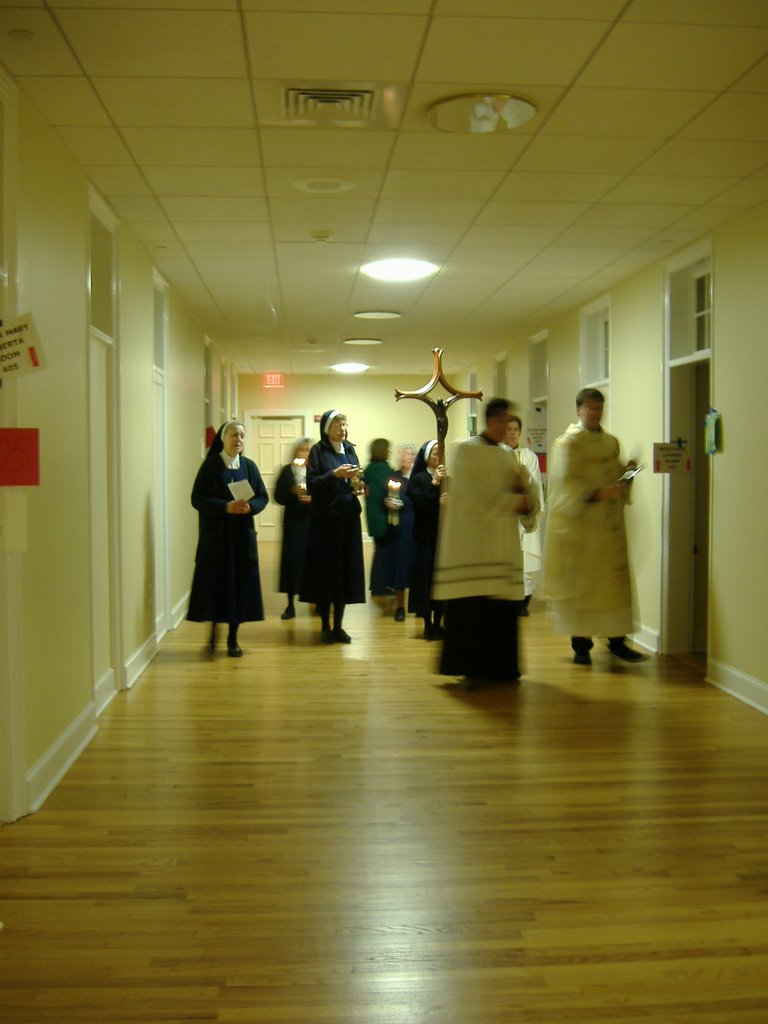
On Monday afternoon, prior to our first night in the "new" monastery, we had a formal blessing of all the rooms. Pictured below, Sister Anne Francis, Sister Mary de Sales (candle bearers) and Sister Leonie Therese wait while the rest of the procession visits the Chapel of St. Joseph on the retreat wing for its blessing.


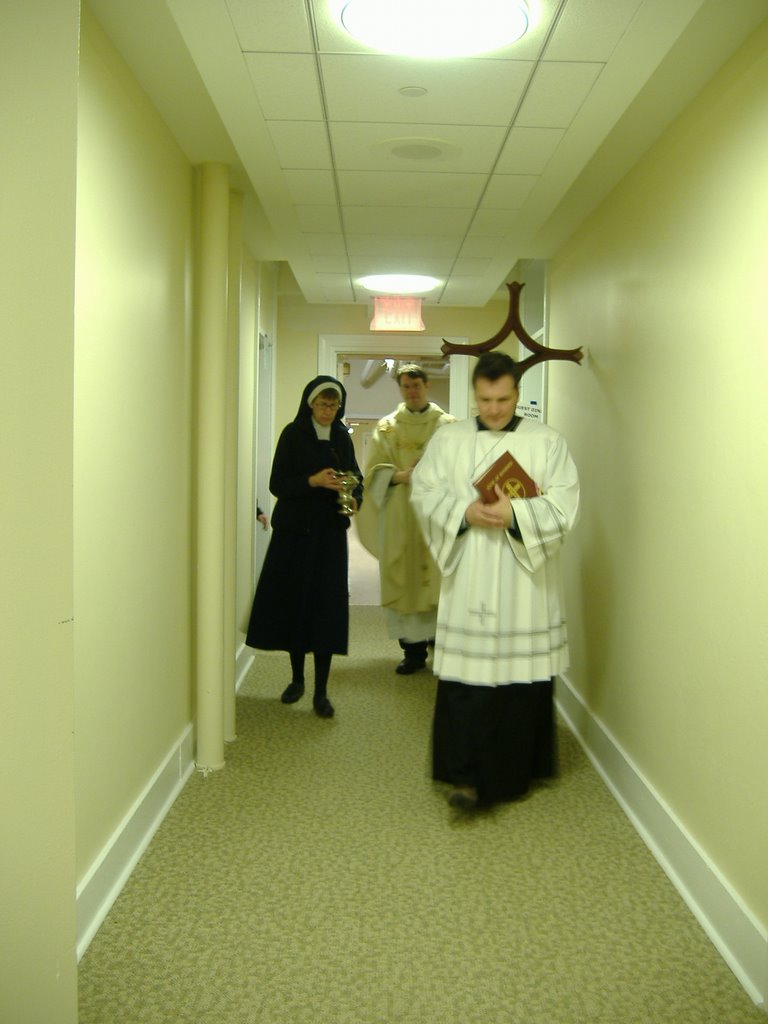
The blessing of the monastery proceeds through the novitiate hallway.


The procession passes the infirmary and approaches the professed sisters' dormitory wing.


More pictures forthcoming!

21 January 2007

Happy Campers!

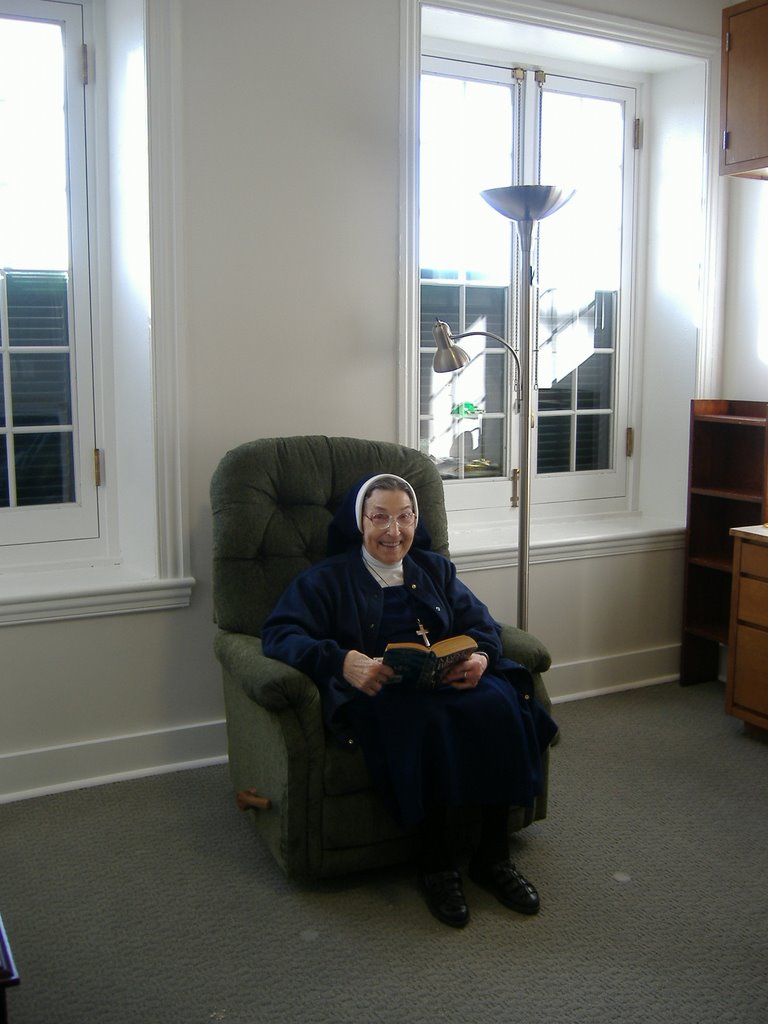
The days are growing closer! For those of our readers who have been following our journey to the promised land -- during our ten months (who's counting!?) in exile -- we have a few pictures of some very happy campers who can see the end of the exile approaching on the horizon. Pictured below, Sister Mary Austin pauses to do some spiritual reading in a new chair.

Sister Bernardine, below, gives her seal of approval on one of the new chairs in our assembly room. We're not sure we will recognize the room without a complete set of "unmatching" chairs!

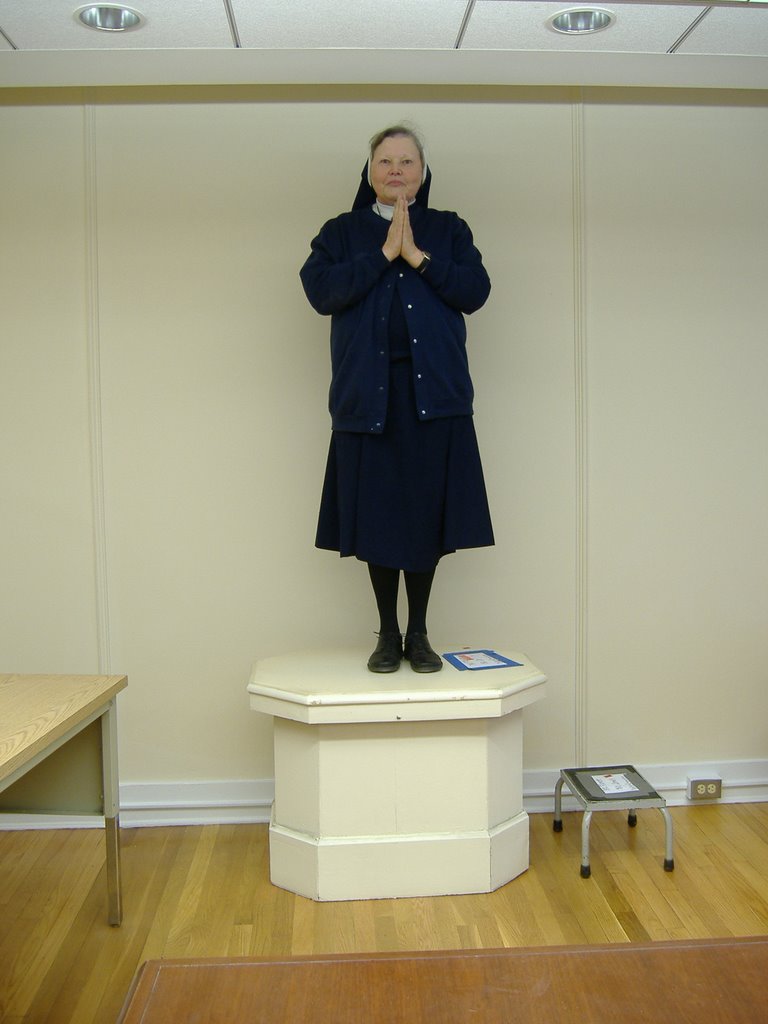
On Saturday, many of our Visi Dads came and moved boxes, arranged furniture, assembled beds (and some moms were seen doing heavy lifting, too) while Moms and daughters helped clean and unpack. While many worked hard, some of us, er, worked hard at entertaining our cheerful helpers. Below, Sister Mada-anne seizes the opportunity to pose on an empty statue pedestal.


. . . and Sister Anne E thinks she's Augustus Caesar -- though she looks a lot more like she's trying to hail a taxi than the noble style of Polyclitus' spear carrier. Fortunately for the community, the Blessed Mother will soon be atop that pedestal. Stay tuned for more pictures.


17 January 2007

A Cut Above the Rest!

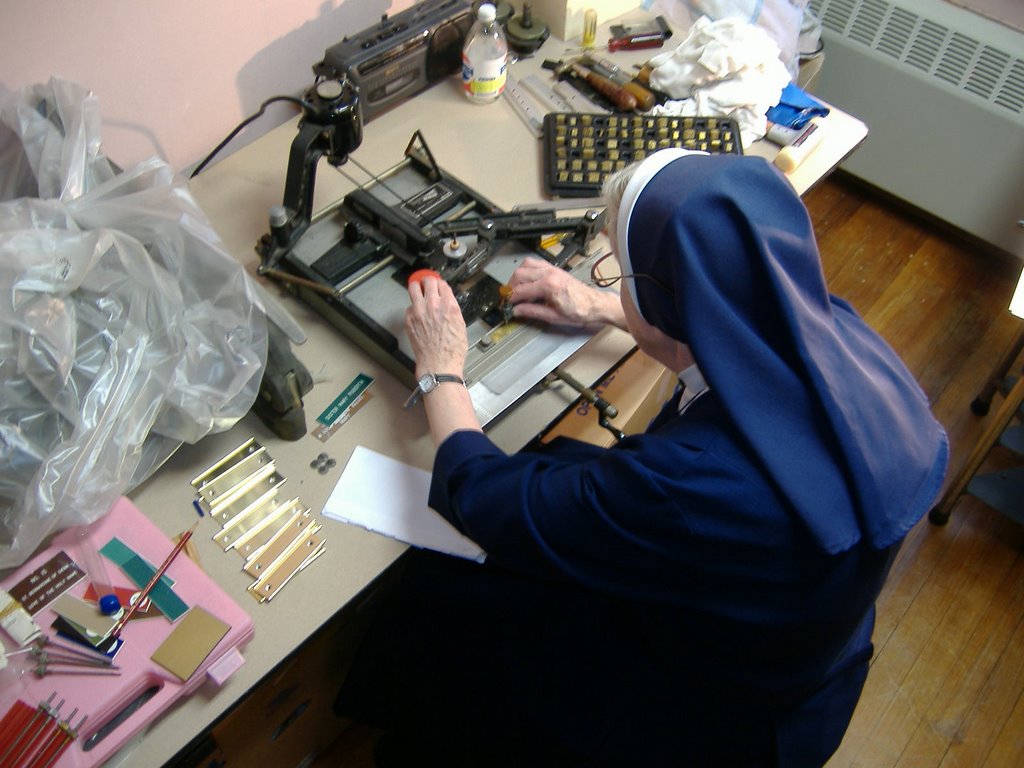
As we make final preparations for our move back into our renovated monastery, we have the opportunity to make new door tags. One of our monastic customs is to have a saint's name and a virtue on the door of each sister's room, as well as that of our common rooms and offices. Pictured below, Sister Mary de Sales prepares the engraving machine for the virtue "courage."

Many years ago, when she was director of athletics, the price of engraving skyrocketed from 2 cents a letter to 15 cents a letter. Sister recalls being so frugal that the year the price increased, the "Ping Pong Runner-Up" trophy read, "PPRU." (Apparently sister was working on a 60 cent budget!) Given the cost of engraving, Mother Cecilia thought it was a great idea for Sister Mary de Sales to learn how to engrave. And learn she did.

One anecdote that Sister tells with a chuckle is how, as a student at Visitation, Sister Mary de Sales, on a national spelling test, scored in the lowest 10% of the nation. She recalls being late to field hockey practice because she had to go to an after-school spelling class in Mother Mary Leonard's office. That Sister is "spelling-challenged" is no secret in community -- and it was Sister Mary Paula who, upon hearing that she was taking up engraving, said to Sister Mary de Sales, "Now it will cost you money to misspell a word!" Lo, these many years later, Sister is still a poor speller but she is a very fine engraver! Pictured below is the plate for Room 405: the virtue is courage and the soon-to-be-engraved saint is our Holy Sister, Saint Margaret Mary. Stay tuned for more pictures!

13 January 2007

Moving Along

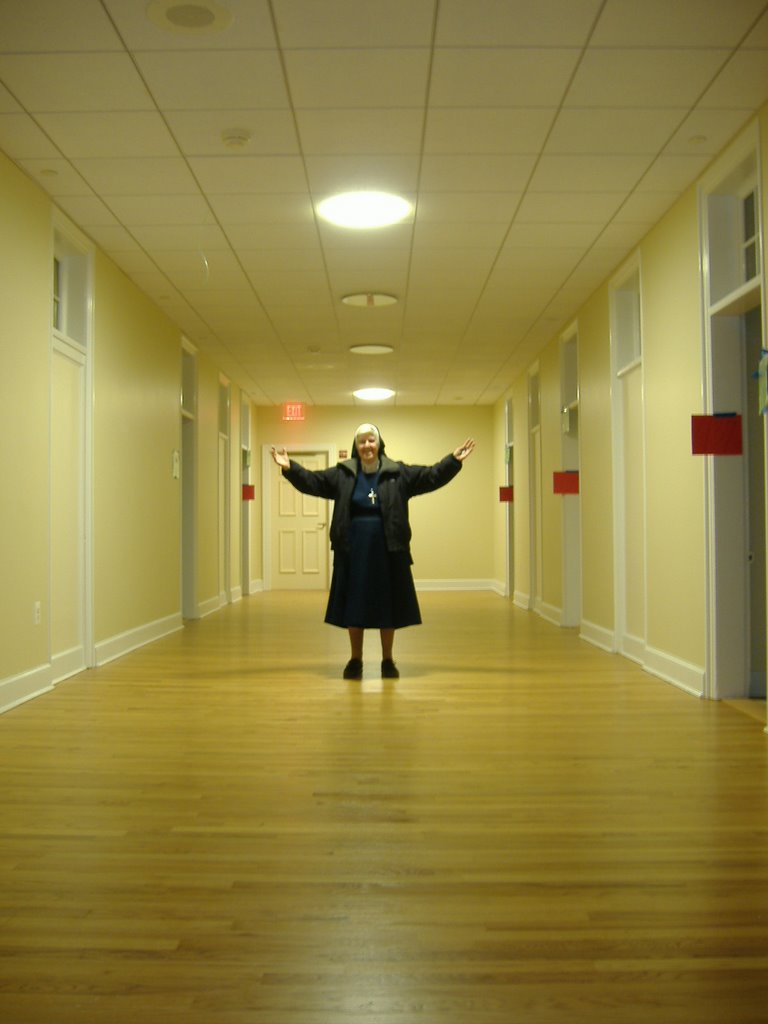
The countdown has begun! The finishing touches are being completed and the "new" monastery is beginning to look like a home. Sister Mary de Sales, pictured below, is showing off the novitiate hallway. (The red signs, to the right, are not going to stay on the doors; they are there for the day when the movers bring our furniture back.)


Sister Anne E, below, is testing out a chair in the "new" teachers' workroom. Before long, there will be a desks to go with the chairs. . . and the room will be filled with books and supplies (and papers to grade...) Stay tuned for more pictures in the coming weeks as we hope to be living in the monastery by the Solemnity of our Holy Father, St. Francis de Sales, later this month.


11 January 2007

Spreading the Good News

The former-leper in today's Gospel was asked to present himself only to the priests and not to tell anyone about his miraculous healing. Instead, he does just the opposite. If we may overlook his failure to obey Jesus' wishes, we can find in this leper a good example of how we should respond to the gifts which we receive from the Lord.

In our culture, where rugged independence is praised, esteemed and encouraged, we are not often comfortable telling everyone about a little (or big) grace we have received from the Lord. There is something in the message of the media which exhorts us to be fiercely independent and self-made beings. And yet the Lord would have it otherwise. He invites us, constantly, to tell him our needs and to ask for them. When we receive a blessing, a happy surprise, let us not keep it quiet, but let us share it with those around us. Let us make known the wonders of our God!


"As regards your smaller consolations and joys, I wish you not to be so reserved about them, and, when the occasion presents itself, to speak of the frankly and simply to one another."
St. Francis de Sales

07 January 2007

The Wise Still Seek Him

The magi left the royal court of Herod and followed the star to Bethlehem where it rested upon a stable. The wise men traveled from what was likely a palace to a humble stable where they paid homage to the newborn Messiah. Earthly riches did not cloud the discerning eyes of the magi; they encountered the Lord in a fragile baby, born in a stable. They knew that this was an altogether different kind of royalty, but one very worthy of their gifts and their journey.

We can learn from the magi -- that the Lord is found in the most ordinary of circumstances, in the most humble of places: where we least expect Him to be. Let us, like the wise men, seek the Lord at all times. Let us be vigilant to keep our eyes on all that points toward him, all the "stars" of our life that lead us ever closer to his presence.

"When the magi kissed the feet of Jesus, they kissed the feet of God."
St. Francis de Sales

03 January 2007

Trivia but not Trivial!

Today is commemoration of the Holy Name of Jesus, a feastday which was reinstituted by Pope John Paul II after being dropped from the Roman calendar during the 1969 revisions (the Feast erstwhile known as the "Feast of the Circumcision.")

The letters "IHS" are ubiquitous in Churches, on altars, on vestments, etc. and they are sometimes mistakenly represented with periods between the letters (I.H.S.) as an acronym for "Jesus Hominum Salvator." Originally, however, they were intended to represent the first three (capital) letters of the Most Holy Name of Jesus in Greek (Iota, Eta, Sigma).
"How are we to pronounce the sacred name of Jesus? . . . It is not enough to say it with your lips; it must be engraved upon your heart."
St. Francis de Sales

31 December 2006

The Holy Family - on the move!

It seems, each year, that the Feast of the Holy Family suffers some unfortunate liturgical fate. Last year, in the shortest Christmastide possible, it was relegated to a Friday and first Vespers were omitted. This year, it assumes its usual place on a Sunday but cedes its second Vespers to the Solemnity of Mary on 1 January.

Despite the liturgical aerobics that this happy Feast suffers, it offers us an opportunity to reflect on the time that Jesus spent with Mary and Joseph -- a time about which we know very little. The story of the finding in the temple, which we hear in today's Gospel, is the only documented pericope we have of the years between the Jesus' presentation in the temple and his baptism. Whatever the events that filled the silent years spent together, we can presume that the Holy Family experienced the joys and sorrows common to all families - and we can presume that they received those joys and sorrows with unparalleled grace.

As we experience the day-to-day events in our family, our parish, our community, etc., let us remember that every feeling we experience has first passed through the Most Sacred Heart of our Lord. And, although none of our families can approximate the holiness of the Holy Family, we can trust that, in some way, the feelings of frustration or helplessness that we may feel when we watch a loved one suffer -- or that we may experience ourselves -- were not entirely unknown to the Holy Family. Let us look to this first domestic Church for strength and consolation for each of our families. Let us entrust to Mary's and Joseph's care all families who are in special need of healing.

"Not that there is any comparison . . . yet still we may say that it was a trinity on earth representing in some sort the most holy Trinity -- Mary, Jesus and Joseph; Joseph, Jesus and Mary -- a trinity worth indeed to be honored and greatly esteemed."
St. Francis de Sales

25 December 2006

The Lord is Come!

The desert shall bloom with flowers; the Lord is near!
The desert has bloomed with flowers; the Lord is come!

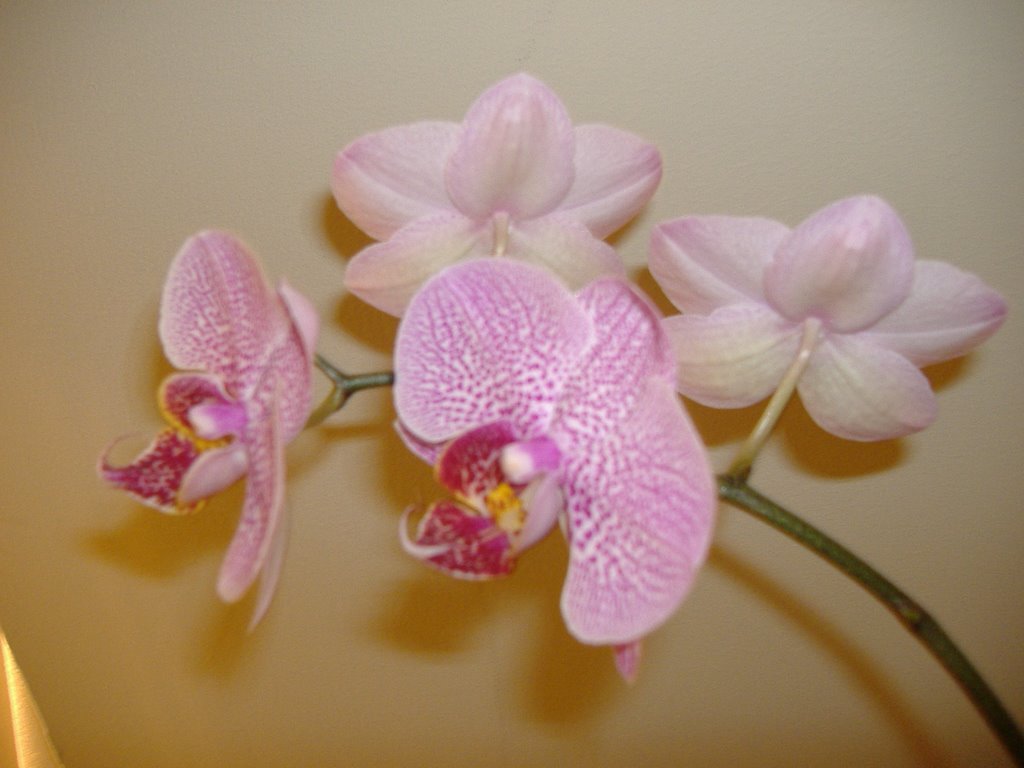
This is an unusual Christmas for us, in many ways. We are counting down the days to the end of our exile and we are trying make Christmas as smooth and prayerful a celebration as possible, given the limitations of our living conditions. So, why are orchids in bloom in Washington DC in December? Indeed, this is an unusual Christmas! It seems that our Sister Leonie Therese has been coaxing these orchids to bloom (without success) for four years. Recently, in the Fennessy refugee camp, the over zealous radiators have caused some areas to reach 85-90 degrees (with the windows open!) When sister placed the orchids near the "rainforest" they began to bloom and they are simply majestic. There are four more buds just beginning to bloom -- perhaps they will come out in time for the Solemnity of Mary!
All kidding aside, as we celebrate the coming of our Lord, we rejoice and give thanks for all the blessings we have received in the past year -- most especially the kindness and generosity of our benefactors who are making the renovation of our monastery a dream come true. We anticipate moving in within a month or so. Stay tuned for pictures!

A happy and holy Christmas to our readers.
With love from your Sisters of the Visitation of Georgetown.

23 December 2006

O Emmanuel!

Today we sing the last of the Great O Antihons. The apostrophe of this last antiphon has become the title (and first verse) for the popular Advent hymn.

O Emmanuel, Rex et legifer noster, expectatio gentium, et Salvator earum: Veni ad salvandum nos Domine Deus noster.
---
O Emmanuel, our King and law-giver, the desire of the nations and their Savior: come and save us Lord our God.

Historians who study these antiphons have discovered that the first letter of the Latin titles, spelled backwards reveals: "Ero cras" (I will be tomorrow.) Either the historians need a hobby or the monk who penned these hallowed verses embedded them, from every angle, with hints of the promise that is fulfilled in the incarnation. Presuming the latter, we approach this penultimate day of waiting with great hope for we trust that He, the long-desired of nations, will come and be born again in the hearts of those who seek him. As we make our last-minute preparations these next two days, let us ask for the grace of stillness. Come, Lord Jesus.

22 December 2006

O Rex Gentium!

The King is coming and today we recall His unifying role, making both to be one, as he includes the Gentiles among the sons of Israel as those he has come to save.
O Rex Gentium, et desideratus earum, lapisque angularis, qui facis utraque unum: Veni, et salve hominem, quem de limo formasti.
---
O King of the Nations, and their desire, the cornerstone, who makes both to be one: Come and save mankind, whom you formed from clay.
The long-desired Messiah approaches and we rejoice because our weak and frail human nature will be restored to its original dignity when it is embraced and worn by the King of kings. God repairs our broken humanity by becoming one of us and we marvel at how He who formed us from clay is come among us as a fragile baby. The Creator entrusts his creation, whom he formed from clay, with Himself. Indeed, too great a mystery for us to comprehend -- one can only marvel and adore the mystery of God made man in the form of a child. O come, let us adore!
"Behold God incarnate! How beautiful it has been to reflect on the very profound mystery of our Savior's Incarnation! This mystery is so exalted and so profound that we understand next to nothing about it. Finally, some day in Heaven above, we will grasp it fully."
St. Francis de Sales

21 December 2006

O Oriens!

Today we call Christ the "Oriens," the rising brightness, the dawn. The Latin verb "orior" literally means "to rise up" or "to be born" and, used substantively, it has come to signify the rising of the sun in the east.

O Oriens, splendor lucis aeternae et sol iustitiae: Veni, et illumina sedentes in tenebris et umbra mortis.
---
O Rising brightness of everlasting light and Sun of justice: come and enlighten those sitting in darkness and in the shadow of death.
The word "oriens" as the place where the sun rises, the east, is responsible for the less than politically correct adjective - once popular - referring to things Asian: oriental. It meant, simply, from the east. Today, "orientation" has become synonymous for "direction" but, in a more accurate reading, it really means a turning to the east, a turning to the rising sun, a turning to Christ.
Let us turn ourselves to the east, to the Rising brightness who comes to the hearts of the faithful who seek him. When He comes, let Him find us neither unprepared nor afraid, like those who, squinting, miss the splendor of the sunrise. Let us greet the Rising dawn with words of praise and grateful hearts. Come, Lord Jesus.

20 December 2006

O Clavis David!

Today's O Antiphon uses a title that is "new" inasmuch as it is used for the first time, as a title, in this antiphon. The "key of David," the six-pointed star, is born and illumines the darkness, just as it once lit the night sky over that humble manger in Bethlehem.
O Clavis David, et sceptrum domus Israel: qui aperis et nemo claudit; claudis et nemo aperit: Veni et educ vinctum de domo carceris sedentem in tenebris et umbra mortis.
---
O Key of David, and scepter of the house of Israel: who opens and none shall close, closes and none shall open: Come and lead out from the prison house the one in chains who sits in darkness and the shadow of death.
Jesus is the key that unlocks the gate of heaven. Man is held captive, chained by sin and temptation, walking a road that leads only to despair and death. The law, the old covenant, did not lead men to freedom -- it was yet another fetter waiting to be unlocked. Jesus is the long-awaited messiah. And by his coming among us as man, Jesus ended the reign of sin and death.
As we prepare for Jesus' coming, let us examine our hearts for those little trappings that hold us bound. Sometimes we find it difficult to forgive someone and we are held captive by a feeling of guilt or sorrow. Perhaps we struggle with an addiction that makes it difficult for us to carry out our daily responsibilities and we are held captive by a feeling of helplessness. Whatever it is that restrains our heart can be loosed by the power of the mighty Key of David -- and the wise still seek that six-pointed star in the dark sky that veils the dawn of his coming.

19 December 2006

O Radix Jesse!

The third antiphon, sung tonight, calls Jesus the "Root of Jesse," identifying him with his ancestral line as a son of David, the son of Jesse.
O Radix Jesse, qui stas in signum populorum, super quem continebunt os suum, quem gentes deprecabuntur: Veni ad liberandum nos, iam noli tardare.
---
O Root of Jesse, who stands as a sign for the peoples, before whom kings will fall silent, whom the nations will entreat: Come and free us now, do not tarry.
Jesus' lineage as a son of Jesse is important for many reasons -- one of which is Jesse's own heritage. Jesse was the son of Obed, whose mother was Ruth. Ruth herself is a significant figure: she was a Moabite woman and the widow of a Bethlehemite. When her mother-in-law Naomi chose to return to Bethlehem, Ruth insisted on going with her. In Israel, Ruth married Boaz and they became the parents of Obed (the father of Jesse). Had Ruth stayed in Moab and not accompanied Naomi to Bethlehem, the lineage of King David, the royal line in which Jesus was to follow, might never have come to be.
Ruth's fidelity to her mother-in-law and to the daily work of gleaning the fields for food were both significant factors which led to her becoming the wife of Boaz, the mother of Obed, the grandmother of Jesse and the great-grandmother of King David. As we await the birth of another little boy in the city of Bethlehem, let us ask for the grace to be faithful to the Lord in all that is asked of us each day -- for we can never estimate the far-reaching effects of our fidelity.

18 December 2006

O Adonai!

This second of the Great O Antiphons heralds the coming of the Lord, as the promised leader of the House of Israel -- He who approached Moses on Mount Sinai.
O Adonai, et Dux domus Israel, qui Moysi in igne flammae rubi apparuisti, et ei in Sina legem dedisti: Veni ad redimendum nos in brachio extento.
---
O Lord, and Leader of the house of Israel, who appeared to Moses in the red fire of flame and gave him the law on Sinai: Come and redeem us with outstretched arm.
Moses himself was a leader of the House of Israel who led his people out of slavery to the Egyptians, a foreshadowing of the great Leader who would lead His people out of slavery to sin and death. Moses was a man of great faith who led his people not only by his deeds but also by his prayers. When, to avoid the Philistines, the Israelites took a longer route through the desert and encountered the Amalekites, Moses appointed Joshua to lead the Israelites in battle. Moses did not rest secure in Joshua and his men, however, he went up a hill and prayed for his people. Through his intercession, the Israelites continued their journey toward the promised land.
Let us learn from Moses that the Lord who trusts us with the responsibilities that come our way -- be they to our family, our employer, our community, our parish, etc. -- also trusts us to trust Him. Let us not forget to ask the Lord's blessing and assistance on all that we undertake in His name. For his arm is outstretched to help those who call upon Him.

17 December 2006

O Sapientia!

This evening we begin the Great O Antiphons of Advent. In the shortest Advent the calendar can possibly provide for us, these ancient antiphons begin on Gaudete Sunday and continue for the duration of the third week of Advent.

O Sapientia, quae ex ore Altissimi prodiisti, attingens a fine usque ad finem, fortiter suaviterque disponens omnia: Veni ad docendum nos viam prudentiae.
----
O Wisdom, you who come forth from the mouth of the Most High, and reaching from end to end, mightily and sweetly ordering all things: Come and teach us the way of prudence.
This first antiphon reminds us of Christ's role in creation. It is striking that we proclaim how the Lord reaches "from end to end, ordering all things mightily" while we wait for His coming among us as a baby. This mighty Lord whose birth changed the world and whose death brought salvation will be born of woman and laid in a manger. That Christ came among us as a child tells us a great deal about his humility, a humility that we are invited to cultivate. Let us pray for the grace to imitate the Lord in this profound humility which prepares our hearts follow Him more closely.
"Humility and charity are united like St. John the Baptist and Our Lord. Humility is the forerunner and precursor of charity . . . . humility must come in order to empty hearts that they might then receive charity."
St. Francis de Sales

15 December 2006

The Advent Journey Continues

The prophet Isaiah reminds us, in today's first reading, that the Lord will lead us on the way we should go. It is a consoling reminder that He goes before us, He leads us and He will not lead us astray. It is also a "reality check" -- as some of our students might call it -- because we know that the way which the Lord has marked out for us is not always the one we might prefer. It is hard to see the Lord's hand at work when circumstances unfold in ways that frustrate us, challenge us and cause us or those we love to suffer. It is at these times, however, when we must remember that the Lord's own road led him to the cross, for love of us. And, for love of us, He will not leave us to walk alone if we follow Him. When we do not understand why the Lord permits certain challenges to befall us and when we cannot see the road ahead, let us ask for the grace to trust Him and to trust that He knows the road by which we should go.

"Live each day well, eat what is given you, and you will nourish yourself well by putting that into practice. Leave the rest to Divine Providence, which will surely provide sufficiently for your needs. Use well only what is given you, and be free of all other care."
St. Francis de Sales

12 December 2006

Profession Pictures -- part III

Most of our fellow Visitandines in other parts of the world are celebrating the Solemnity of Our Holy Mother, St. Jane de Chantal today. Here in North America, she's been moved to August for the Feast of Our Lady of Guadalupe.
Little by little we are receiving photos from friends and family who were in attendance at the profession on 1 December. We have a few more pictures (at great risk of boring our faithful readers) and a few more customs to share.

Sister Maureen and Sister Anne Elizabeth kneel after their profession for the solemn blessing. Much like our formula for the profession of vows, this blessing has been used for many generations of sisters:

Father in heaven, our desire to serve you is itself your gift.
And our perseverance needs your guiding hand.
How right it is that we should sing your praise.

With boundless love you created the human family through your word, in the Holy Spirit,
And lifted it up into communion with yourself;
You make the human family your bride,
radiant with your own likeness, adorned with gifts of everlasting life.

When your bride, deceived by the evil one, broke faith with you, you did not abandon her.
With everlasting love you renewed with your servant Noah the covenant you had made with Adam.

Then you chose Abraham, the man of faith,
to be the father of a people more numerous than the stars of heaven.
By the hand of Moses you sealed a covenant with them in the tables of the law.
Throughout the ages there arose from this favored people
Holy women renowned for devotion and courage, justice and faith.

In the fullness of time you raised up the Holy Virgin from the stock of Jesse.
The Holy Spirit was to come upon her, and your power was to overshadow her,
Making her the Immaculate Mother of the world’s Redeemer.

He became poor, humble and obedient, the source and pattern of all holiness.
He formed the Church into his bride by loving it with love so great that
he gave himself up for it and sanctified it in his blood.

Father, in your loving wisdom, you have singled out many of your daughters to be disciples espoused to Christ and to receive the honor of his love.

Father, we earnestly pray you:
Send the fire of your Holy Spirit into the heart of this, your daughter, to keep alive within her the holy desire He has given her.

Lord, may the glory of Baptism and holiness of life shine in her heart.
Strengthened by the vows of her consecration, may she always be one with you in loving fidelity to Christ, her only Bridegroom.

May she cherish the Church as her mother, and love the whole world as your creation, teaching all people to look forward in joy and hope to the good things of heaven.
Lord, holy Father, guide the steps of your servant and guard her on her pilgrimage though life. When she comes at last to the throne of Christ her King may she not fear him as her judge, but hear the voice of her Bridegroom lovingly inviting her to the wedding feast of heaven.
We ask this through Christ our Lord. AMEN!


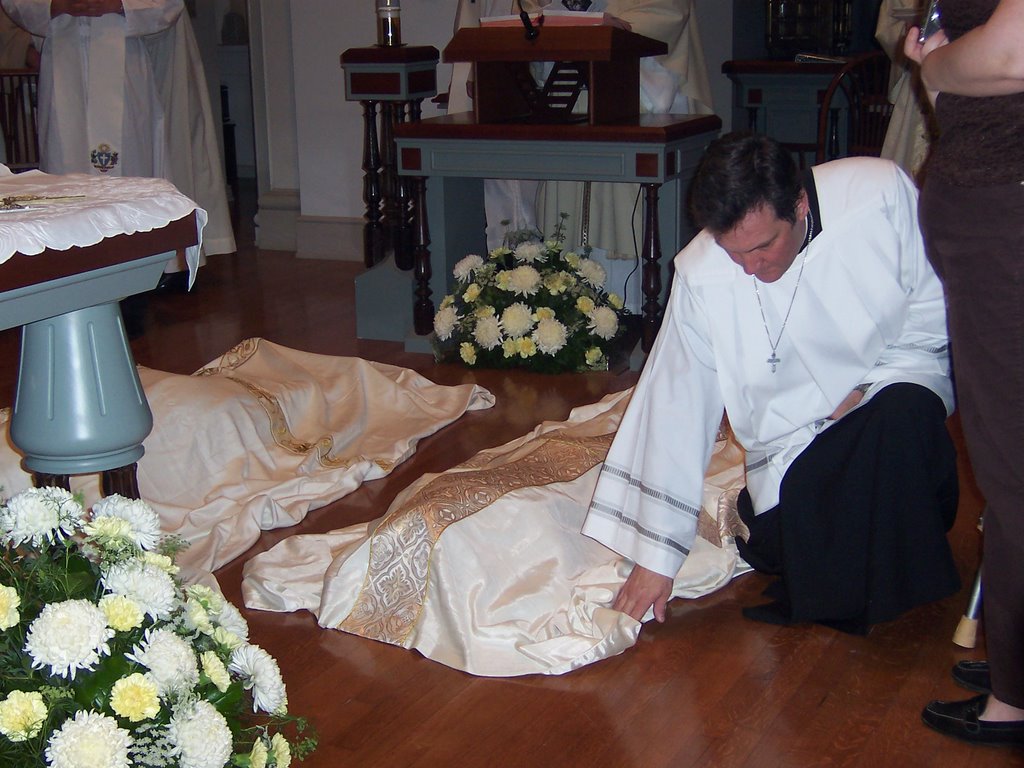
One pious practice that our community observes is the tradition of placing prayer intentions in the pockets of those about to be professed. For it is believed that when they prostrate under the pall the prayers are placed before the Lord in a very special way, as the sisters prepare to offer their lives to the Lord. Pictured above is our faithful master of ceremonies, David, adjusting the pall (just in case sister had hopes of breathing!)
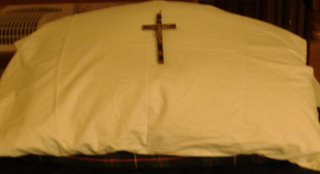
The crucifix presented to a sister at her solemn profession is, traditionally, placed on her pillow each morning after she makes her bed. Although it may seem to be an odd place for a crucifix (since our rooms all have one hanging on the wall), the crucifix of profession is a daily reminder of the permanence of our consecration to the Lord, which teaches us to seek no glory but that of his cross.

"For I have chosen and have sanctified this place that my name may be there forever and my eyes and my heart may remain there perpetually."

2 Chronicles 7:16

10 December 2006

Second Sunday of Advent

On one of his two feast days during the past year, St. John the Baptist received an unusual tribute at morning Mass: one of our chaplains told the story of how, as a little boy, he heard St. John the Baptist referred to as the "precursor" to Jesus -- and he thought it meant that the saintly herald went around saying bad words. Father went on to explain that he later learned that the word "precursor" comes to us from the Latin verb "to run," suggesting, of course, that St. John the Baptist "ran ahead" of Jesus and prepared his way.

We can take today's Gospel, to heart -- literally -- and allow St. John the Baptist's words to run ahead and prepare a path in our own hearts for the coming of the Lord. The prophet Isaiah's proclamation promises that every mountain and hill will be leveled and every valley will be filled. Let us locate those "mountains" in our own hearts -- those obstacles that keep us from responding with love to all that the Lord asks of us; let us find the "valleys" of our hearts -- those little spiritual pitfalls which await us -- and let us ask the Lord for grace to allow ourselves to be changed. The contour of our heart -- with its mountains and valleys -- may be a little different each Advent, but we are invited to find those growing edges where, with God's grace, we may straighten and make smooth the road for Him who comes. Let us pray that, during this most sacred season, we may prepare a place in our hearts worthy of the coming of the newborn King.
"St. John was the son of Zachary and the word of God came to him not merely that he might treasure it within himself but that he might also communicate it to others."
St. Francis de Sales

07 December 2006

Profession Pictures - Part II

We have a few more pictures from the profession to share ... and a few explanations of our customs and traditions.

After the sisters have made their profession, signed their vows and received the crucifix and candle, the monastic community extends a sign of welcome (not to be confused with the kiss of peace which occurs at its usual place in the Mass).

Mother Philomena looks on as Sister Maureen and Sister Anne Elizabeth greet each other in the monastic welcome.

The meeting of the "Annes" -- Sister Anne Francis greets Sister Anne E.

In addition to the monastic welcome, one of our customs here in Georgetown is for the guests to line the front hall after Mass for newly professed to greet them.


The sisters greeted the guests prior to the reception. Sister Maureen is pictured here greeting some of the concelebrants.


The vows are received by the superior who takes the hands of the sister into her own while the vows are pronounced. This formula for solemn profession has been used in our community for generations of sisters:

O Heavens! Hear ye what I say, and let the earth listen to the words of my mouth. To Thee, my Savior, Jesus Christ, my heart speaks though I be but dust and ashes. O my God! To Thee I make the Vows of living in perpetual chastity, poverty and obedience, according to the Rule of St. Augustine and the Constitutions of St. Francis of Sales, for the Congregation of our Lady of the Visitation: for the observance of which, I offer and consecrate to Thy divine Majesty, to the sacred Virgin Mary, Thy Mother our Lady, and to this Congregation, my person and my life. Receive me, O Eternal Father! Into the arms of Thy most merciful Paternity, that I may constantly bear the yoke and burden of Thy Holy service and that I may abandon myself forever and without reserve to Thy divine love, to which I again dedicate and consecrate myself. O most glorious, most sacred, most sweet Virgin Mary! I beseech thee for the love and through the death of thy Son, receive me into the bosom of thy maternal protection. I choose Jesus, my Lord and my God, for the only object of my love. I choose His holy and Sacred Mother for my protection and this Congregation for my perpetual direction. Glory be to the Father, and to the Son, and to the Holy Spirit. Amen.

Stay tuned for a few more pictures . . .

05 December 2006

Profession Photos

We have a first installment of some photos to share -- thanks to our kind benefactors, family and friends of our sisters who shared the role of "photographer." This set of pictures is a collection of highlights. In our next installment, we shall share a few more of our community customs and explain some of the symbols used during the rite of religious profession.

SrAEandSrMdeCh
Sister Anne E and Sister Maureen de Chantal stand for the examination prior to the homily.


Prior to pronouncing their vows, the sisters prostrate during the Litany of the Saints and are covered with a pall as a reminder of their baptism and the promises made for them at the moment they became children of God.


Sister Maureen reads the formula for profession.

Sister Anne Elizabeth reads the formula for profession.

The newly professed sign and date their vows.

More pictures to come. . . stay tuned!

03 December 2006

Bethlehem or Bust!

Before we share a little thought about Advent, just an update and a promise that we will have pictures from Friday's profession -- just as soon as our two newly professed collect themselves (and collect some pictures from their friends and family!) From the looks things, they will be writing thank-you notes from now until Easter -- but we promise to interrupt that process and have them post pictures!

Several years ago, one of the greeting card companies made buttons with a star at the top and below it were the words, "Bethlehem or Bust!" In a way, the buttons remind us that as we begin this sacred season of Advent we begin a journey, a journey of the heart -- to Bethlehem, to the manger, to the crib of the newborn King. Like Mary and Joseph, we must travel light. We must strip our hearts of all that does not lead us to the Lord -- attachments, anxieties, distractions -- the little things that slow the journey or tempt us to stray from the path. And when we arrive, if we have made the journey well and faithfully, we pray that we may approach the stable with a heart that is "empty" -- ready to be filled with the blessings of this Holy Child.

"Knowing that Divinity was unknown to the human family, the Divine Majesty desired to become incarnate, uniting with human nature so that under this human mantle Divinity could again be acknowledged."
St. Francis de Sales

30 November 2006

New Blogger in the Family

We've got a new blogger in the house! Our Sister Mary Berchmans has begun a blog called, "Visitation Connections" for the purpose of facilitating a forum for dialogue among the six schools in the Visitation Network. If you have a moment to drop in and visit her blog, you can find it here.

If we may be so bold as to say so -- most people, after a long career in administration settle into hobbies such as knitting or crocheting -- and good hobbies they are! We think it is meritorious that Sister Mary Berchmans has included blogging as one of her new "hobbies" (but we're pretty sure we'll still see her doing bargello needlepoint!!)

27 November 2006

Solemn Profession Approaching

In case our readers are wondering why our blogposts have been so few and far between, it might make sense if we mention that two of our more "tech-savvy" sisters have been in retreat since 20 November. Sister Maureen de Chantal and Sister Anne E are making their retreat in preparation for their solemn vows on 1 December. You can be sure that there will be pictures and posts to follow -- once they are both out of retreat. Stay tuned and, in the meantime, keep them in your prayers!

Archbishop Wuerl Visits Visitation!

On Monday 20 November, Archbishop Donal Wuerl celebrated Mass for our school community. He is pictured at left greeting Mother Philomena and Sister Jacqueline after the Mass.

In his homily and closing remarks, His Excellency spoke of the importance of the gift of faith. His homily was crafted as a response to a question posed by a student at another local high school: "What does the Church offer me?" Archbishop Wuerl spoke eloquently to the student body and teased about keeping his closing remarks brief, lest he upset the faculty by making students late to class.

In her opening remarks, school president Sister Mary Berchmans commented that Archbishop Wuerl stands in a long line of bishops who have counted Georgetown Visitation among the sheep of their flock -- beginning with our founder, Archbishop Leonard Neale, second bishop of Baltimore.

Georgetown Visitation is grateful for Archbishop Wuerl's visit and hope that it is the first of many such occasions.

19 November 2006

A Talking Head

It looks like a talking head, but it's actually our very own Sister Anne E, who was interviewed back in June by the Washington Post's on-line department. One would hardly know that Sister is rather shy and - most especially - camera shy. In the event that Sister seems to jump from topic-to-topic, readers should be aware that the interview was actually a little over an hour and it was skillfully edited down to just over two minutes. All kidding aside about the talking head, Sister shares honest (and, at times, amusing) pieces of her story and her journey to follow the Lord. Click here to view this short video.

16 November 2006

A Shower?


It is not exactly a "shower" as you might imagine a soon-to-be bride having, but it is more that we have experienced a great out"pouring" of generosity by our friends, benefactors and alumnae. On Tuesday evening, after supper, our faithful friends, Nan and Kathy, brought samples of material for various aspects of our new monastery.

When we moved out, in April, for this long-awaited renovation, many of us were sleeping on mid-nineteenth century civil war hospital beds. As quaint as it may seem, it should be mentioned that some of our bedding appeared to be as old as the beds. In order to prepare us for a fresh, new beginning when we move into the monastery, Nan and Kathy, brought samples of materials and colors for sisters who may need new bedding, towels, etc. We had almost as much fun passing around the samples as we did speculating about what "flamingo" colored towels might look like in a sedate baby-blue cell. We are most grateful to all those whose thoughtfulness and generosity are making our renovation possible. (Nan and Kathy are pictured with some of the sisters who are examining the samples. )

13 November 2006

Sr. Stanislaus and her Patron(s)

Today we celebrate the Feast of St. Stanislaus Kostka, patron saint of our faithful infirmarian, Sister Stanislaus -- affectionately called "Sr. Stannie." She is pictured here, (on Ash Wednesday, you might notice) moving a few items into our "temporary infirmary," which has served us well during our time of exile. At current, Sister is making her annual retreat but we will surely celebrate in her honor. Sister is the third "Stanislaus" in the history of our monastery -- spanning an almost-unbroken two centuries with a "Sister Stanislaus" in our community.

For years the feast of St. Stanislaus Kostka was a "recreation day" for the sisters in the novitiate (our newer members remind us continually about the renewing this tradition). When Sister made her solemn vows and left the novitiate, she was made an honorary member of the novitiate on 13 November, every year, when she would join them for their recreation day.

It is fitting that, as infirmarian, Sister's Feast Day falls on the commemoration of St. Frances Xavier Cabrini, patron saint of hospital administrators. As infirmarian, Sister keeps all of us healthy. The infirmary is, beyond doubt, the neatest, cleanest and most well-organized office in the house. In fact, it is such a pleasant place to visit, it is a wonder we don't get sick more often!
For a biography of St. Stanislaus click here. For a biography of St. Frances Xavier Cabrini, first citizen of the United States to be canonized, click here.

10 November 2006

Pope St. Leo the Great

There are many compelling reasons to pray for the Church today -- both the local Church and the Church Universal. The media does not always portray the Church in a charitable light and differences among Catholics are emphasized and -- all too often -- exploited. As discouraging as this can be, it is helpful to remember that the Church has seen difficult times in her past. Today, we commemorate a saint under whose watch the Church saw many difficulties.

During his papacy, St. Leo the Great combated several five and six-syllable heresies as well as an invasion by the Huns. Perhaps one of the intentions closest to his heart was that of Church unity. As we honor his memory today, let us ask his intercession for a greater unity of hearts and minds in the Church.

For a (relatively) short -- but stellar -- homily on the Incarnation, click here.

"I will dwell only on that union which we ought to have with each other. This union has been earnestly preached and taught to us by Our Lord, equally in word and example. . . . To love God without loving the neighbor, who is created in His image and likeness is impossible!"
St. Francis de Sales

07 November 2006

Irritation or Invitation?

So often we hear heaven referred to as the "heavenly banquet." In today's Gospel, Jesus is responding to a fellow guest who remarked about those who will dine in the Kingdom of God; he replies by telling the parable of the invited guests who make excuses as to why they cannot come to the dinner. Although it may be difficult for us to imagine ourselves making excuses, at the last minute, about why we are unable to attend a formal event we might consider the metaphor on its deeper level. If it is the Kingdom of God to which we are invited, how often do we make excuses?


We are invited to a foretaste of heaven, here on earth, when we live in accord with God's will -- in union with His heart. How often are we presented with opportunities to taste heaven and how often do we mistake them for something else? Perhaps we are assigned to work with someone who is very skilled at trying our patience. Do we see it as an irritation and try to get out of the assignment or do we see it as an invitation from the Lord to make his Kingdom present by the way in which we cheerfully overlook the shortcomings of our neighbor. Perhaps the only available seat in the lunchroom today is next to someone whom we do not like. Do we see that as an invitation to the heavenly banquet -- to be polite and cordial to one whom we would prefer to avoid or do we think of a reason why we need to have lunch in our office -- or at a later time?

The Kingdom of God is at hand -- at our hands -- we have only to respond generously and lovingly.

"Let us walk joyously among the difficulties of this passing life; let us embrace with open arms all the mortifications and afflictions that we will meet on our way, since we are sure that these pains will have an end when our mortal life ends."
St. Francis de Sales

04 November 2006

Humility: True or False?

Today's Gospel is a gentle reminder to cultivate that very attractive -- yet very hidden -- virtue of humility. Jesus gives us the example of one who seats himself at a wedding, suggesting that he should seek of place of lesser honor so as to avoid the humiliation of being demoted, so to speak, were a higher ranking guest to arrive. This example, however, might seem a little foreign to us in a culture where our social structures often preclude such an embarrassing faux pas. Today, most weddings or other formal events have pre-arranged seating assignments. In view of this, we might have a hard time seeing this Gospel as little more than a lesson in politeness.

What Jesus is getting at, it seems, is the interior disposition of the person. We should not seek places of honor, yet we should accept them graciously if they are offered to us. If we were to sit at a lower place in order that we may be noticed when our seat is changed then, perhaps, we have lowered our seat without humbling our heart. If, however, we were to sit at a lower place, content to be there and accept graciously an offer to move higher -- if we receive such an offer -- we find our heart in quite a different place. It is not where we sit that matters so much as how our hearts are disposed. And that is known to God alone.

It should come as no surprise that St. Francis de Sales has a great deal to say about this most august of virtues. This is a mere snippet:
"We pretend to hide ourselves, so that the world may seek us out. We feign to wish ourselves to be considered the last in the company and to sit down at the lowest end of the table, but it is with a view that we may be invited to pass more easily to the upper end. True humility does not make a show of itself or use many humble words; for she desires not only to conceal all other virtues, but most of all to conceal itself."
St. Francis de Sales

01 November 2006

Solemnity of All Saints

Why on earth are we sporting a picture of the Pantheon on the Solemnity of All Saints? We could make our readers guess and hold a little contest in the comment box to see which of our readers knows the history of today's Solemnity...but it's not fair to make our readers guess. The Pantheon was built by the Emperor Hadrian as a temple for "all gods" -- hence the name, borrowed from the Greek. About three centuries after the Church began commemorating "all martyrs" Pope St. Boniface IV dedicated the Pantheon as a Christian Church under the patronage of the Mother of God and the Holy Martyrs. Over the course of the next two centuries (and thanks to a couple of Popes named "Gregory") a Chapel in St. Peter's Basilica was dedicated to "all saints" and the Solemnity was formally extended to the whole Church on 1 November. A happy Solemnity to all our readers!

"A sad saint is a sorry saint!"
St. Francis de Sales