20 June 2006

Home Base!


No, this is not a joke, honest. This sign is actually exists. Due to our current state of renovation (updated pictures forthcoming), we spend a great deal of time "commuting" between "refugee camps" and, as a consequence, our security staff has posted the above caution for drivers entering campus.

As promised, quite a few posts ago, this is a report from one of our three "refugee camps." Lalor House is serving as "home base" during our period of exile. Eight sisters live at Lalor House but all 18 of us pray, eat and recreate here. The picture below is our modest chapel which, believe it or not, fits all 18 of us, the celebrant and a guest or two (without a shoe horn!)

The picture below is a shot of Lalor House from 35th Street. The front door opens to 35th Street but the back entrances open up onto campus which makes getting to the school -- and the other two "refugee camps" -- very convenient. We promise future posts about the satellite refugee camps -- and maybe even a first-hand account from an exile!

This post would not be complete without a photo of a very special exile who lives at Lalor House: Nicholas the dog, whom some readers may remember from a previous post. Nick lives in a pen outside Lalor House and he announces every visitor who approaches. We hardly need a doorbell with a watch dog as alert as he. In fact, it used to be the bell ringing the Angelus which told the sisters that Father has arrived for Mass. Now, the dog announces it before sister has a chance to ring the bell. If only we could teach him to bark in syncopation with the Angelus!

18 June 2006

The Solemnity of Corpus Christi

In today’s first reading, Moses reminds us of a dimension of liturgy which is not always evident during Mass. He ratifies the covenant by sprinkling some of the blood on the altar and on the people. This is very much a foreshadowing of the sacred blood which, when sprinkled on the altar of the cross, won our redemption.

In recent decades, we have spoken often about the Eucharist as a meal; we refer to the altar as a “table.” Indeed, we do commemorate the Last Supper, but we also commemorate the sacrifice of the cross. When we consider the Mass as a sacrifice, we present to our hearts an invitation to unite our sufferings, our sacrifices with the most holy sacrifice on the altar.

Let’s be honest: the various elements of liturgy can introduce many opportunities for differences to arise among the most well-meaning of participants. Be they differences in taste or disagreements about style, attending or planning a liturgy amid such challenges can be difficult. It can be hard to pray under such circumstances.

Any number of situations can cause us unrest when we come to worship the Lord. We may come to Mass from a situation which was stressful and we are distracted; perhaps we come to Mass and find ourselves uncomfortable because of elements of preference beyond our control; it might be the case that we are responsible for some service during the Mass such as reading or singing; we may find ourselves sitting at Mass worrying about whether or not we turned off the stove. Any of these situations can cause our hearts to be distracted and minds to wander. Every one of these situations, however, is an opportunity to place our hearts on the altar. When, at Mass, we find ourselves in a situation where our souls are not at rest – for any reason – perhaps we could call to mind the sacrificial dimension of the Mass. When we are suffering, hurt, frustrated, or distracted, we have something to offer the Lord. Instead of gritting our teeth and allowing smoke to escape from our ears, perhaps we could unite our little sacrifice, the cause of our unrest, to the Lord's sacrifice. "Here it is, Lord. It may be small compared to your sacrifice, but it's all I have to offer right now." And may He look with favor on our offering.

"In the Eucharist, our Lord abases Himself, if we may so express it, and changes Himself into food, so that He may penetrate our souls and unite Himself most intimately to the heart and to the body of His faithful."
St. Francis de Sales

15 June 2006

Tough Love

It has been said of the late (and great) John Paul II that he challenged today's youth -- and all of us -- to pursue moral heroism. Instead of "lowering the bar," so to speak, on tough moral issues, he encouraged Catholics and men and women of faith to pursue virtues which are not esteemed in popular culture. In doing this, he was following closely in the footsteps of Christ who speaks bold words to us in today's Gospel.

For most of us, it is difficult to reconcile ourselves to another when we have been at fault. Yet, despite the discomfort, there is something natural and inherently good about being able to say, "I'm sorry I hurt you, that was never my intention." At times we need to say, "It was selfish of me to say that because I knew it would hurt you; I'm sorry." And even still, despite the shame we might feel, there is something natural about asking forgiveness when we have been at fault. Jesus calls us to something even greater in today's Gospel.

We are to pursue the brother - or sister - who has something against us. But why? Who has the problem? Throwing up our hands (or our hearts) and saying, "That's his problem if he doesn't like me" is exactly what Jesus does not want us to do. It is a lot easier to apologize to someone we like than it is to approach someone who does not like us.

Surely we can all think of a colleague, coworker, family member, etc., with whom we enjoy a "polite distance" because we sense that we are the object of an unspoken discomfort or dislike. This is not a reason for alarm; it is a reason for rejoicing. For when we have such a situation, we have an opportunity to love as Jesus has invited us to love. And this is the "tough love" to which the Lord calls us.

"We must consider our neighbor in God who wishes us to love and cherish him. . . . For having asked for the love of God, we must always ask for love of neighbor, and particularly of those for whom our will experiences no inclination."
St. Francis de Sales

13 June 2006

A Salty Claim

Jesus tells us that we are the salt of the earth. Unfortunately, in the post-industrial revolution age of all things electric we have little experience of why this is so significant. We read labels, try to eat foods that boast of having "no preservatives," and refrigerate what is left over. In Jesus' day, salt was the only hope people had for preserving food. So, salt was a very essential and very valuable compound. (You've probably heard this before, but don't stop reading; this post is going to make an outrageous claim.)

At great risk of meddling in the work of professional linguists and etymologists, it seems reasonable to draw a few conclusions. Salt, in Latin, is sal, salis. It was a highly sought-after commodity in the ancient world. Roman soldiers were paid a salary so they could purchase salt for themselves. Although the adjective salvus (safe, well, alive, etc.) usually takes credit for being the root of our word, "salvation," it seems possible to argue that having salt made one well and healthy. Perhaps the root of the Roman notions of health (salus, salutis) and being alive (salvus) was linked to the precious seasoning we know as salt.

If the work of the Church on earth is truly the salvation of souls, then we should take as our marching orders Jesus' claim that we are the salt of the earth. Let us be "consumed" with all that is salubrious for the spiritual good of our neighbors. And let us be willing and gracious instruments who bear witness to the Lord's gift of salvation.

11 June 2006

Solemnity of the Most Holy Trinity

One cannot do justice to the mystery of the Trinity in a blog post. One can only approach this mystery by living well the relationships and personal encounters that are provided by the Lord. (What follows are a few simple thoughts.)

In today's first reading, Moses reflects upon the unique relationship between Yahweh and Israel; he asks, ". . . ever since God created man upon the earth; ask from one end of the sky to the other: Did anything so great ever happen before?" No. Nothing in the history of the world -- prior to the Incarnation -- can compare with the creation of man and God's delight in chosen people.

The first creation story in Genesis gives us a window into the mystery of the Trinity: "Then God said, 'Let us make man in our image'" (Gen 1:26a). God did not say, "Let me make man in my image." The Holy Trinity was present at creation and it is in the image of the Trinity that man was created. "Man" was created male and female. From the dawn of time, God has desired that his creatures, those created in his likeness, imitate him -- the mystery of the Trinity -- in their earthly life. As essential as it is to cultivate a deep relationship with the Trinity, it is never apart from or at the expense of our relationships with one another. For man was not created alone; he was created in the image of the Trinity.

As we reflect upon this grand mystery of the Trinity, let us examine the relationships in our daily lives. Let us consider how we participate in the mystery of the Trinity in our relationships -- those that delight us as well as those that challenge us. For when we are in relationship to one another, we approach this mystery and we have a small taste of the heavenly banquet.

"Our felicity will not stop at this (namely, at conversation with the angels and saints, with Mary and the incarnate Redeemer). It will pass further, for we will see face to face and very clearly the Divine Majesty, the essence God, and the mystery of the Most Holy Trinity."
St. Francis de Sales

09 June 2006

Thinking and Acting Globally


Early yesterday morning, 12 of our students and two adults, Dr. Patrick Kelley (parent) and Sra. Giovanna Bello (Spanish teacher) gathered in the Chapel for a short prayer service with our sisters. Each person in the group was partnered with a sister prayer-partner who will “journey with them” in prayer as the group departs for a two-week trip to Peru. The students will spend some time in Machu Picchu and Cusco and then they will head to Ayacucho where they will spend most of their time working in an orphanage run by the Sisters of St. Ann, who care for 175 orphans up to age 18. In addition, they will be doing some repair work and cosmetic improvements at a local Jesuit school. We commend our students for their efforts and we look forward to hearing about their experiences when they return.

We have shared this quotation before, but it is very fitting for this occasion. When our early sisters in France set out for a new foundation, St. Francis de Sales had these words for the occasion:

“Those who go, stay. Those who stay, go.”

And that is exactly how we feel about our travelers. We go with them in prayer and we know that they remain here – in our hearts!

07 June 2006

Commencement!

At 11.00am, yesterday morning, 133 soon-to-be graduates processed two-by-two down the red carpet as the familiar notes of Elgar were performed by a brass ensemble. Our school's largest graduating class in its 207 year history was addressed by Ms. Gretchen Kane, president of the Ursuline Academy in New Orleans.

Ms. Kane shared some of her experiences from the past year as the oldest girls' school in the country, ravaged by a hurricane, prepared to open its doors on 3 January 2006 -- just 4 months after the city of New Orleans was buried in water. Ursuline Academy, during the months of rebuilding and restoring, was committed to returning tuition dollars and continuing its payroll -- not because they could afford to, but because, in justice, they couldn't afford not to! In her speech, Ms. Kane referred to C.S. Lewis' characters in The Lion, the Witch and the Wardrobe. She recalled how the raccoon family allowed their young to play in the mane of Aslan, the lion. When asked if it was safe to play in the lion's mane, the father replied, "It is not safe, but it is good." And so it is for those who choose Christ's way of love and gentleness in a world that does not value Christian virtues. It is not safe but it is good. In this vein, her parting words of wisdom to the class of 2006 were the very words she used in her own high school yearbook, "March to the beat of your own drum or don't march at all!"

Also in attendance at graduation was Ursuline Academy's recent graduate, Courtney Pratt, who spent the first semester of her senior year with us here at Georgetown Visitation. She received the signature "crescent pin," which our graduates receive with their diplomas, as well as a standing ovation from Visitation's class of 2006.

Beautiful weather. Beautiful young women. We and they have much for which to be grateful.

04 June 2006

Veni Creator Spiritus!

At first Vespers of the Solemnity of Pentecost, it is our community's custom to draw for the gifts of the Holy Spirit. Each sister draws a small card, shaped like a flame, and on the back of the card is written a gift and a fruit of the Spirit. This year's celebration of the Vigil of Pentecost was a little different than usual since it was a little more "cozy" now that we are in our make-shift chapel (pictures coming soon) ... the chapel of the exiles. It was also different from last year for another reason.

This is a true story (and could be sub-titled, "Life in the monastery is never boring part III") :

Pentecost 2005. We were gathered in choir for Office of Readings on the eve of Pentecost. In the middle of the second reading from St. Irenaeus -- just prior to the responsory which reads "...they had all gathered together in one place. Out of the heavens there came the sound of a great wind, which filled the whole house, alleluia" -- lightening struck the roof of the Monastery. There was a sound which filled the whole house; it was the fire alarm, triggered by the lightening. And yes, we were all gathered in one room. No one began speaking in tongues. There was a moment of calm, while everyone looked around to be sure she was not imagining the sound, before the choir emptied and we each proceeded to our "fire-alarm" responsibilities: some to the school, some to the infirmary, most to the assembly room. The fire department dutifully and promptly arrived and checked out the fourth floor roof-access ladder which we suspected was the manner by which the lightening was conducted into the building.

This year, we are most grateful that the Holy Spirit has decided to make his arrival in a quieter manner. And we leave our faithful readers with St. Francis de Sales' words to St. Jane de Chantal from Pentecost 1620:

"As long as we are in the world we can only love by doing good -- since our love must be active -- we have need of counsel in order to discern what we must practice and do for this love which urges us. And in order that we may know how we are to do good, what particular good we must prefer . . . the Holy Spirit gives us his gift of counsel."

02 June 2006

Baby Ducks!

A couple of weeks ago we mentioned the pair of ducks who have arrived on our lawn. Shortly thereafter, they disappeared for awhile, only to reappear with their new family!

At right, Mrs. Duck instructs the little ones to beware of nuns who toss pieces of bread at them.

Below, the ducklings wait by the P Street wall while Mrs. Duck takes a moment to scold the sisters for getting to close to her precious little ones. (We got the message, loudly and clearly!)

Although he was not out for a walk with the little critters, we caught a picture of the proud father. We promise not to bore our readers with too many duck photos, but these were too cute not to share.

31 May 2006

Solemnity of the Visitation

This is the place of our delight. Truly.

We are a monastery of the Visitation but we are also a house full of visitations. The biblical image of Mary and Elizabeth is alive in our walls and halls and Chapel and refectory and school.

We have some sisters who are younger and newer to religious life. They are Mary: their "yes" to God is newer and more recent. Their journey with the Lord, growing inside of them, is only just beginning. They are trusting, faithful -- at times afraid -- but courageous in all their "yeses." They set off (often in haste) to help others, as Mary set off to be with her cousin, Elizabeth.

We have other sisters who represent Mary's cousin, Elizabeth. They are not new brides. They have long been married to Him whom Mary carries. They have lived fully their "Mary years" and, like Elizabeth, they too are fruitful in their golden years for they, too, trust that nothing is impossible with God.

Elizabeth, for Mary, is living proof that God's promises will be fulfilled. And so it is true in our Visitation. The Elizabeths bear witness for our younger and newer members that the Lord is trustworthy. Their joy, their fulfillment, their enthusiasm for their vocations -- lo, these many years after that first "yes" -- speak volumes to the "Marys" among us.

Countless times each day, in our home, a Mary "sets off in haste" to help an Elizabeth. And Elizabeth receives Mary graciously and with joy. This mystery is lived in our daily encounters with our sisters. And truly, this is the place of our delight.

29 May 2006

Memorial Day


"You will suffer in the world. But take courage! I have overcome the world." John 16:33

Jesus' reminder found in today's Gospel speaks a word of encouragement to those who have lost life, limb or loved one in the name of liberty. Those men and women who have laid down their lives on the altar of our freedom have walked a noble path behind the Lord's example. We honor those whose sacrifices have purchased our nation's freedom and defended the safety of countless other countries and peoples.

Few hymnals print all six verses of the Julia Howe's (pictured below) Battle Hymn of the Republic. The fifth verse bears repeating. Current arrangers and publishers have changed Howe's original words. It is here reprinted in its original.
  • In the beauty of the lilies Christ was born across the sea.
  • With a glory in His bosom that transfigures you and me:
  • As He died to make men holy, let us die to make men free;
  • While God is marching on. Glory! Glory! Hallelujah!
  • Glory! Glory! Hallelujah!Glory! Glory! Hallelujah! While God is marching on.

As we commemorate Memorial Day, we remember all those who have purchased our freedom and defended our safety. May we be mindful and grateful for their service.

"In all things holy liberty and freedom must reign, that we may have no other law or constraint than that of love . . . "

St. Francis de Sales

27 May 2006

The Ascension(s) of the Lord!

Somehow, here in the United States we have managed to extend the limitless powers of Jesus well beyond his "normal" divine powers. Due to each diocese's prerogative to choose whether or not to keep "Ascension Thursday" on a Thursday (traditionally Thursday of the sixth week of Easter) we have Jesus ascending to the Father twice in one week -- sometimes even in the same state (New York, Pennsylvania, Connecticut). If that isn't grounds for some theological clarification -- perhaps even a little Vatican Counsel -- it would be hard to say what is!

All kidding aside, here in the metropolitan Archdiocese of Washington, DC we celebrate Ascension Thursday in place of the Seventh Sunday of Easter. And as we wait in hope for the coming of the Holy Spirit, we are reminded of part of Jesus' farewell discourse in the Gospel of John. In both yesterday's and today's Gospel, Jesus speaks of joy. A joy that "no one can take away." This is, perhaps, the hallmark of a healthy Christian life. Despite circumstances which may be difficult, the great mystery of our salvation, begun with the Incarnation and crowned with the Ascension, is the source of our hope and joy.

Whatever day you celebrate(d) the Ascension of the Lord, may it bring a profound sense of joy and an abiding peace in the Lord's good providence.

25 May 2006

St. Bede the Venerable

Shown here on his deathbed, dictating the last of his scholarly work to a young monk, St. Bede the Venerable is one of the lesser known doctors of the Church.

St. Bede is often mistaken for a Benedictine. A careful reading of his work "The History of the Monasteries of Wearmouth and Jarrow," however, reveals that St. Benedict Biscop, although trained by the Benedictines in Lerins, when he founded the Monasteries, constructed a rule for monastic life based upon several monastic rules which were in existence at the time.

Although many details about his life remain shrouded by the veil of history, in St. Bede, we find a timeless recipe for sanctity: doing ordinary things with extraordinary fidelity and love. St. Bede spent his entire adult life (and much of his childhood, as a student -- an oblate) in his beloved monastery. Although he was an eminent scholar and was charged with teaching Latin to the newer monks, he never held an office in the monastery. He worked; he prayed; he preached; he taught. St. Bede's holiness is found in the extraordinary diligence -- love -- with which he carried out his daily tasks.

"Great deeds may not always come our way, but at all times we can do little deeds with perfection, that is, with great love."
St. Francis de Sales

23 May 2006

Squirrel Farmers

This is a true story. Last August we noticed a vine growing several yards from the vegetable garden. It appeared to be something in the melon, cucumber or squash family and it covered a small area of shallow dirt comprised mostly of cedar mulch. Each of the sisters who work outside in the garden thought that another sister had planted the vine and carefully avoided uprooting it. Eventually, the truth came out: none of us planted the mysterious vine. The only logical conclusion: the squirrels.

The compost heap is just a short walk from the location of the "mystery vine" and squirrels can often be seen rummaging through the compost pile for a snack. It seems likely that, upon finding some delectable seeds, one clever squirrel buried them in the shallow patch of dirt and mulch. At the end of the summer we enjoyed two sweet, juicy musk melons -- all thanks to the squirrels.

Just last week, this sprout was spotted in the same location. It is too soon to determine what type of fruit or vegetable it is, but it looks as thought the squirrels might have just planted us another tasty treat!

21 May 2006

Who Has Chosen Whom?

"It is not you who have chosen me, but I who have chosen you..."
John 15:16

It is very easy to believe that our faith is to be credited to us -- as though we could choose to believe in the Incarnation, in the Eucharist, etc. Most of us become aware -- or remind ourselves often -- that faith itself is a gift from God. The desires to know God, to learn about God, to pray to God are all initiated by him. Even when we feel drawn to pray at a particular moment, we must remember that it is only a response to something that God has done first in our hearts. He is always one step ahead of us.

And today we are reminded that even the fundamental "yes" to follow the Lord -- to choose him as the center of our lives -- is also a mere response on our part. For it is he who has first called us, drawn us, led us to himself. This is a welcome reminder when we begin to feel inadequate or underqualified for some work that comes our way. We remember, in these moments, that the Lord does not call us because we are eminently qualified for some work he has in mind for us; rather, he provides the graces necessary, for those whom he calls, to carry out his work.

Today's Gospel is indeed good news: we are chosen. He has chosen us and called us and he will provide the graces necessary for us to be fruitful. Let us rejoice and be glad: we have been called and chosen. Let us resist the temptation to feel unprepared or discouraged when the Lord asks something of us.

"We must look at what God wants and when we know it, we must try to do it joyfully or, at least, courageously."
St. Francis de Sales

19 May 2006

New Neighbors

Mr. and Mrs. Duck have moved onto our lawn. They are pictured here crossing the path between Lalor House and the School (as they flee from the Sr. Mary Snapshot).

Life in the Monastery is never boring part III: We usually have a pair of ducks (or, as some of our sisters prefer to say, "a pair of duck") who arrive on campus every spring. This year they have decided to take up residence on the front lawn of Lalor house, which functions as "home base" during our exile.


They seem happy to share their space with the black squirrel family who live in the willow oak and the various other birds who like to bathe in the puddle near where the ducks have begun to settle. Mr. & Mrs. Duck are rather private about their family life but Mother Philomena, biology teacher emerita, suspects that Mrs. Duck may be "heavy with young!" Stay tuned for duck family updates. We may have a whole fleet of new neighbors before long!

St. Francis de Sales didn't have much to say about ducks (bees, yes; ducks, no). He did, however, have a great deal to say about our neighbors and how we treat them. A few thoughts in that vein:

"We should not be like the Paphlagonian partridge which has two hearts, towards ourselves, gentle and loving but toward our neighbor one that is hard and severe. . . . Put yourself in your neighbor's place and him in yours, and then you will judge fairly."

17 May 2006

Welcome Bishop Wuerl!

The archdiocese of Washington welcomes Bishop Donald Wuerl of Pittsburgh as its sixth archbishop. Yesterday morning, His Holiness Pope Benedict XVI announced his acceptance of the retirement of Theodore Cardinal McCarrick. There have been numerous articles and links on different news services. Cardinal McCarrick had some very gracious words about his successor during a press conference early yesterday. Kudos to Mr. Palmo for the first whisperings of this on 27 April. As usual, his coverage was thorough and articulate.

After a full day of press coverage, there is little left to be said about this exciting moment in our archdiocese that has not already been said. One quotation of Bishop Wuerl, however, bears highlighting. The New York Times reported that, when asked how he would handle the controversial and high-profile issue of pro-abortion politicians, his reply was, "I think the first job of a bishop is to teach." Right on. Welcome to Washington, your Excellency, we're ready to learn!

15 May 2006

'Tis the Season

Tis the season...to plant and to sow, to weed and to reap. Today's commemoration of St. Isidore is a little-known and seldom celebrated outside of rural communities. St. Isidore, patron saint of farmers, was an eleventh century farmer known for his piety and devotion. His wife, Mary de la Cabeza is also revered as a saint.

Having spent his whole life working as a hired hand on a farm outside of Madrid, St. Isidore teaches us the timeless lesson that St. Francis de Sales would articulate and reiterate four centuries later: in all occupations holiness can be found, achieved and shared. Fidelity to the Lord, his wife and his daily work proved to be the path to holiness for this humble farmer.

"It is not merely an error, but a heresy to suppose that a devout life is necessarily banished from the soldier's camp, merchant's shop, the prince's court or the domestic hearth."
St. Francis de Sales

13 May 2006

Nursery School Graduation

No caps. No gowns. No Pomp and Circumstance. This "nursery school graduation" is for 21 tomato plants that will be transplanted to the garden this morning. Sister Anne E poses with the graduating class at left. All the transplants were born in the 4th Floor Fennessy "refugee camp." (If you are wondering why nuns are living in a refugee camp, click here to read a previous post about our renovation.)


All reports from the 4th Floor "refugee camp" confirm that this is a welcome day since the "grow light" which has been in the hall since mid-March is so bright sisters are able to read a book in the "dark" after turning in for the night.

All kidding aside, a garden provides ample opportunity to reflect upon the mystery of creation. Perhaps one of the highlights of something like a "nursery school graduation" is the thrill of looking at a plant and remembering when it was only a seed: dry, lifeless and tiny. It is a small window into the mystery of God himself to be able to look at a healthy plant and say, "I knew you when you were only a seed." Surely God must look at us and say the same thing.

"Be still and bloom where you are planted."

St. Francis de Sales

11 May 2006

On Friendship and Charity

With all the press about the alleged "Gospel of Judas" being uncovered and translated, it is hard not to turn our thoughts to this infamous traitor and wonder what Jesus was thinking when he invited Judas to be among his chosen band of disciples. Today's Gospel seems to add even more mystique to this puzzling dynamic. For Jesus says plainly, "I know the kind of men I chose."

Jesus knew Judas well. He knew his weaknesses and his strengths. Despite his shortcomings the Lord loved him and the Lord chose him. This sets the bar pretty high for those of us who strive to live the Gospel message in our daily lives.

It is easy to observe the behavior of another person and to draw conclusions. We can tell a great deal about a person by the way he presents himself, dresses, speaks, etc. Sometimes we may begin to judge a person's character -- for better or for worse -- based upon some of these observable indicators. When we observe something negative or when we experience something hurtful, sometimes it is very difficult not to draw uncharitable conclusions. And this is precisely where Jesus' friendship with Judas poses a challenge for all of us. Jesus loved Judas despite his weaknesses. We must try to look beyond the weaknesses of our neighbors and see the person who is very worthy of our love and attention.

Easier said than done. This virtuous attitude sounds appealing until the shortcomings of our neighbor try our patience, irritate us, lean on our nerves, etc. We cannot simply decide to "feel love" toward someone whose presence disturbs our peace. We can, however, decide to ask God for such a desire. The grace of God will allow us to love a person despite what our private judgment might conclude. And that, truly, is a gift -- to our neighbor and to us!

"I beg you never to speak ill of your neighbor . . . blame the vice and spare, as much as possible, the person to whom the vice belongs. When we look upon the actions of our neighbor, let us look upon them in the light that is gentlest."
St. Francis de Sales

09 May 2006

Demolition Details


As promised, we will not abuse the patience of our readers with innumerable photos of every stage of our rebuilding -- just a small number of pictures for a peek into the work-in-progress.

Prior to the beginning of demolition, our project manager labeled all parts of the structure to be "demo" or "save." The orange graffiti added an interesting highlight to the muted colors of our walls. Some of the walls, as they come down, reveal extraordinary hand-crafted workmanship including some hand-fashioned nails.


As walls come down and the familiar space begins to look different, we are reminded of some truths which apply to our own interior lives as well as the interior of our building. In order to rebuild or refashion something, sometimes we have to remove old structures. Sometimes these old structures are beautiful, inherently good and, at times, still very useful. Still, they must come down if rebuilding is in order. The same can be true in our relationships -- with the Lord and with other people. Sometimes "useful" and "good" ways of interacting, relating and communicating need to give way to something new. It can be hard to let go of a comfortable way of praying or a familiar way of interacting with someone. At times, however, the Lord calls us to something new. He wants to expand our hearts, our minds, and our knowledge of him. When this happens, we must try to remember that the Lord is the architect (and the project manager!)

Up-coming construction updates will include reports (and photos) from the "refugee camps" where the "nuns-in-exile" are living. Stay tuned!


"What a delightful and profitable law this is to do nothing except for God and to leave to Him the whole care of ourselves! I do not say only as regards temporal things ... but I refer to spiritual things and the advancement of our souls."
St. Francis de Sales

07 May 2006

World Day of Prayer for Vocations

There is a great deal of talk about a "vocation" crisis in the Church. While the observation may be accurate, the statement reveals a great error in semantics. A "vocation" crisis would imply that God has stopped calling men and women to serve him in religious life and the priesthood. Somehow that seems inconceivable. It seems more accurate to say that we are having a "responding" crisis.

Many gifted thinkers, theologians, and sociologists have speculated as to why this might be the case. Convincing arguments abound. One observation -- especially among those of us who work with young people -- is that popular culture presents a subtle message to today's youth: "Keep your options open. Don't commit to anything too soon. If you keep your options open, you will have a life without suffering or sacrifice." This is a lie. A deadly lie.

There is no "life choice," that does not involve a sacrifice. Getting married means choosing to spend the rest of one's life with a particular person, precluding the freedom to date other people. Making a choice means, de facto, that other options are removed. Going to graduate school in one field, means closing the door to studying other disciplines. Responding to the call to be a religious or a priest means foregoing the possibility of marriage, the gift of children and the choice of one's professional career. All life choices involve sacrifice. Life choices in accord with God's will also involve great joy. Any parent will agree that while raising children demands great sacrifice and includes a share of suffering it is also (and foremost) a great joy. Religious who have spent many years in a given community can share stories of great sacrifice but they so often they have a glow about them which reveals a deep joy.

Our freedom as human beings does not come because we do not "commit" to anything and by so doing, "keep our options open." Our freedom is exercised in the very act of making a commitment. And so, on this day when we pray for vocations, let us pray for a great response to the call of the Lord. Let us pray that men and women who have heard the Lord's call will have the grace to respond generously and courageously.

05 May 2006

Into the Lion's Den

In today's first reading, when the Lord asked Ananias to approach the newly-converted Saul, Ananias had good reason to be hesitant. Saul had come to Damascus for the express purpose of persecuting Christians. Crossing paths with the soon-to-be St. Paul might have earned Ananias a one-way ticket to Jerusalem, in chains. When Ananias expressed his hesitation, the Lord pressed him to approach Saul: "Go, for he is an instrument whom I have chosen to bring my name before the Gentiles. . . "

St. Paul's journey as a disciple began, and hinged upon, Ananias' trust in the Lord. Ananias trusted that the Lord would use this chosen instrument of his for good things. And He did! Ananias had no quantitative evidence that the Lord had touched Saul's heart; he had only the Lord's word that Saul would do great things for the dissemination of the Good News.

Sometimes we are asked to display a similar trust in the Lord's presence to those around us. We will never know, on this side of eternity, how many people's journeys to Christ began with a kind word which we said, a simple gesture of courtesy or a good example which we gave. When we sense, in ourselves, a hesitation to approach someone with whom we have been encouraged or instructed to interact, let us remember the Lord's words to Ananias, "Go, for he is an instrument whom I have chosen." Sometimes we do not have a good reason, as did Ananias, to avoid someone. Sometimes it is only an instinct inside us which causes us to feel a hesitation or an aversion to certain people. We cannot let this affect our fidelity to the Lord's will if he desires us to interact with certain people whom he has placed in our life. They are instruments whom he intends to use; sometimes, however, he counts on us to help them begin their journey. May we, by our obedience to the circumstances around us, be his courageous instruments.

"In order to obey well, we must not apply the obedience to us, but we must apply ourselves to the obedience."
St. Jane de Chantal

03 May 2006

The Circus is Coming to Town!

This post could be subtitled "Life in the monastery is never dull, installment II."

The circus is not only "in town" but they are parked, for a few days, in our parking lot! Not the whole circus but a very significant part of the circus: the circus nuns. (We're not kidding!). Three members of The Little Sisters of Jesus (one of whom is an alumna of ours) travel with the Carson and Barnes Circus. While they travel with the circus they minister to the members of the circus in a host of different ways -- both physical and spiritual. They catechize the children, counsel adults, mend costumes, collect tickets and help care for the animals. To read more about their beautiful ministry, click here.

We have been been blest by the presence of the Little Sisters of Jesus who have joined us for Mass and Office these past few days. Their apostolate is certainly a beautiful testimony to the Gospel call to leave everything and follow the Lord. As they prepare to move along, we share St. Francis de Sales' sentiments which often punctuated a farewell when sisters said good-bye to begin a new foundation: "Those who go, stay; those who stay, go." We have enjoyed having our "circus sisters" with us and we send our love and prayers with them on their way.

To read more about Bl. Charles de Foucauld, the founder of the Little Sisters of Jesus, click here. To read more about Carson and Barnes Circus, visit their webpage or their blog.

01 May 2006

Month of Mary

As we begin the month of May, we pause for a moment to recognize the presence of the Blessed Mother in our lives, our liturgy and the Church today. His Holiness Pope Benedict XVI shared a beautiful comment in his Regina Coeli blessing on the third Sunday of Easter: (Translation provided by Rocco Palmo – gratefully borrowed here.)

“The Madonna was for [the early disciples] mother and teacher, a role she continues to develop for the Christians of every age. Each year in Eastertide, we relive most intensely this experience and maybe for this reason the popular tradition has consecrated to Mary the month of May, which normally falls between Easter and Pentecost. This month, which we begin [today], is useful for us to rediscover the maternal function which she develops in our lives, that we may always be docile disciples and courageous witnesses of the risen Lord.”

As we strive to do the Lord’s will in our daily lives – the little day to day decisions as well as the more significant ones – let us fix our eyes on Mary who was so faithful a disciple; from the moment she said, “Yes” to the Angel’s message, her life was never the same. Mary allowed her love for God and His incarnate Son to be the defining boundary for all her actions. Mary’s love for the Lord showed itself in her profound union with the Lord’s will for her throughout her life – in the few details we learn in the Gospels and the many details that remain obscured on this side of eternity. May she intercede for us and teach us to unite our hearts as lovingly as she did to the will of her Son.

“The fruit of love is obedience . . . Oh, my God! How happy we would be, if we were recognized by the exact practice of the solid virtues of our vocation, as the Son of God, in this world, made Himself known by the works of His mission!” St. Jane de Chantal

29 April 2006

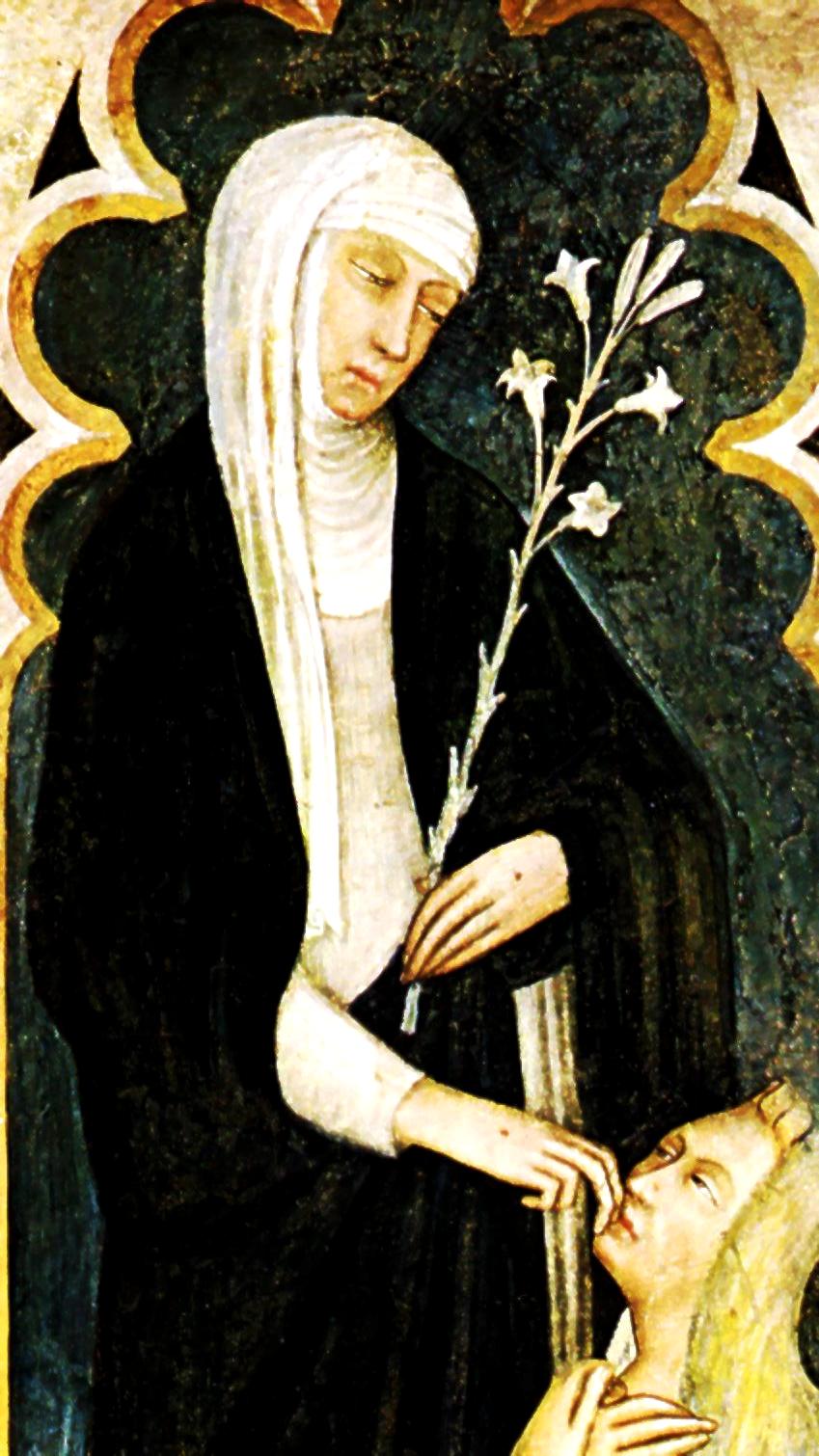
St. Catherine of Siena

An extraordinary woman for an extraordinary time. Born in the 14th century, as the renaissance dawned, St. Catherine of Siena was a welcome light in the Church and in the world. Perhaps her most well-known gift to the Church was her influential hand -- and pen -- in bringing an end to the Avignon papacy. Though Pope Gregory XI moved back to Rome, it did not end tension in the Western Church; through the scandal of having two popes which divided Europe, St. Catherine was a valued and trusted resource for Pope Urban VI as well as other contemporary theologians.

Beyond her diplomatic skills and theological expertise, St. Catherine was a gentle soul well accustomed to suffering. Her family, wishing her to marry, did not easily accept her choice to be a Dominican tertiary. Despite a challenging home environment, St. Catherine attracted a band of spiritual friends to whom she became confidant, advisor and spiritual guide.

In 1461 St. Catherine of Siena was canonized; in 1970 she was named a doctor of the Church by Pope Paul VI and in 1999 Pope John Paul II named her among the patrons of Europe.

Most of us do not have the opportunity (or the gifts and expertise) to serve as advisor to popes and learned theologians. All of us, however, have the opportunity to lead people to Christ by our own lives in our earnest pursuit of virtue.

"We do not always have opportunities to do great things; opportunities do little things with great love abound."
St. Francis de Sales

27 April 2006

Cardinal's Visit

Normally, the visit of a Cardinal marks a formal event in our community. This year, we were privileged to have a leisurely visit with His Eminence Theodore Cardinal McCarrick, who celebrated Mass on Tuesday morning in our "new" (temporary and cozy) Lalor House Chapel. He is pictured above enjoying breakfast with Sr. Mary Berchmans (somewhat obscured by the tulips) as Sr. Mary de Sales arrives at the table.

During his homily for the Feast of St. Mark, Cardinal McCarrick commented that St. Mark was able to get along with both St. Peter and St. Paul, no small diplomatic feat! Clearly, during a quarter-century of Episcopal service, he, too has honed similar skills for gentle diplomacy.

We were privileged to have this lovely visit with His Eminence -- and happy to show him around our "new digs" during this time of our exile. (More construction pictures coming soon!)

"As a bishop you are a master-builder. It is your duty to watch over the leaders of your flock. . . . Remember that while teaching does much,
example does immeasurably more"
St. Francis de Sales' instruction to bishops

25 April 2006

St. Mark

Today the Church celebrates the Fest of St. Mark the Evangelist. A homilist once remarked that "Mark" spelled backwards is "Kram" which is how St. Mark manages to include a plethora of miracles into the shortest of the four canonical Gospels.

St. Mark is often depicted, in art, with a scroll or a winged lion. The lion, representing one of the four windged creatures in Ezekiel, is associated with Mark because he begins his Gospel with St. John the Baptist, the voice in the wilderness.

St. Mark has some interesting patronages. He is patron to attorneys, prisoners, those who work with stained glass as well as Egypt and the Philippines. As we celebrate his Feast today, we give thanks to God for the gift of the Gospels, His Word among us.

22 April 2006

A Post Prom Post

Some people think that life in a monastery is boring. Not for a minute.

This weekend -- Saturday night -- is our school's prom, held in a hotel downtown. In an effort to keep all our darling angels and their dashing dates safe after this event, our parents have sponsored a "post prom" party here on campus for the past several years. The students arrive around 12.30am or 1.00am and play games, enjoy refreshments and visit with their classmates until 4.00am when the "post prom" party ends.

Normally, this is of little consequence to those of us who live in the monastery, since the school buildings and the monastery building are separated by the school quad and the monastery garden. This year, however, with 18 of us "exiles" scattered in different buildings on campus, we are in the middle of the action. Some sisters have the privilege of sleeping just above the live band which will be performing from 12.30am - 4.00am. Others of us are lucky enough to be sleeping just above the lawn where laser tag is scheduled to take place. As this post is being written, parents here on campus are putting the finishing touches on the decorations.

All kidding aside, there are two truths here worth underlining: 1. when over 90% of students attending the prom sign up for "post prom" parents, teachers, administrators and sisters sleep better knowing that our girls are safe (at least until 4.00am!); 2. life in a monastery is NEVER dull.

20 April 2006

Holy Appetizers

Surely there are deep theological reasons why the today's Gospel includes the detail about Jesus asking for food and eating it in front of his disciples. His body was, indeed, a body; Jesus' resurrected body was not that of a ghost or an angel, but a human body. He was hungry and he ate.

This detail, however, suggests another (albeit less theological) theme: Jesus' comfort and intimacy with his disciples. It is only in the company of those with whom we are very comfortable that we can act as Jesus did. It is almost a level of familial comfort. How many young people visit home during college and, upon entering the kitchen, ask, "Got anything to eat, Mom?" as they open the refrigerator and begun to peruse the pickings. In how many other homes are we comfortable enough to ask for food or to raid the refrigerator. Normally, it would be considered rude -- or at least socially awkward -- if one were to behave this way in the home of a host or a stranger.

The company of the disciples was a space in which Jesus was at home, comfortable, and welcome. Would that we too could be considered a place where the Lord is at home. Would that our hearts were places so "familiar" to the Lord that he would choose to visit us often. The Easter season is a wonderful time to cultivate a space for the Lord in our hearts. By our attention to Scripture, our careful and prayerful attention to those around us, we may fashion a welcome place for the Lord to visit.

"The spirit of gentleness must be preserved at all costs, else yours would not be a Visitation house even though all the rest of the rules should be observed, for this, the most important of characteristics would be wanting." St. Jane de Chantal

18 April 2006

Enough is Enough!

Reality shows on television were generated -- not out of creativity -- but out of need. When the writers and actors unions were threatening a strike, the producers had to figure out a way to keep audiences entertained without actors and without writers. And shows fashioned on MTV's "Real World" (possibly the first popular reality show) were born.

In the style of reality shows, A&E recently launched a documentary-type series, God or the Girl, about four men discerning a vocation to the priesthood. Despite an innocuous interview in a Zenit article, a very articulate and well-written critique was published in an on-line journal by Rev. David Nuss, director of vocations for the diocese of Toledo, Ohio. Click here to read it.

Not having cable television and not having seen the show ourselves, it would be unfair for us to comment on this new theme in reality -documentary- television. Having been through the discernment process for a religious vocation (albeit for religious life, not for priesthood), however, it is fair to say that the mystery of a vocation can hardly be captured in a television series; it can barely be articulated in words to family and friends, let alone to a network of curious viewers. Perhaps one good that may come of this series would be a greater interest in the process of discernment and an honest consideration of a religious vocation on the part of some interested viewers.

St. Francis de Sales made three resolutions prior to offering his first Mass as a priest on 21 December 1593:

To make every moment of his day a preparation for Mass the next day; to be as disposed at Mass as he would have himself be at his own day of judgment; to unite himself in all things with Jesus Christ.

15 April 2006

Christ Our Light!

The Rev. Kevin FitzGerald, SJ raises the Paschal Candle
and intones "Christ our Light!"


Easter A.D. 2006. Surrexit Dominus! Alleluia!


Mel Gibson's movie "The Passion of the Christ" leaves very little to the viewer's imagination. It is vivid, graphic and very historically accurate. The movie ends, appropriately, with the deposition from the cross. It might have been interesting, had the movie extended to Easter Sunday, to see how today's Gospel scene would have been recreated: the foot race between John and Peter.

There is something so realistic about today's Gospel. One can just see the cloud of dust arise as young John races ahead of Peter. In deference, he awaits the fisherman and allows him to enter the tomb first. Yet it is John who sees and believes. Why? What it is about the beloved disciple that allows him to believe at the sight of the empty tomb and the rolled-up shroud? Good Friday's Passion provides a clue.

In the Passion narrative read on Good Friday, we hear that in the high priest's courtyard there was a disciple with Jesus who was known to the temple officials. Peter, we recall, waited outside at first. Despite the best of his intentions, Peter, as foretold, denied Jesus while he was outside the courtyard. Someone else stayed with Jesus during his trial. Scholars would suggest that this unnamed disciple is the beloved disciple himself. John did not flee from Jesus in his suffering, persecution and crucifixion.

John's resurrection faith at the sight of the empty tomb was not a "bonus," per se, for sticking around when the other disciples were absent. Rather, John's faith was the grace that comes with obedience and adherence to the Lord's will -- be it persecution or prosperity. The natural reward for not avoiding the sufferings in our lives is the grace which allows us to believe that the Lord is at work -- even when we do not understand how it is possible. Such was John's gift. He could not explain what he saw. He simply believed. His was resurrection faith because he stayed with Christ in his suffering.

The same faith is offered to us. When we face suffering -- be it physical, spiritual, emotional, etc., -- we have an opportunity to embrace whatever circumstances the Lord has permitted for our growth. Like John, we too, are given the opportunity to stay with the Lord in the high priest's courtyard. And we pray that we, too, like John, will be rewarded with resurrection faith.

13 April 2006

Sacred Triduum

So as to focus extra time and attention on the Liturgies of the Sacred Triduum -- and the mystery which they celebrate -- we shall "sign off" until Sunday. For those readers who are local, please refer to our schedule for Mass times during these days. Also, please note the change of location for the Altar of Repose. Due to our newly-begun reconstruction, we shall repose the Most Blessed Sacrament in the Foy Parlor of the School (third parlor on your left as you approach the Chapel) from 6pm-midnight.

May these most sacred days provide moments of prayer and recollection in your in your hearts -- amid other activities and responsibilities which call for your attention.

"In the Holy Eucharist our Lord abases Himself -- if we may so express it -- and changes Himself into food, so that he may penetrate our souls and unite Himself most intimately to the heart and body of His faithful."
St. Francis de Sales

11 April 2006

Triduum Schedule

For the benefit of our locals, whom we welcome -- as always -- here is our schedule for the Triduum.

Due to our renovation, we are only having the major liturgical celebrations in the Chapel of the Sacred Heart. Liturgies of the Hours will be in the Lalor House Chapel.

Holy Thursday: 5.00pm - Mass of the Lord's Supper (the Blessed Sacrament will be reserved in the school parlor until Midnight - all welcome!)

Good Friday: 3.00pm - Commemoration of the Lord's Passion

Holy Saturday: Mass of Easter Vigil - 8.00pm (reception in parlor follows)

Easter Sunday Mass: - 9.00am (reception in parlor follows)

09 April 2006

Palm Sunday of the Lord's Passion


“Blessed is he who comes in the name of the Lord!” What does it mean to “come in the name of the Lord?” We follow in the Lord’s footsteps and embrace his passion when we have Him as the only object of our love. As St. Jane de Chantal tells us, “…our hearts will have no other affections than to please Him, to love Him and to serve Him.” When we carry out all our actions for Him alone, we come in His name. And we, too, are subject to his fate. We are subject to scorn, scourging, criticism, pain, betrayal and injustices. This is our share in the cross. Our share in the cross may be only a small share in the Lord’s sufferings but it is still our share – which we embrace for love of Him.

Let us be generous in the face of suffering: as the woman in today’s Gospel, who was criticized because she broke open the alabaster jar and anointed the Lord, we, too must refuse to count the cost. As we begin the Passiontide this week, let us approach the cross with open hearts and outstretched arms. Let us live generously and gently – for blessed are we too, when we come in the name of the Lord.

“This Congregation [the Visitation] is founded spiritually on Mount Calvary for the service of Jesus Christ crucified in imitation of whom all the sisters must crucify their senses, passions and aversions . . . for the love of their Heavenly Father.” St. Francis de Sales

06 April 2006

Spare Change

Recently, someone shared with us a sign from a restaurant. Sitting over a bowl near the exit was a card that read: "If change bothers you, please leave it here." The Jews in today's Gospel reading could have taken up quite a generous collection. Jesus upset their comfortable vision of life and death when he hinted at eternal life. In fact, Jesus challenged them so much that they intended to stone him.

The experience of having one's vision upset is good -- if we trust that there is another "vision" waiting for us on the other side of this "change." Perhaps one of the most profound moments of spiritual growth is the realization that a certain image of God, which we cherish, is inadequate -- inadequate not because God is not "solid" like a rock or "loving" like a father, but because God is so much bigger than our limited images can suggest.

In today's Gospel, the faithful Jews gathered at the Temple were unwilling to let go of their image of Abraham and the afterlife. Jesus shattered this image by suggesting a more profound vision of eternity. In their fear of "change" they turned to violence and sought to stone Jesus. Let us pray for the grace to respond gently to such change by allowing our images of God to be shattered. For greater and more profound images await us.

"The Incarnation is so preeminent and profound a mystery that it was never anticipated -- nor could it be -- by the ancient pagans and philosophers. Even those skilled in the law of Moses were unable to comprehend it. . . . In this mortal life we believe it because faith teaches it to us."
St. Francis de Sales

04 April 2006

Complaint Department (Part II)

There is much to be said about complaining. (See earlier post.) In today's first reading, the Israelites continue to lament their fortune. Their patience, worn away by the journey, led them to complain bitterly against Moses and the Lord. This is not an unusual example of what happens when we find ourselves in a difficult situation. We can allow a trial or a challenge to erode our own efforts at virtue.

One of the pitfalls about complaining is that it is easy and comfortable. It does not take great effort to complain. In fact, it is one of the more mindless activities known to man. One does not have to be of keen intellect to issue a complaint or grumble about something which is displeasing or inconvenient. And, like the seraph serpent that bit the Israelites, the habit of complaining issues a poisonous "bite" because it infects -- and affects -- our motivation to pursue virtue. This, in turn, affects those around us. Once we have begun to complain about something or someone, it is very difficult to curb the desire to continue. It is difficult but not impossible. It takes an insightful mind and a generous heart to speak honest and kind words in a situation where our first instinct might be to complain. With the grace of God, however, we can turn the mumbling and grumbling of our tendency to complain into life-giving thoughts and words. Let us begin by asking for the grace to be patient and kind amid the different challenges which arise daily.

"Some people are willing to bear only honorable afflictions, like being wounded in battle . . . but such people do not really love affliction, only the honor it brings. Those who are really patient and true servants of God are prepared to bear the ignominious troubles as well as the honorable ones." St. Francis de Sales

02 April 2006

Unbar the Gates!


We promise not to post photos of every detail of this destruction and reconstruction.... but another little window into history is about to be opened: At left is the "poor gate," a gate opening out on to P Street which has been nailed shut for many decades. For years preceding (as well as during) the depression, our monastery had a self-supporting farm, from vegetables to meat. Every morning this gate would be opened and a hot breakfast of bread and oatmeal would be served to those in need. Wagons of vegetables were also available for the poor, as well.

On Monday morning this gate will be opened onto the street for the first time in over 50 years, as our destruction crew will be using it as an egress to access the soon-to-arrive dumpster.

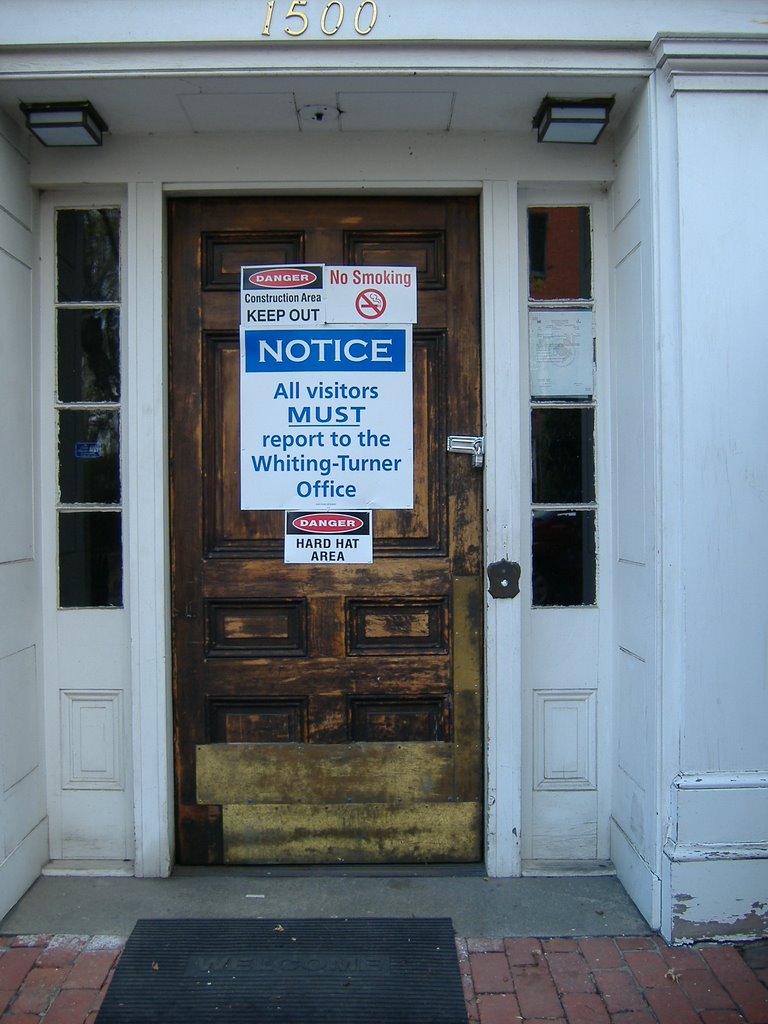
While we "unbar" one gate, we have barred another one. Also pictured here is our front door, now securely fastened with a padlock. The monastery is about to become a "hard hat area." This should produce some interesting photo opportunities when sisters visit the construction site!

As we reflect on the urgent need to begin a renovation, we remember that one year ago today we were ankle deep in a flooded basement at the time that it was announced that His Holiness John Paul II entered into eternal rest. Our tower bell tolled a little late -- later than other bells in the area -- but it rang with gratitude for so great a life and so extraordinary a man. Requiescat in pace!

30 March 2006

In Hoc Signo Vinces

As we prepare for our "destruction" to begin on Monday, we share a few more "moving" moments from our experience:
This is a picture of the hole in the wall where an enormous crucifix hung between the second and third floors on the main stairwell. We are told that the crucifix was built into the wall when the wing was built. It is no surprise, therefore, that it took four moving men nearly two hours to get it out. It was packed in a wooden crate and will return when the construction is complete. (We shall refrain from waxing spiritual about what conclusions we may draw about the crosses in our own lives and the indelible marks they leave!)

In preparation for construction there are now some precautionary construction signs posted on the stairwell. They provide some idea how large the crucifix is.


Sisters who have been trekking over to the monastery to clean up a few last items made a discovery today: a zip door. See photo on right. Our project managers installed a nifty zip door between the construction site and the entrance to the Chapel from the monastery side so as to minimize the amount of dust that flies into the Chapel. Brava!

28 March 2006

Healing Words

There is an interesting exchange in today's Gospel. Jesus asks the man sitting near the temple gate if he wants to be healed and Jesus never gets an answer. The man, instead, tells Jesus why he has not been able, for 38 years, to enter the pool and receive healing.

For most of us, there is at least one "thing" in our lives that warrants healing or correcting but which we are reluctant to address. Sometimes we become very comfortable in our patterns of living, working, behaving, etc., and even though we know that we should work on this "thing," it has almost become too comfortable to change. Perhaps we have a co-worker with whom we could work better -- but we don't try. Perhaps there is someone we avoid, whose company we find troublesome. Maybe we make excuses about why we should avoid him or her and why it is okay, even profitable, to do so. And, like the man at the temple gate, when Jesus asks us if we want to be healed of this situation, if we want to change, to be changed, we have a ready reply of why it has not been possible for us to change -- or why it would not be convenient to change. We, too, avoid the question. Sometimes we can be so busy explaining our excuses to ourselves (and to Jesus) that we do not take the time to ask the Lord for the healing grace we need. Acknowledging that we need this grace is, itself, a great grace. Let us ask the Lord for the vision to see where we need to grow and the grace to respond to this invitation.

In a letter to St. Jane de Chantal while she was still Madame de Chantal, St. Francis de Sales wrote the following:

"...now although we may love our abjection [wretchedness] that comes from a fault, still we must not neglect to correct the fault."

26 March 2006

Laetare!

"Rejoice, Jerusalem!"

Today is the fourth Sunday of Lent, erstwhile known as Laetare Sunday. We pause halfway through this solemn season and take a break from our Lenten journey to enjoy some "restrained" rejoicing. A few flowers on the altar, a little extra music at Mass, bright rose vestments and a maybe even a little extra dessert at dinner or supper (if our cook is reading this!)

On the heels of the great Solemnity of the Annunciation, we continue to reflect on our own ability to say, "Yes" to whatever the Lord asks of us day after day. 384 years ago, on the fourth Sunday of Lent, 22 March 1622, St. Francis de Sales concluded his homily with the following words:

"We say that we do not know whether the will to please Him that we now have will remain with us during our whole life. Alas! It is true for there is nothing so weak and changeable as we are. But, nevertheless, let us not be troubled. Let us, rather, frequently lay this good will before Our Lord; let us place it in His hands and He will renew it as often as is necessary that we may have enough for our whole mortal life."

24 March 2006

Tid-bit of History

Not to bore our readers with every iota of our moving escapades, but this is a little peek into the dormitory quarters (16ths, perhaps!) of the south wing of the monastery. The P Street wing (south), pictured here, was built in 1856. Most of the iron beds were given to us in the late 1860's when they were no longer needed as hospital beds when the civil war ended.

During the civil war, many of the large buildings in Washington were taken over to be made into temporary hospitals for wounded soldiers. Our monastery was spared thanks to General Winfield Scott, whose daughter was a member of our community.

During the civil war years, we had a number of sisters from the north as well as from the south; when a soldier knocked at the door asking for food, the sister who responded would note the color of his uniform and would call upon a sister whose home was in the north or south, depending upon whether he was wearing blue or gray.

Though our civil war years are only a page in our history, there are many countries which are experiencing this trauma today. Let us pray for a swift end to civil wars and for many good things may come from such suffering and strife.

21 March 2006

Moving Moments

In preparation for our first ever renovation (in 207 years!) we have spent the last few weeks gathering into the hallways all the furniture to be moved; now, it seems a bit odd to see most of the hallways empty, once again. We are lucky enough to be able to leave in place a couple of our statues which would be too heavy to move. "Sister Mary Bubblewrap" (pictured left) strikes again as the Sacred Heart of Jesus receives a protective coat for "safe keeping" (pictured below).

One of our chaplains recently commented that we do not have to go looking for extraordinary challenges this Lent; we've been "exiled" already!

All kidding aside, we are very grateful to have enough nooks and crannies on campus to accommodate all of us so that we may remain together. Thanks to our trusty technology support, we have access to the internet in our various new abodes. And as we begin our time of "exile" we are grateful for the many graces of the Lord, the many kindnesses of our benefactors and friends and countless others who have helped us to move.

"Prayer is a hidden manna, neither known nor valued save by those to whom it is given, and the more we taste it the more does our appetite for it grow." St. Jane de Chantal

20 March 2006

Solemnity of St. Joseph

In addition to being the patron saint of the Universal Church, St. Joseph is also the patron saint of our Holy Father, Pope Benedict XVI. Buon onomastico!

We know very few "facts" about the great saint whose solemnity we celebrate today. The fact that he was the foster father of Jesus, however, is most significant. God entrusted his only son to be the son of Joseph on earth. That alone is reason to be certain that St. Joseph was a virtuous and holy man.

There are many different devotions and customs that accompany the celebration of St. Joseph. He has earned himself the patronage of so many different occupations, situations, countries, dioceses, etc., that it would consume this whole blog post to list them. Among the great variety of "responsibilities" are carpenters and wheelwrights, pregnant women, pioneers, those who are dying as well as those who are selling a house.

Many people have heard of the tradition of burying a statue of St. Joseph up-side down, likely started by St. Teresa of Avila, who encouraged a devotion of St. Joseph to acquire land for new convents. (This is not a mere superstition -- ask someone who has tried it and you may be surprised how effective it is.) This patron saint of a happy death has been buried more times than perhaps anyone else.

As a community, we have been making a perpetual novena to St. Joseph for the special intention of the renovation of our monastery. To learn more about our renovation project, click here or stay tuned for "moving pictures" and tales from our temporary quarters. Here below is the novena we have been using:

O glorious St. Joseph, we most humbly beg of you, by the love and care you had for Jesus and Mary to take our affairs, spiritual and temporal, into your hands. Direct them to the greater glory of God and give us the grace to do and accept His holy will. Amen

18 March 2006

Let us Feast

We do not normally think of Lent as a time of feasting. Today's Gospel of the prodigal son and the "feast" that is proclaimed at the sight of his return give us a small window into how the Lord rejoices when any of us children come home -- so to speak -- and leave behind unvirtuous ways.

In a book entitled "Bathe Seven Times" by Mother Nadine, there are insightful suggestions which complement the traditional notions of feasting and fasting: "Fast from judging others and feast on Jesus in them. This gives us something positive to do. Many people find it hard to fast from judging others. Some actually feed on judging others. It feeds their superiority, it feeds their pride, it feeds their own self-image. We need to take time to look at how we feed ourselves. How do we feed ourselves instead of letting God feed us?"

Indeed, when we refrain from actions which are not life-giving, such as looking in judgment on our neighbors, we open ourselves to be fed by the Lord. The elder son in today's Gospel stood outside the party because he judged not only his prodigal brother but his generous father. When we "starve" these temptations and refuse to give in to them, we may enter the feast which the Lord has prepared.

"We must always judge, as far as possible, in favor of our neighbor. If one action could bear a hundred aspects, we should always consider that which is the most favorable."
St. Francis de Sales

16 March 2006

Loving Lazarus

One can almost picture the scene in today's Gospel: Dives, the rich man, returns home day and night and steps over Lazarus, the beggar at his door. The Gospel doesn't say that he stepped on him; he didn't injure him, he just ignored him.

If we are really honest, we all have at least one "Lazarus" in our life. Our Lazarus may not be someone covered in oozing sores, stretched across our doorway. It may, however, be someone who is covered by spiritual or emotional sores -- someone who is difficult company, someone whom we would prefer to "step over" and ignore. We do not wish our Lazarus anything bad or hurtful, but at the same time, we do not stop to love this beggar for whom a scrap of our time, attention and kindness would be a healing salve.

Let us pray for the grace to know, to recognize and to show sincere charity to the Lazarus who is stretched across the threshold of our heart. For that which we do for this beggar, we do for Christ.

" . . . if God had forbidden me to love my enemies I should have a great difficulty in obeying him. It seems to me that the very contradiction we receive from our fellow men ought to stir our spirit to love them more, for they serve as a whetstone to sharpen our virtue."
St. Francis de Sales

14 March 2006

The Widow and the Orphan

Isaiah's exhortation, in today's first reading, is a call to honor those who are neglected. The widow, having no husband, and the orphan, having no parents, would have been summarily dismissed by society at the time the prophet was writing. We may have more opportunities for orphans and widows in our society today, but the command to comfort and listen to those who are neglected is still as salient -- and necessary -- today as it was in Isaiah's time.

We may dismiss someone because he or she makes us uncomfortable. Perhaps we have a colleague at work whom we avoid or someone in our family with whom we prefer not to visit. Sometimes we don't even know a person and we feel a sense of discomfort; perhaps there is someone asking for spare change along our daily walk to the bus or the train and it is easy to drop a dollar in the cup but hard to say, "Good morning." When we put aside our own sense of "comfort" and say "Good morning" as we drop a dollar in the cup, we give much more than our spare change. We give honor. We acknowledge the person as worthy of our greeting and our kindness. That is truly the prophet's message to us today: honor those who are dishonored.

This message -- of loving our neighbor -- prepares our hearts for the Gospel command to love our enemy.

"For the commandment to love the neighbor also includes the love of enemies. O God! What a disproportion between the objects of these two loves, and yet these two commandments are alike to such a degree that the one cannot exist without the other."
St. Francis de Sales

12 March 2006

Our Father in Faith

Each time we pray Eucharistic Prayer I and we profess that Abraham is our father in faith we make a courageous claim. This great patriarch sets the “spiritual bar” very high for those of us who follow him. Abraham was truly a man after the Lord’s own heart.

Childless at 75 years old, he trusted the Lord to lead him to a new homeland and to provide him with countless descendents. When the Lord, having gifted him with Isaac, his legitimate heir, asked Abraham to offer the child in sacrifice – not altogether uncommon in ancient middle-eastern cultures – Abraham did not question this.

It is easy to overlook the significance of today’s first reading. We all know the story so well: the voice of the angel arrives – as if on cue – while Abraham’s hand is ready to strike his child; there is no suspense, for most of us, in the story. What should strike us, however, is what is missing: Abraham’s voice. There is no preference on his part. This is not to say that he did not love Isaac as any father loves his son. Rather, Abraham preferred God’s will to his own will. His heart was so very united to the Lord and so very trusting of the Lord’s care for him that he was unhesitatingly obedient.

Abraham gives us a splendid example of someone who trusts the Lord with all his heart. Amid prosperity or calamity, our trust in the Lord should be the same. Let us ask for the grace to be very trusting of the Lord’s care for us and, in so doing, let us stand on the shoulders of our Father in faith:

“We must follow the example of the great Abraham. When God commanded him to sacrifice the child, he did not become sad; when God dispensed him from it, he did not rejoice. It was all equal to that great heart, provided that God’s will was served.”
St. Francis de Sales

10 March 2006

Lesser Temptations

It may seem funny to think about degrees of temptation, but today’s Gospel gives us a little reminder that the smaller temptations are just as important to avoid as the greater ones. Most of us may not have great difficulty refraining from murder and adultery but we may be tempted to harbor distain for one of our neighbors. Calling someone a “fool,” against which today’s Gospel cautions us, is tantamount to dismissing someone as worthless. The Lord warns us that giving into this temptation can be just as harmful – if not more harmful – than causing a physical injury.

Let us remember that, as important as it is to refrain from giving into the larger temptations, our work is not finished. We must be persistent in asking for the grace to avoid the (seemingly) smaller temptations which befall us.

“It is an easy thing to abstain from murder, but it is very difficult to avoid those angry outbursts which are incessantly aroused within us. . . .it is easy never to desire any man’s death, but hard never to desire what will injure him; easy to avoid open defamation, hard not to indulge in disdain. In short, lesser temptation are the continual trial of the most fervent and devout persons.”
St. Francis de Sales

08 March 2006

Field Trip!


This past Sunday our "Devotion and Discussion" group took a field trip to the Oblates of St. Francis de Sales, who were our gracious hosts for Evening Prayer, supper and a lively discussion of the wisdom of St. Francis de Sales on the topics of sin and temptation.

A brief selection from our readings this week:

"We must not be disturbed at the sight of our imperfections, for our imperfection consists in fighting against them. . . Our victory consists not in being unconscious of them but in refusing to consent to them. . . . It is absolutely necessary for the exercise of our humility that we should sometimes suffer wounds in this spiritual warfare. It is a happy thought for us that we should shall always be victorious, provided that we are willing to fight."

06 March 2006

New Feedbox

Perhaps you have heard friends or colleagues -- or your kids -- talking about their RSS feeds. And perhaps, like most of us, you smile politely, nod your head and then later you google "RSS feeds" to learn about this new phenomenon.

In August 2005 Sacred Heart Media launched "MyCatholic," a Catholic portal which, once customized, delivers news, local weather, and a host of other helpful resources. For those of us who would style ourselves "technophobes" this is a rather user-friendly site. We have posted a button that says "SUB MY CATHOLIC" in our sidebar which links to the page where you can customize your options. Click on "Add" or "Remove" next to the different options to add or remove the links which you want to appear on your page. Be sure to add your zip code under "preferences" to get local weather and Mass times at Churches in your neighborhood. Since there are no passwords for "MyCatholic," once you select your preferences they will be saved only on the computer where you set them. So, if you share a computer at work or at home, you may want to collaborate with other users.

This is a pretty neat resource because you can access several different news services all in one place. You can peruse the headlines and decide what you would like to read rather than opening several different news sites yourself. Among other perks, you can read -- or have read to you -- the Mass readings for the day.

Once you have set your preferences, you can access your own customized page by selecting the link "My Catholic" under the "Resources" section in the sidebar of our blog. (If you go back to the button that says "Sub" you will get the page where you can change your preferences.)


Please note that Georgetown Visitation monastery receives no remuneration for referring users to "MyCatholic." We just wanted to share a this nifty resource with our readers.

04 March 2006

Sabbath Rest

In today's first reading from Isaiah, we are reminded to keep holy the Sabbath, to honor it, to delight in it. We are to refrain from our own pursuits -- be they good or bad. It is easy to forget that Sunday is a day of rest when no one around us is "resting." In many cultures businesses are closed, mass transit is non-existent or very limited, and families are together. In the United States, we have managed to mar the sacredness of the Sabbath rest. The "more is better" mantra of our nation's work ethic has carried itself from the work week into the weekend.

To believe that rest is just as important as work takes an act of faith. We do not earn money for resting; we do not impress our employers by how well we rest; we do not earn a promotion by logging hours of resting. We do, however, give honor to the Lord by resting on the Sabbath. Our leisure, our time spent with family, friends, community, etc., is just as pleasing to the Lord as our labor.

"The devout heart has no less love when it turns to external duties than when it prays. In such hearts, their silence and their speech, their action and their contemplation, their work and their rest equally sing the canticle hymn of their dilection."
St. Francis de Sales

02 March 2006

Neighboring gods

The caution against following "other gods" which we hear in today's reading from Deuteronomy is still applicable to us today. The Israelites were tempted, constantly, to worship the gods of their neighbors, their conquerors and -- as in the case of King Solomon -- the gods of their wives. We probably do not have neighbors who offer sacrifices to what we might consider "other gods." As long as the mainstream media and popular culture often display messages which are contrary to the Gospel and which, if heeded would lead us away from virtue, we do have neighbors who worship "other gods." They may not be sun gods, fertility gods and war gods, but we are, in fact, surrounded by idols.

The Israelites, in many cases, sacrificed to other gods not because they wanted to betray Yahweh, but because they were hedging their bets, so to speak: just in case Yahweh did not come through for them, they had a little incense burning to the local divinity. Their "infidelity," one might conclude, was really due to a lack of trust. When we do not trust that the Lord will provide us will all that we need to carry out his will, we too can be tempted to withhold our trust from Him. And when we fail to trust the Lord, we can be lured into trusting our own means, or the means that popular culture would offer. Some of the world's offerings can lead us toward materialism, relativism, and rugged individualism -- all things which lead us away from Christian virtue.

As we begin our Lenten journey, let us trust that the Lord who has begun this journey with us, is very worth of our turst. St. Francis de Sales urges us to cultivate this trust in the Lord's providence over us and to ask for graces necessary to carry out His will:

"When I say that you must ask for nothing and desire nothing, I am speaking of earthly things; as for virtues, we may, of course, ask for them, and in asking for the love of God, we comprise all, for it contains them all."