31 January 2007

Our Saintly Cousin

John Bosco and the many religious, priests and laity who take him as their patron are some of our favorite relatives here in the Salesian family. Most people associate the adjective "Salesian" with this great saint who cared deeply for young people -- and rightly so. For Saint John Bosco put his humble catechetical program under the patronage of Saint Francis de Sales and thereby gave root to an esteemed and valued branch of our Salesian family tree.

Perhaps one of the more humorous (and human) anecdotes that comes down to us about this saint, fondly referred to as "Don Bosco" is his escapade at the abandoned church near the mill. Having taken his motley group of boys to the local parish Church, Bosco was soon "unwelcome" by the pastor due to the shenanigans that one can expect when gathering young men. Finding an empty Church near a mill, Bosco moved his group and soon enough the mill workers were complaining about the youngsters. The bishop sent two priests to visit St. John Bosco and to invite him to take a "ride" in a carriage which would be arriving shortly. Bosco suspected a plot and graciously agreed. When the carriage arrived he carefully suggested that the two priests precede him into the carriage and, slamming the door, instructed the driver to take them to the local asylum -- the very place they intended to send him! In the days before email, faxes, digital images and text messages, the asylum had no idea which priest they were expecting and the two who arrived at the institution were a long time talking themselves out of an extended stay. With a wink and a smile this cheerful friend of young people narrowly escaped an unexpected "vacation."

A few words from from his own pen regarding youth:

"Give them ample liberty to jump, run, make a din as much as they please. Gymnastics, music, theatrics, hikes, are very effective methods for getting discipline; they favor good living and good health."
St. John Bosco

28 January 2007

And Sew on and Sew forth

Yesterday, our Visi moms held a sew-a-thon to complete curtains for most of the rooms in the monastery. They had an amazing crew of "cutters," "sewers," and "runners" who cut, stitched and delivered the finished curtains to several "stations" in the monastery. (We'll have pictures of the fruits of their labors as soon as they're hung -- a great improvement over the bedsheets we used to use as curtains.)

Little by little, as pictures are returning and statues appearing (to say nothing of curtains made with love) the monastery is beginning to feel like home again. Amid the inevitable inconveniences such as not being able to use the dishwasher or washing machines (calling for very creative solutions!), we are grateful for the many kindnesses shown to us by our benefactors. And it is in the spirit of our Holy Father's exhortation that we strive accept the blessings and (the hopefully temporary) challenges which we discover daily:

"Do you ask what I desire should remain most deeply engraved upon your mind, so that you may put it in practice? Desire nothing, refuse nothing. . . let us receive with perfect evenness of mind all that the Providence of God may permit. May God give us the grace to do this."

St. Francis de Sales

24 January 2007

Solemnity of St. Francis de Sales

This year's Solemnity of St. Francis de Sales is a very different sort of Feast for us; for it finds us settling into our newly renovated Monastery. Despite the little inconveniences to which we need to attend, the joy of being home in the monastery far outweighs any of the unfinished details. And, once again, at risk of boring our readers, we share some pictures from this great event.

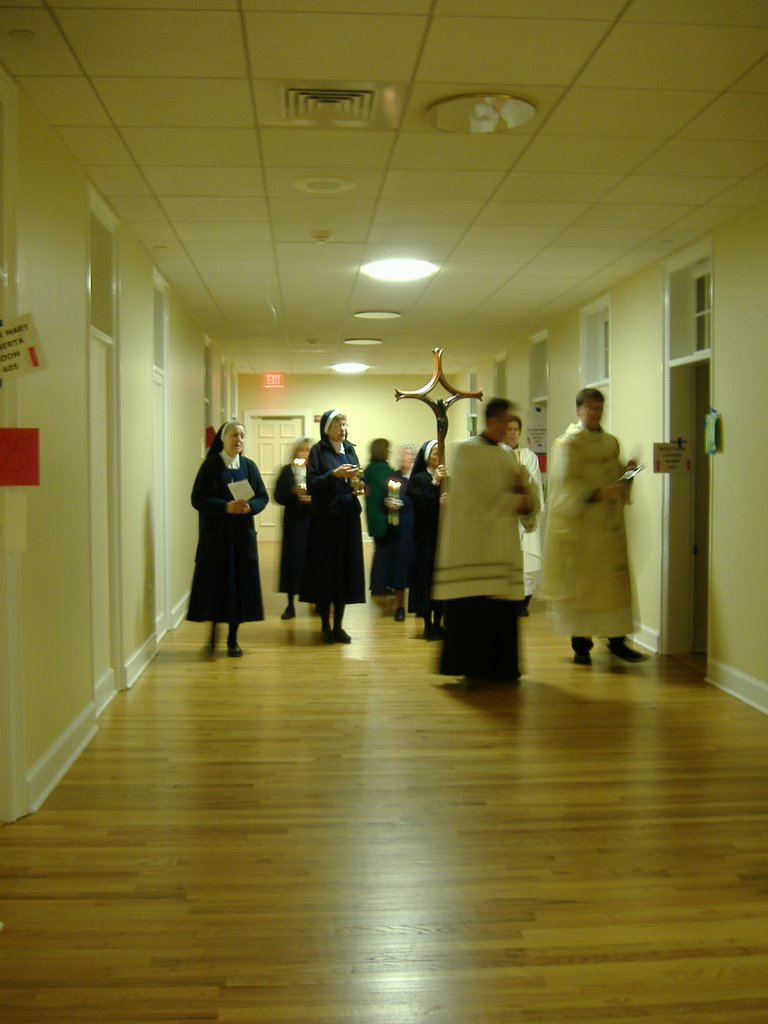
On Monday afternoon, prior to our first night in the "new" monastery, we had a formal blessing of all the rooms. Pictured below, Sister Anne Francis, Sister Mary de Sales (candle bearers) and Sister Leonie Therese wait while the rest of the procession visits the Chapel of St. Joseph on the retreat wing for its blessing.


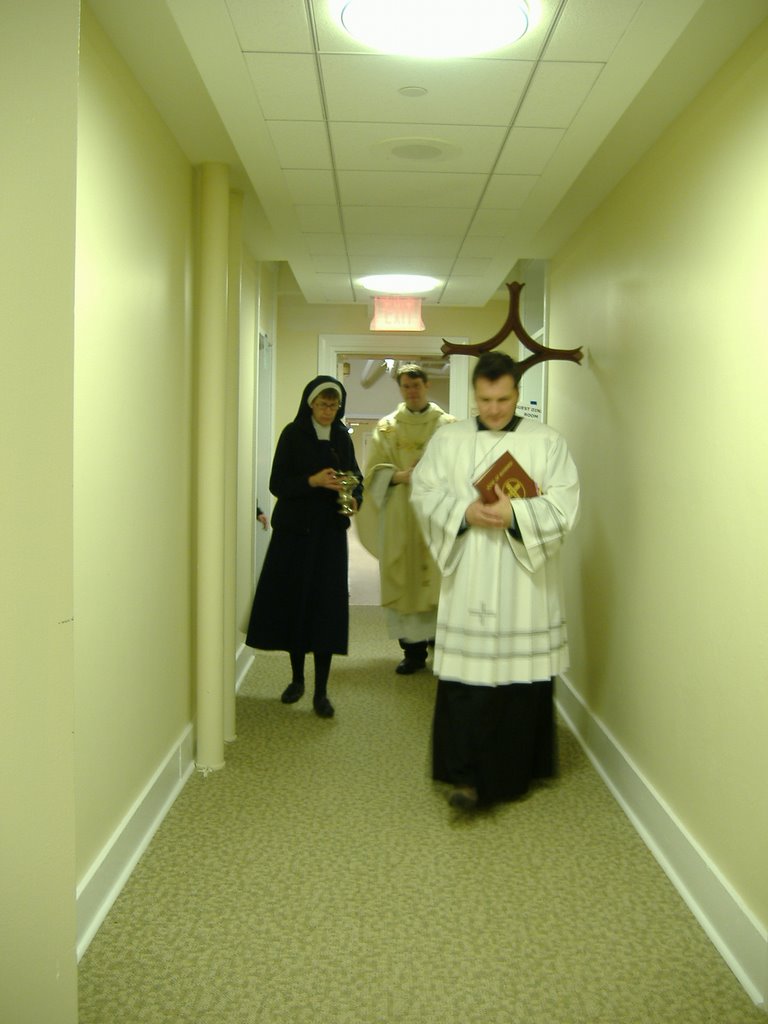
The blessing of the monastery proceeds through the novitiate hallway.


The procession passes the infirmary and approaches the professed sisters' dormitory wing.


More pictures forthcoming!

21 January 2007

Happy Campers!

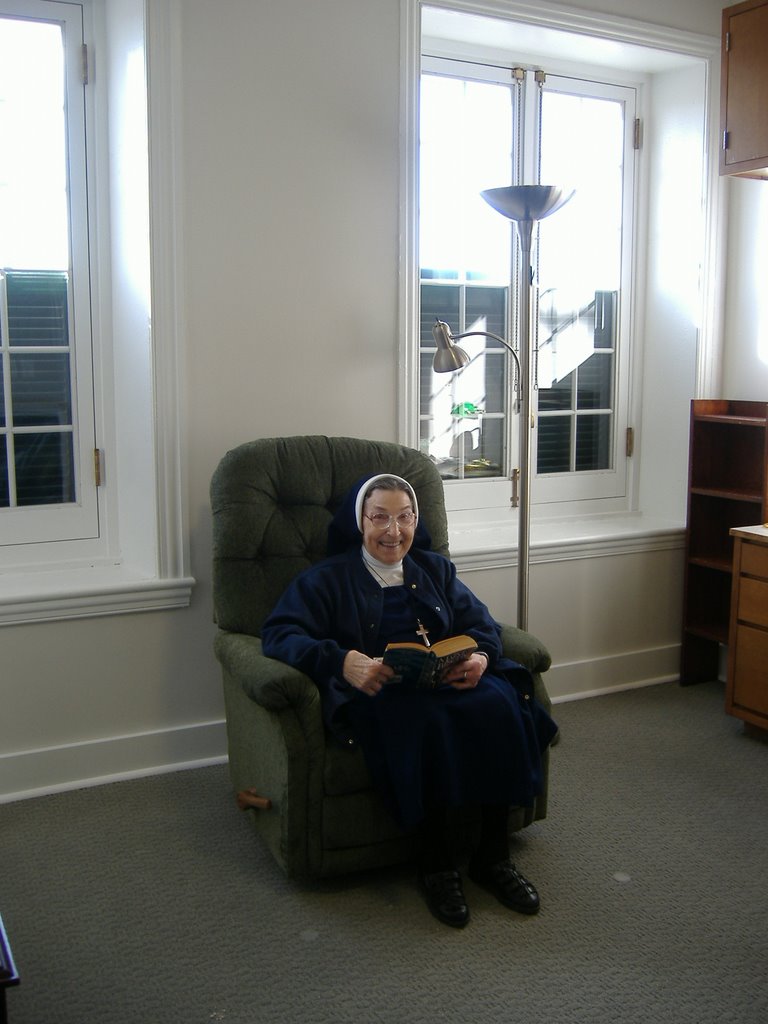
The days are growing closer! For those of our readers who have been following our journey to the promised land -- during our ten months (who's counting!?) in exile -- we have a few pictures of some very happy campers who can see the end of the exile approaching on the horizon. Pictured below, Sister Mary Austin pauses to do some spiritual reading in a new chair.

Sister Bernardine, below, gives her seal of approval on one of the new chairs in our assembly room. We're not sure we will recognize the room without a complete set of "unmatching" chairs!

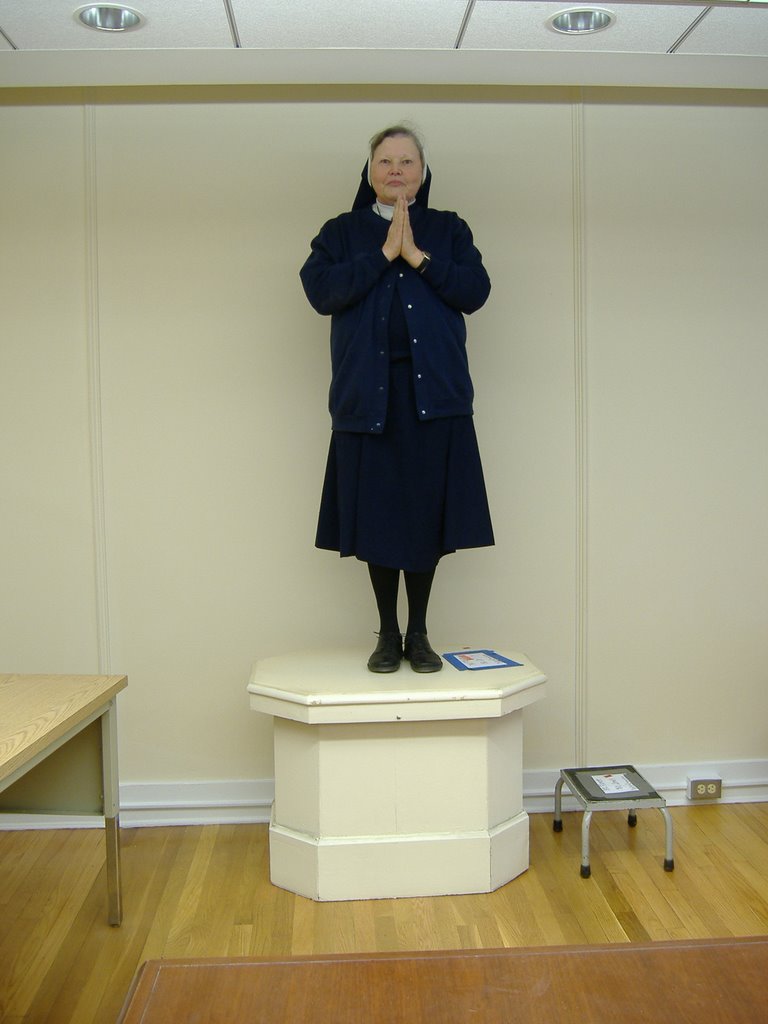
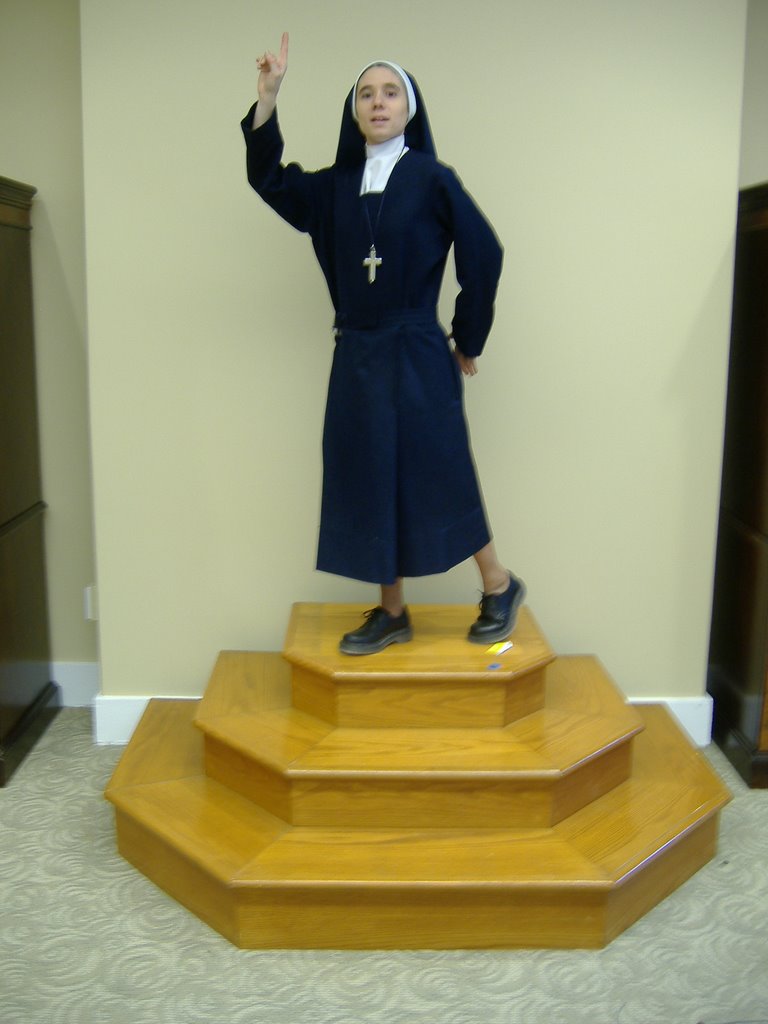
On Saturday, many of our Visi Dads came and moved boxes, arranged furniture, assembled beds (and some moms were seen doing heavy lifting, too) while Moms and daughters helped clean and unpack. While many worked hard, some of us, er, worked hard at entertaining our cheerful helpers. Below, Sister Mada-anne seizes the opportunity to pose on an empty statue pedestal.


. . . and Sister Anne E thinks she's Augustus Caesar -- though she looks a lot more like she's trying to hail a taxi than the noble style of Polyclitus' spear carrier. Fortunately for the community, the Blessed Mother will soon be atop that pedestal. Stay tuned for more pictures.


17 January 2007

A Cut Above the Rest!

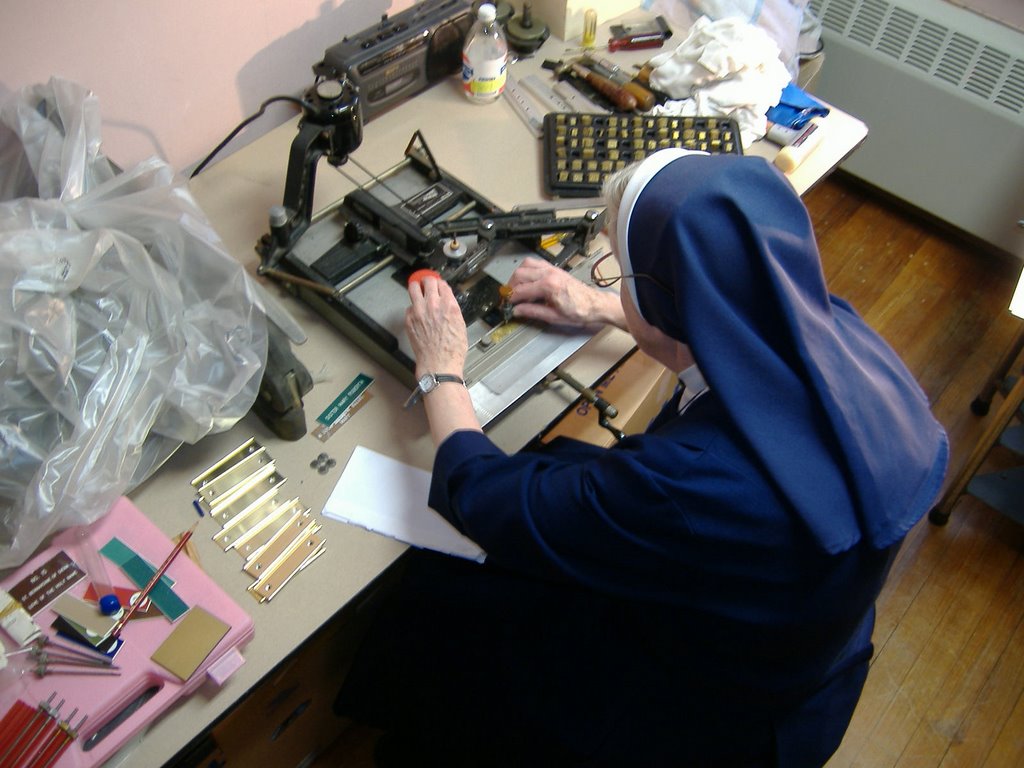
As we make final preparations for our move back into our renovated monastery, we have the opportunity to make new door tags. One of our monastic customs is to have a saint's name and a virtue on the door of each sister's room, as well as that of our common rooms and offices. Pictured below, Sister Mary de Sales prepares the engraving machine for the virtue "courage."

Many years ago, when she was director of athletics, the price of engraving skyrocketed from 2 cents a letter to 15 cents a letter. Sister recalls being so frugal that the year the price increased, the "Ping Pong Runner-Up" trophy read, "PPRU." (Apparently sister was working on a 60 cent budget!) Given the cost of engraving, Mother Cecilia thought it was a great idea for Sister Mary de Sales to learn how to engrave. And learn she did.

One anecdote that Sister tells with a chuckle is how, as a student at Visitation, Sister Mary de Sales, on a national spelling test, scored in the lowest 10% of the nation. She recalls being late to field hockey practice because she had to go to an after-school spelling class in Mother Mary Leonard's office. That Sister is "spelling-challenged" is no secret in community -- and it was Sister Mary Paula who, upon hearing that she was taking up engraving, said to Sister Mary de Sales, "Now it will cost you money to misspell a word!" Lo, these many years later, Sister is still a poor speller but she is a very fine engraver! Pictured below is the plate for Room 405: the virtue is courage and the soon-to-be-engraved saint is our Holy Sister, Saint Margaret Mary. Stay tuned for more pictures!

13 January 2007

Moving Along

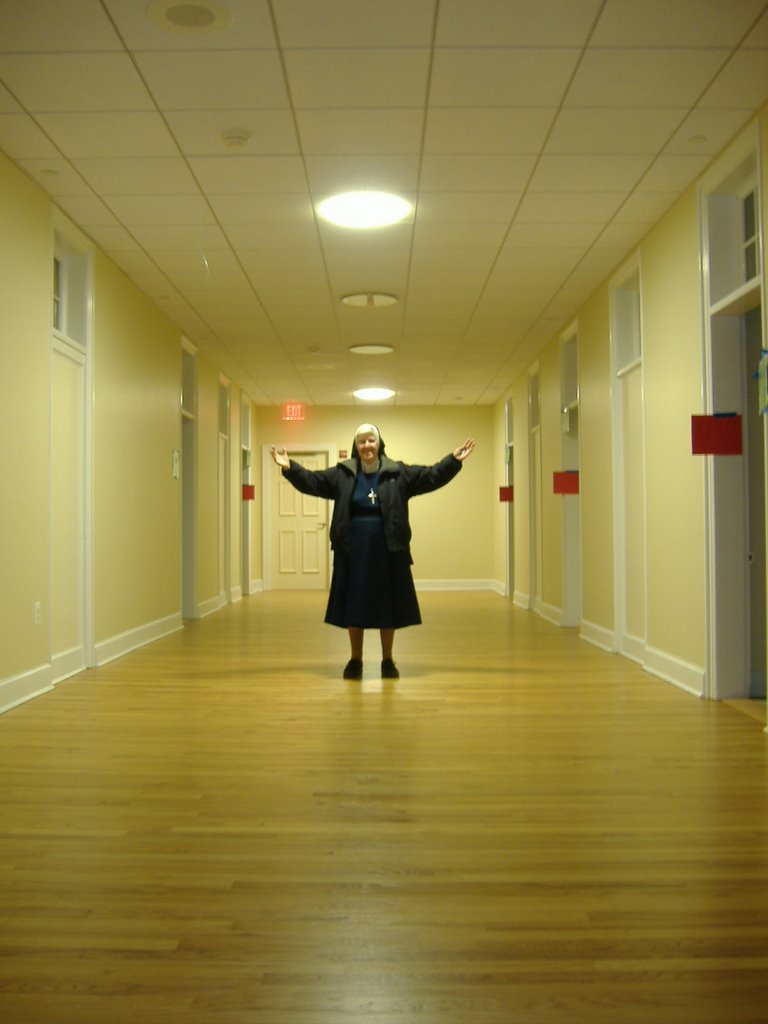
The countdown has begun! The finishing touches are being completed and the "new" monastery is beginning to look like a home. Sister Mary de Sales, pictured below, is showing off the novitiate hallway. (The red signs, to the right, are not going to stay on the doors; they are there for the day when the movers bring our furniture back.)


Sister Anne E, below, is testing out a chair in the "new" teachers' workroom. Before long, there will be a desks to go with the chairs. . . and the room will be filled with books and supplies (and papers to grade...) Stay tuned for more pictures in the coming weeks as we hope to be living in the monastery by the Solemnity of our Holy Father, St. Francis de Sales, later this month.


11 January 2007

Spreading the Good News

The former-leper in today's Gospel was asked to present himself only to the priests and not to tell anyone about his miraculous healing. Instead, he does just the opposite. If we may overlook his failure to obey Jesus' wishes, we can find in this leper a good example of how we should respond to the gifts which we receive from the Lord.

In our culture, where rugged independence is praised, esteemed and encouraged, we are not often comfortable telling everyone about a little (or big) grace we have received from the Lord. There is something in the message of the media which exhorts us to be fiercely independent and self-made beings. And yet the Lord would have it otherwise. He invites us, constantly, to tell him our needs and to ask for them. When we receive a blessing, a happy surprise, let us not keep it quiet, but let us share it with those around us. Let us make known the wonders of our God!


"As regards your smaller consolations and joys, I wish you not to be so reserved about them, and, when the occasion presents itself, to speak of the frankly and simply to one another."
St. Francis de Sales

07 January 2007

The Wise Still Seek Him

The magi left the royal court of Herod and followed the star to Bethlehem where it rested upon a stable. The wise men traveled from what was likely a palace to a humble stable where they paid homage to the newborn Messiah. Earthly riches did not cloud the discerning eyes of the magi; they encountered the Lord in a fragile baby, born in a stable. They knew that this was an altogether different kind of royalty, but one very worthy of their gifts and their journey.

We can learn from the magi -- that the Lord is found in the most ordinary of circumstances, in the most humble of places: where we least expect Him to be. Let us, like the wise men, seek the Lord at all times. Let us be vigilant to keep our eyes on all that points toward him, all the "stars" of our life that lead us ever closer to his presence.

"When the magi kissed the feet of Jesus, they kissed the feet of God."
St. Francis de Sales

03 January 2007

Trivia but not Trivial!

Today is commemoration of the Holy Name of Jesus, a feastday which was reinstituted by Pope John Paul II after being dropped from the Roman calendar during the 1969 revisions (the Feast erstwhile known as the "Feast of the Circumcision.")

The letters "IHS" are ubiquitous in Churches, on altars, on vestments, etc. and they are sometimes mistakenly represented with periods between the letters (I.H.S.) as an acronym for "Jesus Hominum Salvator." Originally, however, they were intended to represent the first three (capital) letters of the Most Holy Name of Jesus in Greek (Iota, Eta, Sigma).
"How are we to pronounce the sacred name of Jesus? . . . It is not enough to say it with your lips; it must be engraved upon your heart."
St. Francis de Sales

31 December 2006

The Holy Family - on the move!

It seems, each year, that the Feast of the Holy Family suffers some unfortunate liturgical fate. Last year, in the shortest Christmastide possible, it was relegated to a Friday and first Vespers were omitted. This year, it assumes its usual place on a Sunday but cedes its second Vespers to the Solemnity of Mary on 1 January.

Despite the liturgical aerobics that this happy Feast suffers, it offers us an opportunity to reflect on the time that Jesus spent with Mary and Joseph -- a time about which we know very little. The story of the finding in the temple, which we hear in today's Gospel, is the only documented pericope we have of the years between the Jesus' presentation in the temple and his baptism. Whatever the events that filled the silent years spent together, we can presume that the Holy Family experienced the joys and sorrows common to all families - and we can presume that they received those joys and sorrows with unparalleled grace.

As we experience the day-to-day events in our family, our parish, our community, etc., let us remember that every feeling we experience has first passed through the Most Sacred Heart of our Lord. And, although none of our families can approximate the holiness of the Holy Family, we can trust that, in some way, the feelings of frustration or helplessness that we may feel when we watch a loved one suffer -- or that we may experience ourselves -- were not entirely unknown to the Holy Family. Let us look to this first domestic Church for strength and consolation for each of our families. Let us entrust to Mary's and Joseph's care all families who are in special need of healing.

"Not that there is any comparison . . . yet still we may say that it was a trinity on earth representing in some sort the most holy Trinity -- Mary, Jesus and Joseph; Joseph, Jesus and Mary -- a trinity worth indeed to be honored and greatly esteemed."
St. Francis de Sales

25 December 2006

The Lord is Come!

The desert shall bloom with flowers; the Lord is near!
The desert has bloomed with flowers; the Lord is come!

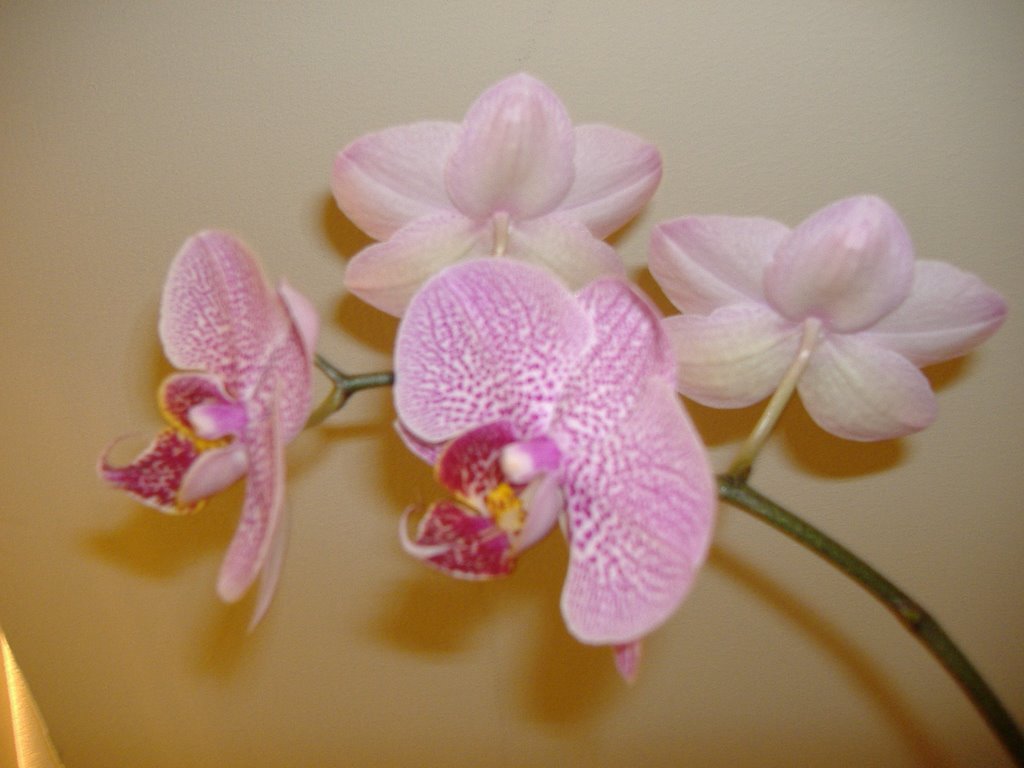
This is an unusual Christmas for us, in many ways. We are counting down the days to the end of our exile and we are trying make Christmas as smooth and prayerful a celebration as possible, given the limitations of our living conditions. So, why are orchids in bloom in Washington DC in December? Indeed, this is an unusual Christmas! It seems that our Sister Leonie Therese has been coaxing these orchids to bloom (without success) for four years. Recently, in the Fennessy refugee camp, the over zealous radiators have caused some areas to reach 85-90 degrees (with the windows open!) When sister placed the orchids near the "rainforest" they began to bloom and they are simply majestic. There are four more buds just beginning to bloom -- perhaps they will come out in time for the Solemnity of Mary!
All kidding aside, as we celebrate the coming of our Lord, we rejoice and give thanks for all the blessings we have received in the past year -- most especially the kindness and generosity of our benefactors who are making the renovation of our monastery a dream come true. We anticipate moving in within a month or so. Stay tuned for pictures!

A happy and holy Christmas to our readers.
With love from your Sisters of the Visitation of Georgetown.

23 December 2006

O Emmanuel!

Today we sing the last of the Great O Antihons. The apostrophe of this last antiphon has become the title (and first verse) for the popular Advent hymn.

O Emmanuel, Rex et legifer noster, expectatio gentium, et Salvator earum: Veni ad salvandum nos Domine Deus noster.
---
O Emmanuel, our King and law-giver, the desire of the nations and their Savior: come and save us Lord our God.

Historians who study these antiphons have discovered that the first letter of the Latin titles, spelled backwards reveals: "Ero cras" (I will be tomorrow.) Either the historians need a hobby or the monk who penned these hallowed verses embedded them, from every angle, with hints of the promise that is fulfilled in the incarnation. Presuming the latter, we approach this penultimate day of waiting with great hope for we trust that He, the long-desired of nations, will come and be born again in the hearts of those who seek him. As we make our last-minute preparations these next two days, let us ask for the grace of stillness. Come, Lord Jesus.

22 December 2006

O Rex Gentium!

The King is coming and today we recall His unifying role, making both to be one, as he includes the Gentiles among the sons of Israel as those he has come to save.
O Rex Gentium, et desideratus earum, lapisque angularis, qui facis utraque unum: Veni, et salve hominem, quem de limo formasti.
---
O King of the Nations, and their desire, the cornerstone, who makes both to be one: Come and save mankind, whom you formed from clay.
The long-desired Messiah approaches and we rejoice because our weak and frail human nature will be restored to its original dignity when it is embraced and worn by the King of kings. God repairs our broken humanity by becoming one of us and we marvel at how He who formed us from clay is come among us as a fragile baby. The Creator entrusts his creation, whom he formed from clay, with Himself. Indeed, too great a mystery for us to comprehend -- one can only marvel and adore the mystery of God made man in the form of a child. O come, let us adore!
"Behold God incarnate! How beautiful it has been to reflect on the very profound mystery of our Savior's Incarnation! This mystery is so exalted and so profound that we understand next to nothing about it. Finally, some day in Heaven above, we will grasp it fully."
St. Francis de Sales

21 December 2006

O Oriens!

Today we call Christ the "Oriens," the rising brightness, the dawn. The Latin verb "orior" literally means "to rise up" or "to be born" and, used substantively, it has come to signify the rising of the sun in the east.

O Oriens, splendor lucis aeternae et sol iustitiae: Veni, et illumina sedentes in tenebris et umbra mortis.
---
O Rising brightness of everlasting light and Sun of justice: come and enlighten those sitting in darkness and in the shadow of death.
The word "oriens" as the place where the sun rises, the east, is responsible for the less than politically correct adjective - once popular - referring to things Asian: oriental. It meant, simply, from the east. Today, "orientation" has become synonymous for "direction" but, in a more accurate reading, it really means a turning to the east, a turning to the rising sun, a turning to Christ.
Let us turn ourselves to the east, to the Rising brightness who comes to the hearts of the faithful who seek him. When He comes, let Him find us neither unprepared nor afraid, like those who, squinting, miss the splendor of the sunrise. Let us greet the Rising dawn with words of praise and grateful hearts. Come, Lord Jesus.

20 December 2006

O Clavis David!

Today's O Antiphon uses a title that is "new" inasmuch as it is used for the first time, as a title, in this antiphon. The "key of David," the six-pointed star, is born and illumines the darkness, just as it once lit the night sky over that humble manger in Bethlehem.
O Clavis David, et sceptrum domus Israel: qui aperis et nemo claudit; claudis et nemo aperit: Veni et educ vinctum de domo carceris sedentem in tenebris et umbra mortis.
---
O Key of David, and scepter of the house of Israel: who opens and none shall close, closes and none shall open: Come and lead out from the prison house the one in chains who sits in darkness and the shadow of death.
Jesus is the key that unlocks the gate of heaven. Man is held captive, chained by sin and temptation, walking a road that leads only to despair and death. The law, the old covenant, did not lead men to freedom -- it was yet another fetter waiting to be unlocked. Jesus is the long-awaited messiah. And by his coming among us as man, Jesus ended the reign of sin and death.
As we prepare for Jesus' coming, let us examine our hearts for those little trappings that hold us bound. Sometimes we find it difficult to forgive someone and we are held captive by a feeling of guilt or sorrow. Perhaps we struggle with an addiction that makes it difficult for us to carry out our daily responsibilities and we are held captive by a feeling of helplessness. Whatever it is that restrains our heart can be loosed by the power of the mighty Key of David -- and the wise still seek that six-pointed star in the dark sky that veils the dawn of his coming.

19 December 2006

O Radix Jesse!

The third antiphon, sung tonight, calls Jesus the "Root of Jesse," identifying him with his ancestral line as a son of David, the son of Jesse.
O Radix Jesse, qui stas in signum populorum, super quem continebunt os suum, quem gentes deprecabuntur: Veni ad liberandum nos, iam noli tardare.
---
O Root of Jesse, who stands as a sign for the peoples, before whom kings will fall silent, whom the nations will entreat: Come and free us now, do not tarry.
Jesus' lineage as a son of Jesse is important for many reasons -- one of which is Jesse's own heritage. Jesse was the son of Obed, whose mother was Ruth. Ruth herself is a significant figure: she was a Moabite woman and the widow of a Bethlehemite. When her mother-in-law Naomi chose to return to Bethlehem, Ruth insisted on going with her. In Israel, Ruth married Boaz and they became the parents of Obed (the father of Jesse). Had Ruth stayed in Moab and not accompanied Naomi to Bethlehem, the lineage of King David, the royal line in which Jesus was to follow, might never have come to be.
Ruth's fidelity to her mother-in-law and to the daily work of gleaning the fields for food were both significant factors which led to her becoming the wife of Boaz, the mother of Obed, the grandmother of Jesse and the great-grandmother of King David. As we await the birth of another little boy in the city of Bethlehem, let us ask for the grace to be faithful to the Lord in all that is asked of us each day -- for we can never estimate the far-reaching effects of our fidelity.

18 December 2006

O Adonai!

This second of the Great O Antiphons heralds the coming of the Lord, as the promised leader of the House of Israel -- He who approached Moses on Mount Sinai.
O Adonai, et Dux domus Israel, qui Moysi in igne flammae rubi apparuisti, et ei in Sina legem dedisti: Veni ad redimendum nos in brachio extento.
---
O Lord, and Leader of the house of Israel, who appeared to Moses in the red fire of flame and gave him the law on Sinai: Come and redeem us with outstretched arm.
Moses himself was a leader of the House of Israel who led his people out of slavery to the Egyptians, a foreshadowing of the great Leader who would lead His people out of slavery to sin and death. Moses was a man of great faith who led his people not only by his deeds but also by his prayers. When, to avoid the Philistines, the Israelites took a longer route through the desert and encountered the Amalekites, Moses appointed Joshua to lead the Israelites in battle. Moses did not rest secure in Joshua and his men, however, he went up a hill and prayed for his people. Through his intercession, the Israelites continued their journey toward the promised land.
Let us learn from Moses that the Lord who trusts us with the responsibilities that come our way -- be they to our family, our employer, our community, our parish, etc. -- also trusts us to trust Him. Let us not forget to ask the Lord's blessing and assistance on all that we undertake in His name. For his arm is outstretched to help those who call upon Him.

17 December 2006

O Sapientia!

This evening we begin the Great O Antiphons of Advent. In the shortest Advent the calendar can possibly provide for us, these ancient antiphons begin on Gaudete Sunday and continue for the duration of the third week of Advent.

O Sapientia, quae ex ore Altissimi prodiisti, attingens a fine usque ad finem, fortiter suaviterque disponens omnia: Veni ad docendum nos viam prudentiae.
----
O Wisdom, you who come forth from the mouth of the Most High, and reaching from end to end, mightily and sweetly ordering all things: Come and teach us the way of prudence.
This first antiphon reminds us of Christ's role in creation. It is striking that we proclaim how the Lord reaches "from end to end, ordering all things mightily" while we wait for His coming among us as a baby. This mighty Lord whose birth changed the world and whose death brought salvation will be born of woman and laid in a manger. That Christ came among us as a child tells us a great deal about his humility, a humility that we are invited to cultivate. Let us pray for the grace to imitate the Lord in this profound humility which prepares our hearts follow Him more closely.
"Humility and charity are united like St. John the Baptist and Our Lord. Humility is the forerunner and precursor of charity . . . . humility must come in order to empty hearts that they might then receive charity."
St. Francis de Sales

15 December 2006

The Advent Journey Continues

The prophet Isaiah reminds us, in today's first reading, that the Lord will lead us on the way we should go. It is a consoling reminder that He goes before us, He leads us and He will not lead us astray. It is also a "reality check" -- as some of our students might call it -- because we know that the way which the Lord has marked out for us is not always the one we might prefer. It is hard to see the Lord's hand at work when circumstances unfold in ways that frustrate us, challenge us and cause us or those we love to suffer. It is at these times, however, when we must remember that the Lord's own road led him to the cross, for love of us. And, for love of us, He will not leave us to walk alone if we follow Him. When we do not understand why the Lord permits certain challenges to befall us and when we cannot see the road ahead, let us ask for the grace to trust Him and to trust that He knows the road by which we should go.

"Live each day well, eat what is given you, and you will nourish yourself well by putting that into practice. Leave the rest to Divine Providence, which will surely provide sufficiently for your needs. Use well only what is given you, and be free of all other care."
St. Francis de Sales

12 December 2006

Profession Pictures -- part III

Most of our fellow Visitandines in other parts of the world are celebrating the Solemnity of Our Holy Mother, St. Jane de Chantal today. Here in North America, she's been moved to August for the Feast of Our Lady of Guadalupe.
Little by little we are receiving photos from friends and family who were in attendance at the profession on 1 December. We have a few more pictures (at great risk of boring our faithful readers) and a few more customs to share.

Sister Maureen and Sister Anne Elizabeth kneel after their profession for the solemn blessing. Much like our formula for the profession of vows, this blessing has been used for many generations of sisters:

Father in heaven, our desire to serve you is itself your gift.
And our perseverance needs your guiding hand.
How right it is that we should sing your praise.

With boundless love you created the human family through your word, in the Holy Spirit,
And lifted it up into communion with yourself;
You make the human family your bride,
radiant with your own likeness, adorned with gifts of everlasting life.

When your bride, deceived by the evil one, broke faith with you, you did not abandon her.
With everlasting love you renewed with your servant Noah the covenant you had made with Adam.

Then you chose Abraham, the man of faith,
to be the father of a people more numerous than the stars of heaven.
By the hand of Moses you sealed a covenant with them in the tables of the law.
Throughout the ages there arose from this favored people
Holy women renowned for devotion and courage, justice and faith.

In the fullness of time you raised up the Holy Virgin from the stock of Jesse.
The Holy Spirit was to come upon her, and your power was to overshadow her,
Making her the Immaculate Mother of the world’s Redeemer.

He became poor, humble and obedient, the source and pattern of all holiness.
He formed the Church into his bride by loving it with love so great that
he gave himself up for it and sanctified it in his blood.

Father, in your loving wisdom, you have singled out many of your daughters to be disciples espoused to Christ and to receive the honor of his love.

Father, we earnestly pray you:
Send the fire of your Holy Spirit into the heart of this, your daughter, to keep alive within her the holy desire He has given her.

Lord, may the glory of Baptism and holiness of life shine in her heart.
Strengthened by the vows of her consecration, may she always be one with you in loving fidelity to Christ, her only Bridegroom.

May she cherish the Church as her mother, and love the whole world as your creation, teaching all people to look forward in joy and hope to the good things of heaven.
Lord, holy Father, guide the steps of your servant and guard her on her pilgrimage though life. When she comes at last to the throne of Christ her King may she not fear him as her judge, but hear the voice of her Bridegroom lovingly inviting her to the wedding feast of heaven.
We ask this through Christ our Lord. AMEN!


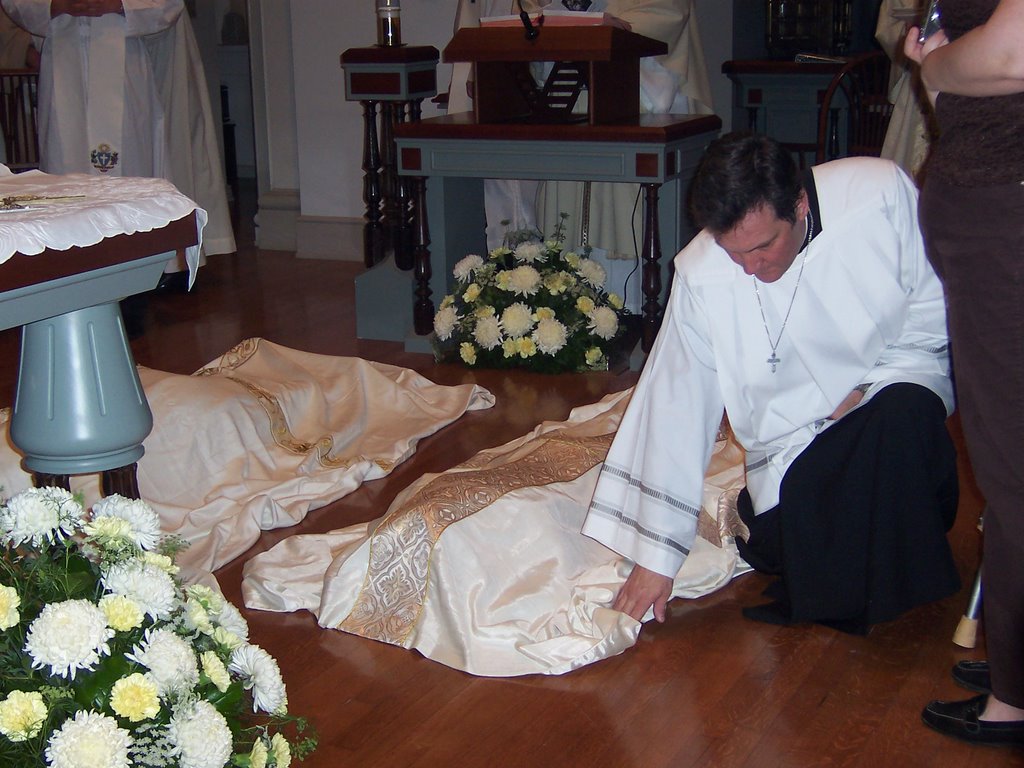
One pious practice that our community observes is the tradition of placing prayer intentions in the pockets of those about to be professed. For it is believed that when they prostrate under the pall the prayers are placed before the Lord in a very special way, as the sisters prepare to offer their lives to the Lord. Pictured above is our faithful master of ceremonies, David, adjusting the pall (just in case sister had hopes of breathing!)
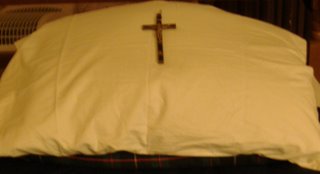
The crucifix presented to a sister at her solemn profession is, traditionally, placed on her pillow each morning after she makes her bed. Although it may seem to be an odd place for a crucifix (since our rooms all have one hanging on the wall), the crucifix of profession is a daily reminder of the permanence of our consecration to the Lord, which teaches us to seek no glory but that of his cross.

"For I have chosen and have sanctified this place that my name may be there forever and my eyes and my heart may remain there perpetually."

2 Chronicles 7:16