29 April 2006

St. Catherine of Siena

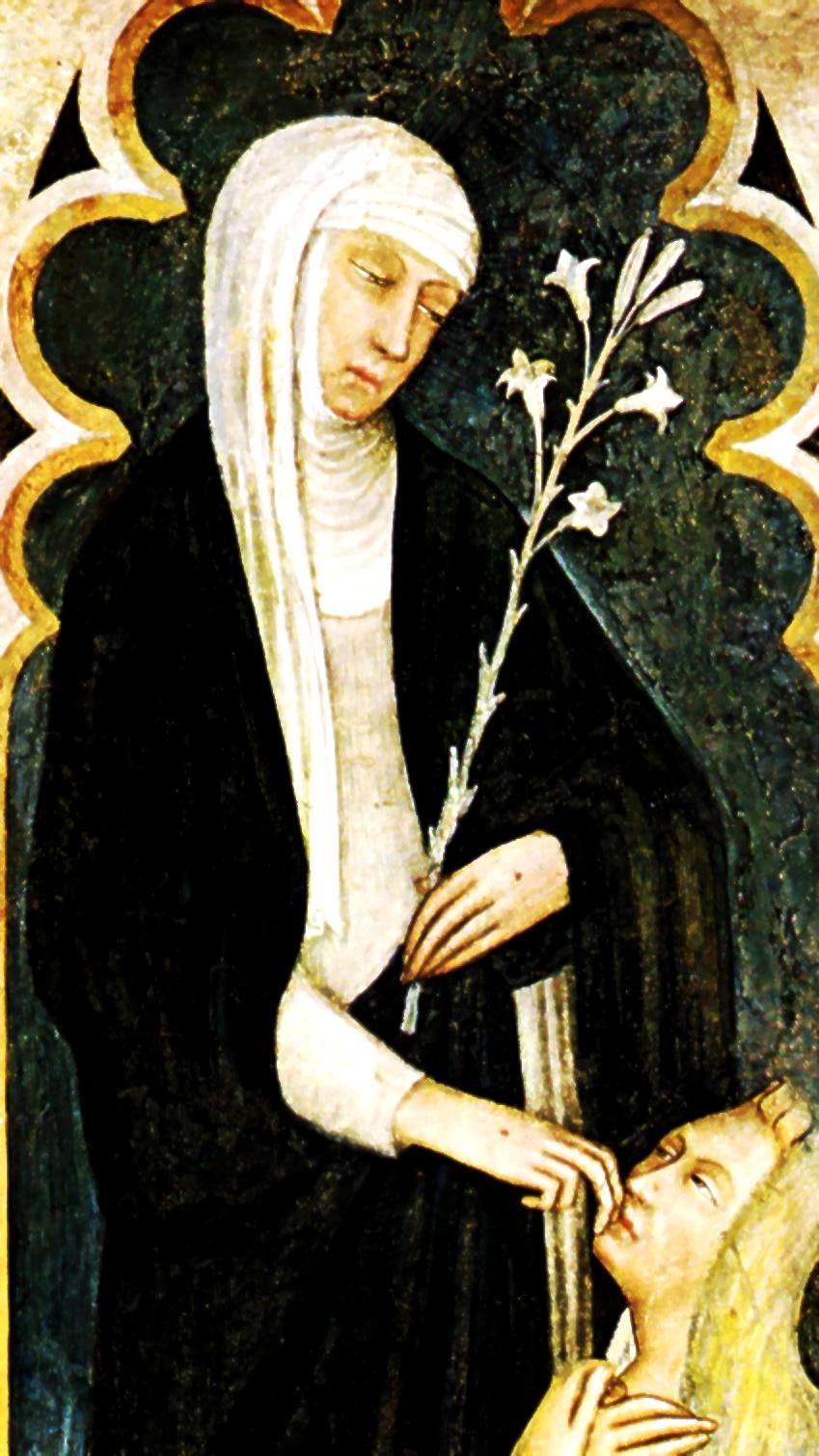
An extraordinary woman for an extraordinary time. Born in the 14th century, as the renaissance dawned, St. Catherine of Siena was a welcome light in the Church and in the world. Perhaps her most well-known gift to the Church was her influential hand -- and pen -- in bringing an end to the Avignon papacy. Though Pope Gregory XI moved back to Rome, it did not end tension in the Western Church; through the scandal of having two popes which divided Europe, St. Catherine was a valued and trusted resource for Pope Urban VI as well as other contemporary theologians.

Beyond her diplomatic skills and theological expertise, St. Catherine was a gentle soul well accustomed to suffering. Her family, wishing her to marry, did not easily accept her choice to be a Dominican tertiary. Despite a challenging home environment, St. Catherine attracted a band of spiritual friends to whom she became confidant, advisor and spiritual guide.

In 1461 St. Catherine of Siena was canonized; in 1970 she was named a doctor of the Church by Pope Paul VI and in 1999 Pope John Paul II named her among the patrons of Europe.

Most of us do not have the opportunity (or the gifts and expertise) to serve as advisor to popes and learned theologians. All of us, however, have the opportunity to lead people to Christ by our own lives in our earnest pursuit of virtue.

"We do not always have opportunities to do great things; opportunities do little things with great love abound."
St. Francis de Sales

27 April 2006

Cardinal's Visit

Normally, the visit of a Cardinal marks a formal event in our community. This year, we were privileged to have a leisurely visit with His Eminence Theodore Cardinal McCarrick, who celebrated Mass on Tuesday morning in our "new" (temporary and cozy) Lalor House Chapel. He is pictured above enjoying breakfast with Sr. Mary Berchmans (somewhat obscured by the tulips) as Sr. Mary de Sales arrives at the table.

During his homily for the Feast of St. Mark, Cardinal McCarrick commented that St. Mark was able to get along with both St. Peter and St. Paul, no small diplomatic feat! Clearly, during a quarter-century of Episcopal service, he, too has honed similar skills for gentle diplomacy.

We were privileged to have this lovely visit with His Eminence -- and happy to show him around our "new digs" during this time of our exile. (More construction pictures coming soon!)

"As a bishop you are a master-builder. It is your duty to watch over the leaders of your flock. . . . Remember that while teaching does much,
example does immeasurably more"
St. Francis de Sales' instruction to bishops

25 April 2006

St. Mark

Today the Church celebrates the Fest of St. Mark the Evangelist. A homilist once remarked that "Mark" spelled backwards is "Kram" which is how St. Mark manages to include a plethora of miracles into the shortest of the four canonical Gospels.

St. Mark is often depicted, in art, with a scroll or a winged lion. The lion, representing one of the four windged creatures in Ezekiel, is associated with Mark because he begins his Gospel with St. John the Baptist, the voice in the wilderness.

St. Mark has some interesting patronages. He is patron to attorneys, prisoners, those who work with stained glass as well as Egypt and the Philippines. As we celebrate his Feast today, we give thanks to God for the gift of the Gospels, His Word among us.

22 April 2006

A Post Prom Post

Some people think that life in a monastery is boring. Not for a minute.

This weekend -- Saturday night -- is our school's prom, held in a hotel downtown. In an effort to keep all our darling angels and their dashing dates safe after this event, our parents have sponsored a "post prom" party here on campus for the past several years. The students arrive around 12.30am or 1.00am and play games, enjoy refreshments and visit with their classmates until 4.00am when the "post prom" party ends.

Normally, this is of little consequence to those of us who live in the monastery, since the school buildings and the monastery building are separated by the school quad and the monastery garden. This year, however, with 18 of us "exiles" scattered in different buildings on campus, we are in the middle of the action. Some sisters have the privilege of sleeping just above the live band which will be performing from 12.30am - 4.00am. Others of us are lucky enough to be sleeping just above the lawn where laser tag is scheduled to take place. As this post is being written, parents here on campus are putting the finishing touches on the decorations.

All kidding aside, there are two truths here worth underlining: 1. when over 90% of students attending the prom sign up for "post prom" parents, teachers, administrators and sisters sleep better knowing that our girls are safe (at least until 4.00am!); 2. life in a monastery is NEVER dull.

20 April 2006

Holy Appetizers

Surely there are deep theological reasons why the today's Gospel includes the detail about Jesus asking for food and eating it in front of his disciples. His body was, indeed, a body; Jesus' resurrected body was not that of a ghost or an angel, but a human body. He was hungry and he ate.

This detail, however, suggests another (albeit less theological) theme: Jesus' comfort and intimacy with his disciples. It is only in the company of those with whom we are very comfortable that we can act as Jesus did. It is almost a level of familial comfort. How many young people visit home during college and, upon entering the kitchen, ask, "Got anything to eat, Mom?" as they open the refrigerator and begun to peruse the pickings. In how many other homes are we comfortable enough to ask for food or to raid the refrigerator. Normally, it would be considered rude -- or at least socially awkward -- if one were to behave this way in the home of a host or a stranger.

The company of the disciples was a space in which Jesus was at home, comfortable, and welcome. Would that we too could be considered a place where the Lord is at home. Would that our hearts were places so "familiar" to the Lord that he would choose to visit us often. The Easter season is a wonderful time to cultivate a space for the Lord in our hearts. By our attention to Scripture, our careful and prayerful attention to those around us, we may fashion a welcome place for the Lord to visit.

"The spirit of gentleness must be preserved at all costs, else yours would not be a Visitation house even though all the rest of the rules should be observed, for this, the most important of characteristics would be wanting." St. Jane de Chantal

18 April 2006

Enough is Enough!

Reality shows on television were generated -- not out of creativity -- but out of need. When the writers and actors unions were threatening a strike, the producers had to figure out a way to keep audiences entertained without actors and without writers. And shows fashioned on MTV's "Real World" (possibly the first popular reality show) were born.

In the style of reality shows, A&E recently launched a documentary-type series, God or the Girl, about four men discerning a vocation to the priesthood. Despite an innocuous interview in a Zenit article, a very articulate and well-written critique was published in an on-line journal by Rev. David Nuss, director of vocations for the diocese of Toledo, Ohio. Click here to read it.

Not having cable television and not having seen the show ourselves, it would be unfair for us to comment on this new theme in reality -documentary- television. Having been through the discernment process for a religious vocation (albeit for religious life, not for priesthood), however, it is fair to say that the mystery of a vocation can hardly be captured in a television series; it can barely be articulated in words to family and friends, let alone to a network of curious viewers. Perhaps one good that may come of this series would be a greater interest in the process of discernment and an honest consideration of a religious vocation on the part of some interested viewers.

St. Francis de Sales made three resolutions prior to offering his first Mass as a priest on 21 December 1593:

To make every moment of his day a preparation for Mass the next day; to be as disposed at Mass as he would have himself be at his own day of judgment; to unite himself in all things with Jesus Christ.

15 April 2006

Christ Our Light!

The Rev. Kevin FitzGerald, SJ raises the Paschal Candle
and intones "Christ our Light!"


Easter A.D. 2006. Surrexit Dominus! Alleluia!


Mel Gibson's movie "The Passion of the Christ" leaves very little to the viewer's imagination. It is vivid, graphic and very historically accurate. The movie ends, appropriately, with the deposition from the cross. It might have been interesting, had the movie extended to Easter Sunday, to see how today's Gospel scene would have been recreated: the foot race between John and Peter.

There is something so realistic about today's Gospel. One can just see the cloud of dust arise as young John races ahead of Peter. In deference, he awaits the fisherman and allows him to enter the tomb first. Yet it is John who sees and believes. Why? What it is about the beloved disciple that allows him to believe at the sight of the empty tomb and the rolled-up shroud? Good Friday's Passion provides a clue.

In the Passion narrative read on Good Friday, we hear that in the high priest's courtyard there was a disciple with Jesus who was known to the temple officials. Peter, we recall, waited outside at first. Despite the best of his intentions, Peter, as foretold, denied Jesus while he was outside the courtyard. Someone else stayed with Jesus during his trial. Scholars would suggest that this unnamed disciple is the beloved disciple himself. John did not flee from Jesus in his suffering, persecution and crucifixion.

John's resurrection faith at the sight of the empty tomb was not a "bonus," per se, for sticking around when the other disciples were absent. Rather, John's faith was the grace that comes with obedience and adherence to the Lord's will -- be it persecution or prosperity. The natural reward for not avoiding the sufferings in our lives is the grace which allows us to believe that the Lord is at work -- even when we do not understand how it is possible. Such was John's gift. He could not explain what he saw. He simply believed. His was resurrection faith because he stayed with Christ in his suffering.

The same faith is offered to us. When we face suffering -- be it physical, spiritual, emotional, etc., -- we have an opportunity to embrace whatever circumstances the Lord has permitted for our growth. Like John, we too, are given the opportunity to stay with the Lord in the high priest's courtyard. And we pray that we, too, like John, will be rewarded with resurrection faith.

13 April 2006

Sacred Triduum

So as to focus extra time and attention on the Liturgies of the Sacred Triduum -- and the mystery which they celebrate -- we shall "sign off" until Sunday. For those readers who are local, please refer to our schedule for Mass times during these days. Also, please note the change of location for the Altar of Repose. Due to our newly-begun reconstruction, we shall repose the Most Blessed Sacrament in the Foy Parlor of the School (third parlor on your left as you approach the Chapel) from 6pm-midnight.

May these most sacred days provide moments of prayer and recollection in your in your hearts -- amid other activities and responsibilities which call for your attention.

"In the Holy Eucharist our Lord abases Himself -- if we may so express it -- and changes Himself into food, so that he may penetrate our souls and unite Himself most intimately to the heart and body of His faithful."
St. Francis de Sales

11 April 2006

Triduum Schedule

For the benefit of our locals, whom we welcome -- as always -- here is our schedule for the Triduum.

Due to our renovation, we are only having the major liturgical celebrations in the Chapel of the Sacred Heart. Liturgies of the Hours will be in the Lalor House Chapel.

Holy Thursday: 5.00pm - Mass of the Lord's Supper (the Blessed Sacrament will be reserved in the school parlor until Midnight - all welcome!)

Good Friday: 3.00pm - Commemoration of the Lord's Passion

Holy Saturday: Mass of Easter Vigil - 8.00pm (reception in parlor follows)

Easter Sunday Mass: - 9.00am (reception in parlor follows)

09 April 2006

Palm Sunday of the Lord's Passion


“Blessed is he who comes in the name of the Lord!” What does it mean to “come in the name of the Lord?” We follow in the Lord’s footsteps and embrace his passion when we have Him as the only object of our love. As St. Jane de Chantal tells us, “…our hearts will have no other affections than to please Him, to love Him and to serve Him.” When we carry out all our actions for Him alone, we come in His name. And we, too, are subject to his fate. We are subject to scorn, scourging, criticism, pain, betrayal and injustices. This is our share in the cross. Our share in the cross may be only a small share in the Lord’s sufferings but it is still our share – which we embrace for love of Him.

Let us be generous in the face of suffering: as the woman in today’s Gospel, who was criticized because she broke open the alabaster jar and anointed the Lord, we, too must refuse to count the cost. As we begin the Passiontide this week, let us approach the cross with open hearts and outstretched arms. Let us live generously and gently – for blessed are we too, when we come in the name of the Lord.

“This Congregation [the Visitation] is founded spiritually on Mount Calvary for the service of Jesus Christ crucified in imitation of whom all the sisters must crucify their senses, passions and aversions . . . for the love of their Heavenly Father.” St. Francis de Sales

06 April 2006

Spare Change

Recently, someone shared with us a sign from a restaurant. Sitting over a bowl near the exit was a card that read: "If change bothers you, please leave it here." The Jews in today's Gospel reading could have taken up quite a generous collection. Jesus upset their comfortable vision of life and death when he hinted at eternal life. In fact, Jesus challenged them so much that they intended to stone him.

The experience of having one's vision upset is good -- if we trust that there is another "vision" waiting for us on the other side of this "change." Perhaps one of the most profound moments of spiritual growth is the realization that a certain image of God, which we cherish, is inadequate -- inadequate not because God is not "solid" like a rock or "loving" like a father, but because God is so much bigger than our limited images can suggest.

In today's Gospel, the faithful Jews gathered at the Temple were unwilling to let go of their image of Abraham and the afterlife. Jesus shattered this image by suggesting a more profound vision of eternity. In their fear of "change" they turned to violence and sought to stone Jesus. Let us pray for the grace to respond gently to such change by allowing our images of God to be shattered. For greater and more profound images await us.

"The Incarnation is so preeminent and profound a mystery that it was never anticipated -- nor could it be -- by the ancient pagans and philosophers. Even those skilled in the law of Moses were unable to comprehend it. . . . In this mortal life we believe it because faith teaches it to us."
St. Francis de Sales

04 April 2006

Complaint Department (Part II)

There is much to be said about complaining. (See earlier post.) In today's first reading, the Israelites continue to lament their fortune. Their patience, worn away by the journey, led them to complain bitterly against Moses and the Lord. This is not an unusual example of what happens when we find ourselves in a difficult situation. We can allow a trial or a challenge to erode our own efforts at virtue.

One of the pitfalls about complaining is that it is easy and comfortable. It does not take great effort to complain. In fact, it is one of the more mindless activities known to man. One does not have to be of keen intellect to issue a complaint or grumble about something which is displeasing or inconvenient. And, like the seraph serpent that bit the Israelites, the habit of complaining issues a poisonous "bite" because it infects -- and affects -- our motivation to pursue virtue. This, in turn, affects those around us. Once we have begun to complain about something or someone, it is very difficult to curb the desire to continue. It is difficult but not impossible. It takes an insightful mind and a generous heart to speak honest and kind words in a situation where our first instinct might be to complain. With the grace of God, however, we can turn the mumbling and grumbling of our tendency to complain into life-giving thoughts and words. Let us begin by asking for the grace to be patient and kind amid the different challenges which arise daily.

"Some people are willing to bear only honorable afflictions, like being wounded in battle . . . but such people do not really love affliction, only the honor it brings. Those who are really patient and true servants of God are prepared to bear the ignominious troubles as well as the honorable ones." St. Francis de Sales

02 April 2006

Unbar the Gates!


We promise not to post photos of every detail of this destruction and reconstruction.... but another little window into history is about to be opened: At left is the "poor gate," a gate opening out on to P Street which has been nailed shut for many decades. For years preceding (as well as during) the depression, our monastery had a self-supporting farm, from vegetables to meat. Every morning this gate would be opened and a hot breakfast of bread and oatmeal would be served to those in need. Wagons of vegetables were also available for the poor, as well.

On Monday morning this gate will be opened onto the street for the first time in over 50 years, as our destruction crew will be using it as an egress to access the soon-to-arrive dumpster.

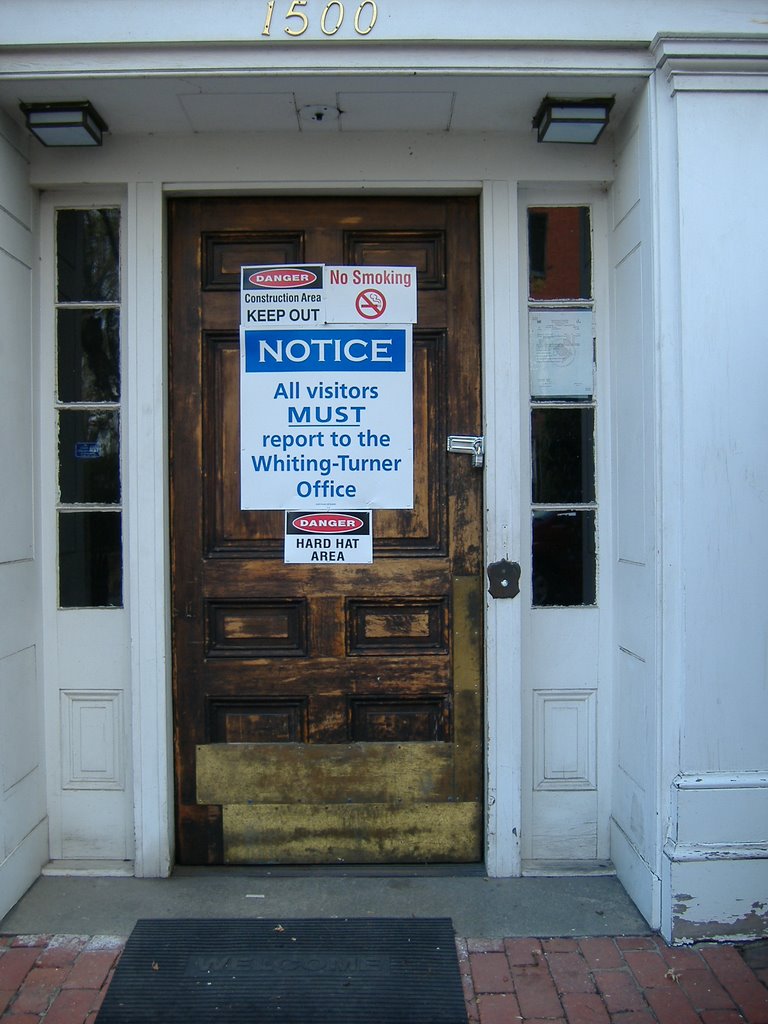
While we "unbar" one gate, we have barred another one. Also pictured here is our front door, now securely fastened with a padlock. The monastery is about to become a "hard hat area." This should produce some interesting photo opportunities when sisters visit the construction site!

As we reflect on the urgent need to begin a renovation, we remember that one year ago today we were ankle deep in a flooded basement at the time that it was announced that His Holiness John Paul II entered into eternal rest. Our tower bell tolled a little late -- later than other bells in the area -- but it rang with gratitude for so great a life and so extraordinary a man. Requiescat in pace!

30 March 2006

In Hoc Signo Vinces

As we prepare for our "destruction" to begin on Monday, we share a few more "moving" moments from our experience:
This is a picture of the hole in the wall where an enormous crucifix hung between the second and third floors on the main stairwell. We are told that the crucifix was built into the wall when the wing was built. It is no surprise, therefore, that it took four moving men nearly two hours to get it out. It was packed in a wooden crate and will return when the construction is complete. (We shall refrain from waxing spiritual about what conclusions we may draw about the crosses in our own lives and the indelible marks they leave!)

In preparation for construction there are now some precautionary construction signs posted on the stairwell. They provide some idea how large the crucifix is.


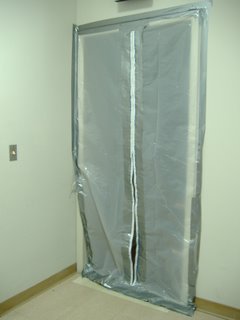
Sisters who have been trekking over to the monastery to clean up a few last items made a discovery today: a zip door. See photo on right. Our project managers installed a nifty zip door between the construction site and the entrance to the Chapel from the monastery side so as to minimize the amount of dust that flies into the Chapel. Brava!
28 March 2006

Healing Words

There is an interesting exchange in today's Gospel. Jesus asks the man sitting near the temple gate if he wants to be healed and Jesus never gets an answer. The man, instead, tells Jesus why he has not been able, for 38 years, to enter the pool and receive healing.

For most of us, there is at least one "thing" in our lives that warrants healing or correcting but which we are reluctant to address. Sometimes we become very comfortable in our patterns of living, working, behaving, etc., and even though we know that we should work on this "thing," it has almost become too comfortable to change. Perhaps we have a co-worker with whom we could work better -- but we don't try. Perhaps there is someone we avoid, whose company we find troublesome. Maybe we make excuses about why we should avoid him or her and why it is okay, even profitable, to do so. And, like the man at the temple gate, when Jesus asks us if we want to be healed of this situation, if we want to change, to be changed, we have a ready reply of why it has not been possible for us to change -- or why it would not be convenient to change. We, too, avoid the question. Sometimes we can be so busy explaining our excuses to ourselves (and to Jesus) that we do not take the time to ask the Lord for the healing grace we need. Acknowledging that we need this grace is, itself, a great grace. Let us ask the Lord for the vision to see where we need to grow and the grace to respond to this invitation.

In a letter to St. Jane de Chantal while she was still Madame de Chantal, St. Francis de Sales wrote the following:

"...now although we may love our abjection [wretchedness] that comes from a fault, still we must not neglect to correct the fault."

26 March 2006

Laetare!

"Rejoice, Jerusalem!"

Today is the fourth Sunday of Lent, erstwhile known as Laetare Sunday. We pause halfway through this solemn season and take a break from our Lenten journey to enjoy some "restrained" rejoicing. A few flowers on the altar, a little extra music at Mass, bright rose vestments and a maybe even a little extra dessert at dinner or supper (if our cook is reading this!)

On the heels of the great Solemnity of the Annunciation, we continue to reflect on our own ability to say, "Yes" to whatever the Lord asks of us day after day. 384 years ago, on the fourth Sunday of Lent, 22 March 1622, St. Francis de Sales concluded his homily with the following words:

"We say that we do not know whether the will to please Him that we now have will remain with us during our whole life. Alas! It is true for there is nothing so weak and changeable as we are. But, nevertheless, let us not be troubled. Let us, rather, frequently lay this good will before Our Lord; let us place it in His hands and He will renew it as often as is necessary that we may have enough for our whole mortal life."

24 March 2006

Tid-bit of History

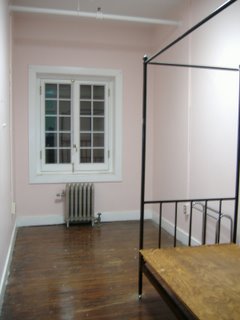
Not to bore our readers with every iota of our moving escapades, but this is a little peek into the dormitory quarters (16ths, perhaps!) of the south wing of the monastery. The P Street wing (south), pictured here, was built in 1856. Most of the iron beds were given to us in the late 1860's when they were no longer needed as hospital beds when the civil war ended.

During the civil war, many of the large buildings in Washington were taken over to be made into temporary hospitals for wounded soldiers. Our monastery was spared thanks to General Winfield Scott, whose daughter was a member of our community.

During the civil war years, we had a number of sisters from the north as well as from the south; when a soldier knocked at the door asking for food, the sister who responded would note the color of his uniform and would call upon a sister whose home was in the north or south, depending upon whether he was wearing blue or gray.

Though our civil war years are only a page in our history, there are many countries which are experiencing this trauma today. Let us pray for a swift end to civil wars and for many good things may come from such suffering and strife.

21 March 2006

Moving Moments

In preparation for our first ever renovation (in 207 years!) we have spent the last few weeks gathering into the hallways all the furniture to be moved; now, it seems a bit odd to see most of the hallways empty, once again. We are lucky enough to be able to leave in place a couple of our statues which would be too heavy to move. "Sister Mary Bubblewrap" (pictured left) strikes again as the Sacred Heart of Jesus receives a protective coat for "safe keeping" (pictured below).

One of our chaplains recently commented that we do not have to go looking for extraordinary challenges this Lent; we've been "exiled" already!

All kidding aside, we are very grateful to have enough nooks and crannies on campus to accommodate all of us so that we may remain together. Thanks to our trusty technology support, we have access to the internet in our various new abodes. And as we begin our time of "exile" we are grateful for the many graces of the Lord, the many kindnesses of our benefactors and friends and countless others who have helped us to move.

"Prayer is a hidden manna, neither known nor valued save by those to whom it is given, and the more we taste it the more does our appetite for it grow." St. Jane de Chantal

20 March 2006

Solemnity of St. Joseph

In addition to being the patron saint of the Universal Church, St. Joseph is also the patron saint of our Holy Father, Pope Benedict XVI. Buon onomastico!

We know very few "facts" about the great saint whose solemnity we celebrate today. The fact that he was the foster father of Jesus, however, is most significant. God entrusted his only son to be the son of Joseph on earth. That alone is reason to be certain that St. Joseph was a virtuous and holy man.

There are many different devotions and customs that accompany the celebration of St. Joseph. He has earned himself the patronage of so many different occupations, situations, countries, dioceses, etc., that it would consume this whole blog post to list them. Among the great variety of "responsibilities" are carpenters and wheelwrights, pregnant women, pioneers, those who are dying as well as those who are selling a house.

Many people have heard of the tradition of burying a statue of St. Joseph up-side down, likely started by St. Teresa of Avila, who encouraged a devotion of St. Joseph to acquire land for new convents. (This is not a mere superstition -- ask someone who has tried it and you may be surprised how effective it is.) This patron saint of a happy death has been buried more times than perhaps anyone else.

As a community, we have been making a perpetual novena to St. Joseph for the special intention of the renovation of our monastery. To learn more about our renovation project, click here or stay tuned for "moving pictures" and tales from our temporary quarters. Here below is the novena we have been using:

O glorious St. Joseph, we most humbly beg of you, by the love and care you had for Jesus and Mary to take our affairs, spiritual and temporal, into your hands. Direct them to the greater glory of God and give us the grace to do and accept His holy will. Amen

18 March 2006

Let us Feast

We do not normally think of Lent as a time of feasting. Today's Gospel of the prodigal son and the "feast" that is proclaimed at the sight of his return give us a small window into how the Lord rejoices when any of us children come home -- so to speak -- and leave behind unvirtuous ways.

In a book entitled "Bathe Seven Times" by Mother Nadine, there are insightful suggestions which complement the traditional notions of feasting and fasting: "Fast from judging others and feast on Jesus in them. This gives us something positive to do. Many people find it hard to fast from judging others. Some actually feed on judging others. It feeds their superiority, it feeds their pride, it feeds their own self-image. We need to take time to look at how we feed ourselves. How do we feed ourselves instead of letting God feed us?"

Indeed, when we refrain from actions which are not life-giving, such as looking in judgment on our neighbors, we open ourselves to be fed by the Lord. The elder son in today's Gospel stood outside the party because he judged not only his prodigal brother but his generous father. When we "starve" these temptations and refuse to give in to them, we may enter the feast which the Lord has prepared.

"We must always judge, as far as possible, in favor of our neighbor. If one action could bear a hundred aspects, we should always consider that which is the most favorable."
St. Francis de Sales