08 February 2006

From the Inside Out

Seventeenth century science did not always produce an accurate knowledge of botany. This led St. Francis de Sales to make use of some very creative -- albeit inaccurate -- similies when comparing the spiritual life to examples found in nature. Perhaps one of the most endearing is that of the almond tree: he posited that if one were to take an almond, carve a word or a letter into it, and plant it in the ground the fruit of that tree would all bear the same emblem. We know from modern studies in biology and botany that this would not work. His point, however, is clear and it is not altogether different from our Lord's message in today's Gospel.

Jesus speaks in response to those who were overly concerned about the Jewish dietary laws. He declared all food clean and explained that "uncleanness" has its source in a person's heart and not in the food he eats. For if we nurture negative thoughts, hurt feelings, angry responses, etc., we are bound to manifest the negative energy in our actions and our words -- even if we ourselves are unaware of it. St. Francis de Sales' botanical example suggests that if we "plant" and nurture kindness in our hearts, then the fruit of our thoughts and feelings will be made manifest in good deeds and kind words. In many ways it is easy to nurture the negative feelings which arise in our hearts because they bring with them great energy; kind feelings or thoughts may not always come naturally, but they do have a way of displacing the negative energy. Let us ask for the grace to sow seeds of kindness in our hearts and for an abundant harvest of good fruit.

"If we remain close to the Savior, meditating on him and giving heed to his words, his actions and his affections we shall gradually, by the help of his grace, learn to speak, to act and will like him."
St. Francis de Sales

06 February 2006

The Glory of the Lord

Several years ago, our faculty read Parker Palmer's The Courage to Teach. One of the striking insights he provides into the vocation of teaching is that "Technique is what you do until the teacher shows up." In one sense, that is what is going on in today's first reading when the Israelites are dedicating the temple. The priests offered hosts of sacrifices -- countless oxen and sheep -- and the glory of the Lord so overwhelmed them that the Levitical priests could no longer carry out their charge. "Technique" is what a teacher practices until he grows into his role as "teacher." Sacrifices and offerings, the 'ministering' of the Levitical priests, were the methods by which the Israelites related to the Lord until the Lord revealed himself in his glory and took possession of the temple.

Sometimes we are reluctant to allow the Lord to move us to a new place in our spiritual lives because we are comfortable where we are. We like our routine: the prayers we say, the times and places we pray, etc. Regularity is good; arguably, it is indispensable in any serious life of prayer. Resistance to growth, however, is not good. It is difficult to discern the difference. When the Lord is inviting us to let go of our "burnt offerings" because he wants to fill us with himself -- much like the cloud that overwhelmed the priests in Solomon's temple -- he is not negating the goodness of our "burnt offerings" or the sincerity of our intentions; he is inviting us to grow. And sometimes growing means letting go of what is comfortable, retiring the "techniques" when the teacher arrives. Anyone who has made the transition from "technique" to "teacher" knows well that the process is a life-giving one -- not only for the teacher but for all those affected. So too, with our prayer lives, it is life-giving for us and for those around us when we allow the Lord to have His way.

04 February 2006

Double-edged Sword

The gifts that we have received from the Lord -- be they spiritual, physical, intellectual, etc., -- are just that, they are gifts. They are ours to cultivate, to use, and to share; they can be used for good works or for less-than-good works. They are, in this sense, double-edged swords.

Today's first reading about the young king Solomon is, perhaps, the quintessential example of this. Most people, when they think of Solomon, are familiar with his wisdom, the understanding heart for which he asked. It is admirable that a young king, when asked what gift of the Lord he would like to have, sought wisdom and understanding. And it is clear that Solomon began to use this gift to serve his people. Solomon's story, unfortunately, has an unhappy ending. His "understanding heart" was not always used to serve the God of Israel; his later years as king were marked with great infidelity as he built temples and shrines to the neighboring gods, worshiped by some of his many wives. Solomon intended to serve Yahweh unreservedly and his request for wisdom and understanding was well-intentioned. He did not, however, persevere is using his gifts for the glory of the God of Israel and the service of His chosen people.

Most of us are not asked in a dream, as was Solomon, which gift we would like to receive from the Lord. We usually discover the gifts we have been given -- often with the help of people and circumstances we encounter at different points in our lives. Our gifts, too, are double-edged swords. We can use them to serve those around us or we can squander them on endeavors which are not pleasing to God. In remembering that our gifts are from the Lord, we are reminded that they are not "ours" to keep; when we ask for the grace use them for the good of those around us, we act with humility. Let us pray for the grace to use wisely the gifts we have been given. Let us pray for the wisdom of Solomon and the fidelity of heart of his father David.

"We must know that there are within us two kinds of gifts, some which are both in us and of us, and others which are in us but not of us. When I say 'of us' I do not mean they do not come from God . . . I mean they seem to be actually of us. Such gifts are health, riches, learning, and the like. Humility prevents us from esteeming ourselves on account of these gifts."
St. Francis de Sales

02 February 2006

Vita Consecrata

On 6 January 1997, the Pope John Paul II declared 2 February to be World Day of Prayer for Consecrated Life. He had a threefold intention in this commemoration. First, that the day -- the Feast of the Presentation of our Lord (Candlemas) -- be a day of thanksgiving for the gift of consecrated life. Secondly, that the people of God grow in knowledge and understanding of consecrated life as a vocation which invites men and women to intensify the baptismal promises that were made for them. Lastly, that this Feast day be a day for consecrated men and women to celebrate together "the marvels which the Lord has accomplished in them."

This year, as we celebrate the Presentation of the Lord and reflect upon the gift of our vocation as daughters of prayer and daughters of the Church, we recognize our newest solemnly professed member, Sister Leonie Therese who made her final profession on 15 October 2005. She is pictured at right receiving the solemn blessing at the hands of Rev. Stephen Spahn, sj.

31 January 2006

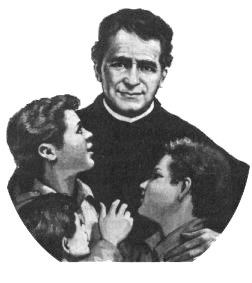
St. John Bosco

Very often, when people hear us speaking of "Salesian Spirituality" they think immediately of St. John Bosco. Indeed, the Salesians of Don Bosco are very much a part of our Salesian family. In 1869 when John Bosco formally established his Oratory, he took St. Francis de Sales as his patron. The gentleness which is so prevalent in St. Francis de Sales' writings and exhortations would serve him well in his work with the boys to whom he ministered.

Perhaps one of the most endearing qualities of St. John Bosco was his great love and enthusiasm for young people -- the boys who attached themselves to him, whom he befriended, who eventually became the first members of his Oratory. His attitude, in the face of youth, was one of great hope. He saw enormous potential in the young men he welcomed into the oratory; he trusted that a little kindness, a little structure, little tough love and his mother's good cooking would nourish their bodies and their souls. And he was right. Among the boys he welcomed into his company was young Dominic Savio. Dominic died of tuberculosis at age 15 and was canonized in 1954. A feather in St. John Bosco's halo!

It is sometimes too easy to see only the externals of a young person: how he acts, talks, walks, etc., -- things that were learned or not learned at home. St. John Bosco was able to see beyond the sometimes-mannerless attitude of the boys who joined his number. He looked at these boys and saw the potential for great holiness. Let us ask his intercession for all those who strive to bring the Gospel message to our young people today.

To read more about St. John Bosco, click here.

29 January 2006

Unclean Spirits

We don't like to talk about unclean spirits -- and with good reason. It is striking -- and even jarring -- how the unclean spirits in today's Gospel know who Jesus is. The evil one knows a good thing when he sees it. And the evil one knows well who Jesus is.

It should come as no surprise to us that the most modest of Lenten resolutions have a way of seeming to be Herculean tasks by the second or third week of Lent -- if not before. At first a new endeavor seems manageable and easy but as time passes, the resolution becomes harder and, very often, our motivation seems to wane. Whenever we set our hearts to follow the Lord more closely and take deliberate steps to do so, it attracts the attention of the evil one. When we make a resolution to be kind to someone whom we find troublesome or when we arrange our day to make a little more time for prayer or spiritual reading we open ourselves to the grace of God -- and, we attract the attention of the evil one. Very often, the discouragement we feel, the lack of motivation to persevere, etc., are all manifestations of the evil one trying to keep us from growing in holiness. In the same way that the "unclean spirit" in today's Gospel recognized Jesus, it recognizes our desire for Jesus when we set our hearts and our minds to grow closer to Him.

We cannot, of ourselves, overcome temptations of any kind. Only the Lord can steel our hearts against evil, "unclean" spirits. We can only remain as calm and unaffected as possible, trusting in the Lord's care for us. (Much easier said than done!) St. Francis de Sales, in a letter to St. Jane de Chantal had the following to say about such temptations:

"And are we to get anxious about it and change our attitude? Oh, no, never! It is the devil who is roaming around our soul, spreading confusion and prying to see whether he cannot find some door open somewhere. . . . Let him kick his heels outside, and keep all the doors and windows tightly shut; he will get tired of it in the end, and if he does not, God will make him raise the siege."

27 January 2006

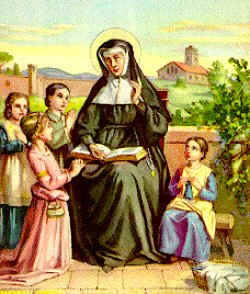
St. Angela Merici

Today's feast of St. Angela Merici is technically an optional memorial for most people. It is, however, no mere commemoration for those who teach -- and teach girls, at that. One homilist, a number of years ago, gave us a lengthy description of St. Angela's life and ministry and at the end, he leaned into the microphone and said, "...and truly, she is the patron of all who teach little girls."

St. Angela was a woman ahead of her time. She had a vision which was unprecedented and untested. In 1535, when she founded the "Company of St. Ursula" (the patron saint of learning in Europe at the time), she sent these women back into the world, into their families, into society, to change the world from the inside out. The "company" which she founded on 25 November 1535 became formally incorporated as a religious order known today as the Ursulines. Click here to read more about the Ursulines

Today, in addition to the Ursuline sisters who live out her legacy in the world today, we have many men and women who live lives similar to what St. Angela originally envisioned, changing the world from the inside out. Some of these men and women live as members of secular institutes. In her day there was no such canonical distinction. She was a visionary well ahead of her time.

Her message to those of us to teach -- and all who work with the young -- is as applicable today as when she wrote it, over 400 years ago. Speaking of the young charges entrusted to her early sisters she writes, " . . . it will be impossible for you not to have each and every one engraved upon your memory and in your mind. I beg you, strive to draw them by love, modesty, charity and not by pride and harshness." A timeless message for all messengers of God's word to the young!

26 January 2006

Ask for Nothing Refuse Nothing

St. Francis de Sales gave an entire conference to our early Mothers and Sisters on this very topic. Among the more commonly quoted selections is the following:

"I say that we must neither ask anything nor refuse anything, but leave ourselves absolutely in the arms of divine Providence, without busying ourselves with any desires, except to will what God wills for us."

Nearly two months ago, when we began this blog, we were hoping to be able to share some spiritual reflections, some of our Holy Founders' writings and a provide a little window into our community life for people who know us or who are interested in learning more about Salesian Spirituality. Although we had some reservations about entering the prodigiously growing blogging-world, we thought that St. Francis de Sales would approve of using the means available to share the Gospel message with those whom we might not be able to reach by ordinary means. It has proven, thus far, to be an interesting adventure and one which we are grateful to have begun.

The last few days we received an unusual number of visits and it was our "Big Sisters" in the blogging world, the Dominicans of Summit, NJ, who solved the mystery for us -- pointing out Mr. Scheske's article in the National Catholic Register.

Mr. Scheske highlights blogs by sisters and nuns (and a Dominican brother) and providers readers with a web address to locate his recommendations. Other blogs mentioned in his article are the following. Click to visit them: Dominicans of Summit, NJ, NunBlog, Living Christ, Communicating Christ, and Fra Lawrence.

And so, it is in the spirit of asking for nothing and refusing nothing that we gratefully acknowledge this well-written "guide" to convents and monasteries in Mr. Scheske's column.

24 January 2006

Happy Solemnity!

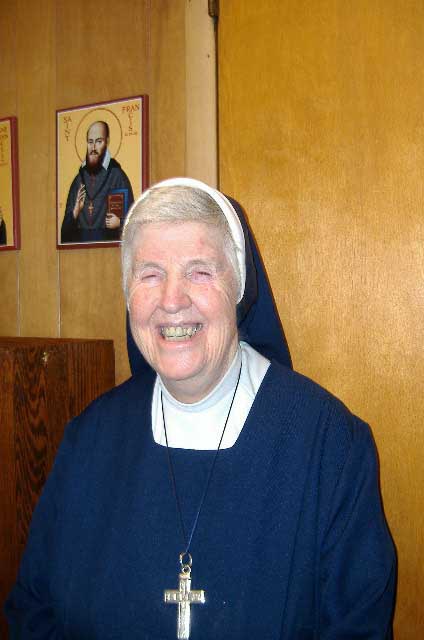
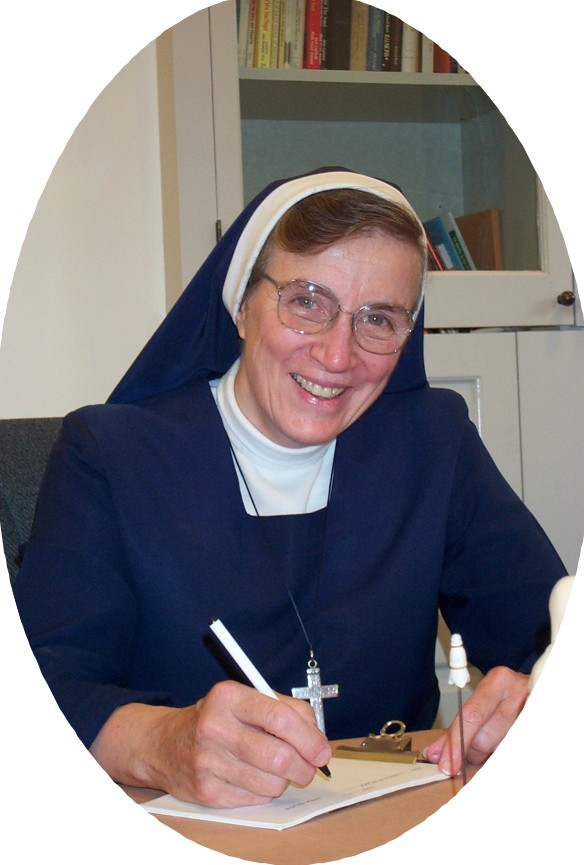
Every year on the Solemnity of St. Francis de Sales we sing "Happy Feast Day" to our very own Sister Mary de Sales (pictured left, with an icon of St. Francis de Sales behind her.) This is no ordinary rendition of "Happy Feast Day," however, because Sister Mary de Sales adds a little extra twist: in the momentary pause after each line of "Happy Feast Day to you..." she pipes in and sings, "and you and you and you and you and you..." as she points to each of us standing around her.

Today, we thought it might be nice to share a thought from both Sister Mary de Sales and Saint Francis de Sales. If she had to have a favorite quotation from her namesake, Sister is fond of repeating, "A sad saint is a sorry saint!" And, indeed, she is even more fond of living it. Those of us who live with her know that there are few situations which can bring down Sister's spirits. Among the many "hats" that she has worn, she has been our faithful "Sister Mary Maintenance" for many years. Be it a middle-of-the-night fire alarm, a leaky pipe, a falling ceiling, a broken water main, or a flooded basement, Sister Mary de Sales greets every disaster as an opportunity. And when it is over, she smiles and says, "Good show!" Would that we all were so gracious and joyful at life's little -- and not so little -- surprises.

It seems fitting, on this patronal feast, to quote a selection from St. Francis de Sales' treatise from which the name of this blog is derived: Treatise on the Love of God Book XII, chapter XIII.

"Live, Jesus, live, your death upon the tree
Shows all your boundless love for me!
Mount Calvary is the mount of lovers. All love that does not take its origin from the Savior's passion is foolish and perilous. Unhappy is death without the Savior's love; unhappy is love without the Savior's death. . . . all is either eternal death or eternal love. All Christian wisdom consists in choosing rightly. . . . . That we may live in your eternal love, O Savior of our Souls, we eternally sing, 'Live Jesus! Jesus, I love! Live, Jesus whom I love! Jesus I love, Jesus who lives and reigns forever and ever. Amen.'"

Our Sister Mary Berchmans likes to remark that the teaching of St. Francis de Sales, as embodied in Salesian Spirituality today is "inspired common sense." We celebrate today a man whose gentleness and kindness won the hearts of many and whose down-to-earth common-sense approach to growing in holiness won heaven many souls. Dieu soit beni.!

23 January 2006

The Fate of a Nation

One of the founding fathers of our country quipped that the fate of a nation depends upon the education of its youth. Indeed, this is true. And it is even more true today than when it was so declared.

In 2004 at one of the town-hall style presidential debates, president George Bush was asked, very directly, for his views on abortion. His answer spoke of the inviolable dignity of life and seemed to hint at an undeclared desire to change the supreme court's 1973 ruling, while admitting that it was beyond his immediate power to do so. He seemed to suggest, however, that it would be a great day for our nation if abortion were to be declared illegal.

It would be a great feat to see the reversal of Roe vs. Wade. It would, however, be a greater victory to see an even more powerful conversion of mind and heart. Would it not be a great day if abortion clinics closed their doors not on account of a supreme court ruling but, rather, on account of a nation of young adults who refuse to patronize abortion clinics? To educate today's young people about the dignity of human life in such a profound way that it impacts the decisions they make is an extraordinarily important part of evangelizing and proclaiming the Gospel of Life.

What a beautiful day it would be if abortion clinics were put out of business because a nation's youth were so well educated. Since abortion was legalized in 1973 there have been over 46 million abortions performed in this country. In this case, the fate of the nation depends -- quite literally--upon the education of its youth. Oremus!

22 January 2006

Good Works and God's Will

For many of us, the thought of leaving a work unfinished is intolerable or, at least uncomfortable. Today's readings cast light on the (albeit admirable) attitude of "I need to finish what I started." In the first reading, Jonah prophesies destruction for the city of Ninevah if the people do not repent. They listen; they repent; God spares them destruction. What we do not hear in the first reading is how Jonah reacts to God's mercy. Jonah is bitter and angry that God did not carry out the destruction he planned. In Jonah's mind, this was a work left "unfinished." St. Francis de Sales suggests that "Jonah did God's will in proclaiming the destruction of Ninevah, but he mingled his own interests and will with those of God."

The disciples in today's Gospel serve as a contrast to Jonah. They do not mix their will and their interests with the Lord's will. When Jesus asks them to follow him they abandon their nets without hesitation. The four fisherman left their "day jobs" --so to speak-- to become Jesus' disciples. This willingness to respond to the Lord's will is a great mark of faithful disciple. St. Francis de Sales has much to say about situations where we must leave off one good work for another: "How blessed are such souls, bold and strong in undertakings that God proposes to them and yet ready and humble to give them up when God so disposes!" He also describes the mark of a perfect disciple, one who is ready "to leave of doing some good work when to do so pleases God, and to return after going halfway when it is so ordained by God's will, which is our guide."

Situations where we are challenged to leave one "good work" for another one can be complicated by the question, "is this really God's will?" In addition to the discomfort of leaving one project or job, etc., unfinished, we are often uncertain about whether it is really God's will. This is where we are asked to trust that the Lord does not abandon us -- just as he did not abandon his faithful disciples, to whom he sent the Holy Spirit. Let us pray, in these moments of discernment, for the light of the Holy Spirit so that we may know and carry out his holy will.

20 January 2006

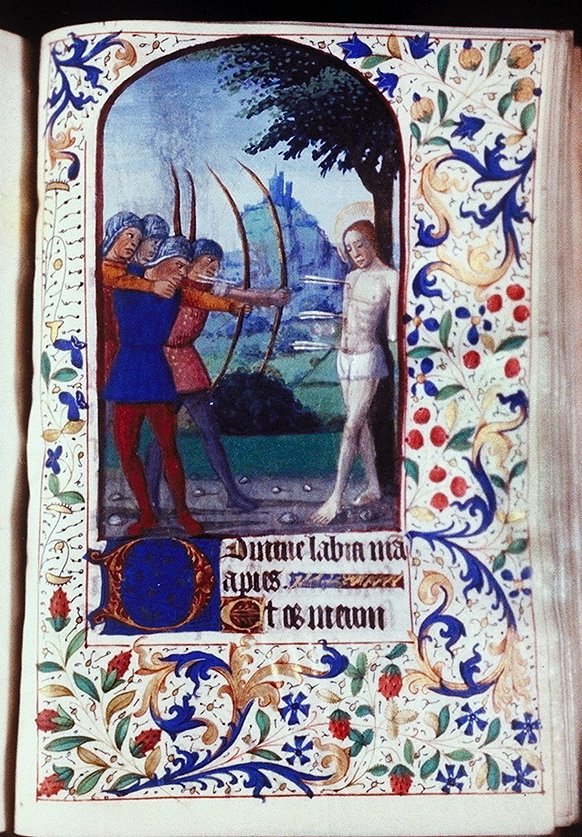
Patron Saint of Athletes

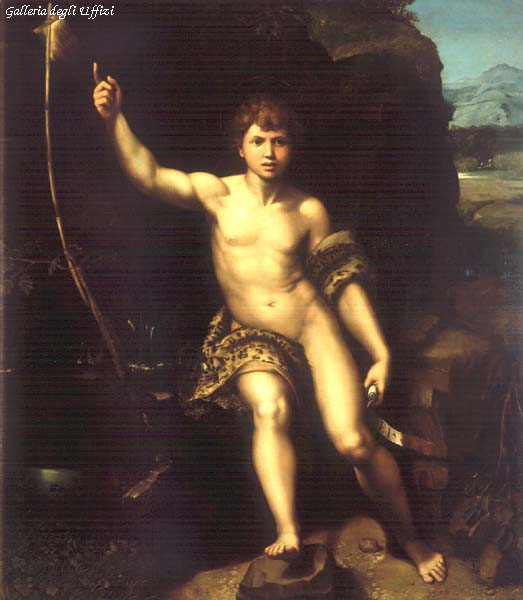
We know very little about the legendary St. Sebastian, martyred in the late third century. St. Sebastian is often depicted as a young man tied to a tree and pierced with arrows. Legend has it that he survived the painful encounter and was later ordered to be beaten to death. Among the many other occupations, trades, and causes placed under his care is that of the athlete.

For many, sports and athletics are a source of refreshment and a healthy outlet for energy. St. Francis de Sales believed if a person attended a tennis match -- even if he had no vested interest in either competitor -- he would, quite naturally, begin to favor one player more than the other. So natural, indeed, is the inclination for sports. As with all things, St. Francis de Sales believed that, in moderation, such a recreation of playing or watching sports was most healthful for a person.
One of our sisters who was a long-distance runner is fond of saying that running is like praying, "it makes my heart bigger" she quips. We haven't seen any conclusive evidence yet, but we'll take her word for it!

"Air and exercise, cheerful games, music, field sports and the like are such innocent amusements that they only require to be used with ordinary discretion. . . . Those games which exercise mental or bodily activity or skill, such as bowling, chess, etc., are praiseworthy amusements."
St. Francis de Sales

18 January 2006

The Battle is the Lord's

As far as bloody biblical battles go, the David and Goliath account is a charming one. David says something very profound during their encounter. Young people today would call the verbal exchange between the two "trash talk," as each party described how he will annihilate the other. After this exchange, David tells Goliath that "the battle is the Lord's." This was hardly "trash talk," it was a profound spiritual truth from which we can all learn. David went into battle without armor, with only a slingshot and five stones; today, that might be the equivalent of going into a rapid open-fire battle with a bee-bee gun. By all human accounts, we should be reading about David's demise. The battle, however, was the Lord's and David put his trust in the Lord.

Although most of us do not have to encounter nine foot titans in our daily lives, we may sometimes feel as ill-equipped as David must have appeared. Let us follow David's example and trust that our daily "battles" also belong to the Lord. Let us trust in His loving providence for us.

"Oh, how good it is to see the servants of God gain their livelihood as the Apostles did by the work of their hands, and to have no other tomorrow than that of His Providence!"
St. Jane de Chantal

16 January 2006

The Holy Alarm Clock

In today's first reading, Samuel berates Saul for his disobedience to the Lord; he declares that obedience is more pleasing to Yahweh than sacrifices. For some reason, it seems that the notion of "obedience" is odious to our contemporary American culture. A canon lawyer/professor who is a dear friend of our community has a wonderful explanation of this underappreciated virtue. She tells her students that all Christians are called to be obedient -- even if they have not taken a vow of obedience. She continues to challenge their thinking by explaining that all of us are obedient whether we acknowledge it or not; for most of us, she observes, obedience begins with the alarm clock, first thing in the morning.

Obedience comes to us from the Latin verb "to hear/to listen." Whether it be the strident sound of an alarm clock, the request of a neighbor, the instructions of our employer or co-worker, an assignment from our superior, etc., obedience is a matter of listening which transcends the pejorative connotation of "being commanded." Being obedient is a choice -- a choice we make in freedom. We choose to bend our ears and listen to what is asked (or suggested) and then we bend our hearts to respond. Let us ask the Lord for the grace to bend our ears and our hearts to the needs of those around us.

"Here is the general rule of obedience, and I write it in capital letters:
ALL MUST BE DONE THROUGH LOVE, NOTHING THROUGH CONSTRAINT."
St. Francis de Sales
14 January 2006

The Response of Levi

So often we hear today's Gospel referred to as "The Call of Levi" (or "Matthew"). Indeed, the Gospel is about a very counter-cultural move on Jesus' part: the invitation for a public sinner to join his band of followers. What is equally striking, however, is Levi's response. The author of Mark's Gospel does have a flair for brevity, but the description is stunning nonetheless: Levi got up and followed Jesus. Some of us, perhaps, might have been tempted to have a conversation about the matter before we got up to follow Jesus: "Sure, I'd be happy to follow you, but where are we going? . . . how long is this going to take? Should I take some money with me?" How often do we, in our own lives, play out some of these conversations when we are invited to something new? Perhaps it is a new project, a new job, a new assignment; perhaps it is not something physical but something "spiritually new" to which the Lord is inviting us -- a new way of praying, a new way of looking at someone or something, etc. Let us follow the example of Levi and follow the Lord's invitation unhesitatingly, trusting that he will provide all that we need to be His faithful followers.

12 January 2006

Ordinary Time

For some, the return to ordinary time is a welcome return to a routine where things are predictable and comfortable. For others it is a challenge to return to the "ordinary" liturgical season. The grace of perseverance is a worthy gift for which to ask during this time between Christmas and Lent. Making the "ordinary" holy by our attention and care is no small work. Let us pray for the grace to persevere in all that we do: in our work, in our prayer, in whatever our our family obligations may be, in the resolutions we have made, etc.

A pearl of wisdom from St. Francis about this great grace:

"The enemy often tries to make us attempt and start many projects so that we will be overwhelmed with too many tasks, and therefore achieve nothing. . . Sometimes he even suggests the wish to undertake some excellent work . . . He does not care how many beginnings we make so long as nothing is finished. Among Christians, it is not so much the beginning as the end that counts."

10 January 2006

Poet in Residence

Among the many charming traditions of our Epiphany celebration, the toasts, poems and spontaneous jingles are a favorite. We are fortunate to have several on-the-spot poets who can crank out a rhyme or two between salad and dessert. We are also blessed, however, to have our very own poet/artist, Sr. Mary Agnes. No jubilee or feastday passes without a poem from Sister's pen and a bird-on-canvas from her pallate. Here is a recent gem:

God's love is a treasure of finest gold
Which flows in waves upon my soul
It is my crown, my joy to hold
It changes me and makes me whole.
Yet there are days when I feel cold
My prayers and sighs remain untold
No crown is there no joy to hold
"Where is my Love," not far, I'm told
"My child," he says be not upset,
Let naught on earth cause you to fret
My love is gift to all, but yet
Not all respond, and soon forget
So many souls out there adrift,
Deprived, bereaved and so bereft
Be humble, holy and uplift
These souls, by prayer and my great Gift.

08 January 2006

Three Kings and a Queen

Most people correctly associate the Solemnity of the Epiphany with the three magi -- or kings -- who came from the east. In our Order, however, we have one more "person" who figures prominently at the Epiphany: the queen. In a time-tried French custom, we bury a bean (usually a jelly bean) in fruit cake on Epiphany night and, much like the traditional Mardi Gras celebrations, we draw pieces of the cake and wait for everyone to take a piece before we peek under our cake. The sister who draws the bean (the "Queen of the Bean") is our queen for the year. The queen has a few special privileges and responsibilities and she is usually inundated with requests from her "subjects." Once this year's queen has been selected (and has adjusted to her royal responsibilities) we shall feature her in a future blog post!

On a more serious note, the Epiphany is an invitation for all of us to extend the Christmas season, in our hearts, as we venture into Ordinary Time. It is a reminder for us to seek always the newborn king -- in all that we do. As daily life becomes "ordinary" again and work, school, home, etc., provide comfortable routines, let us remember that the journey to Bethlehem is an everyday affair for the pilgrim Church on earth. Several years ago, a company put out a button that said "Bethlehem or Bust!" What a wonderful motto for our everyday life.

06 January 2006

Cousin Andre

Alfred Bessette was born to Isaac Bessette and Clothilde (Foisy) Bessette on 10 August 1845. This fragile young baby, baptized just moments after his birth was to become Blessed Andre Bessette, known today as the "miracle man of Montreal."

We have a special place in our hearts for Blessed Andre because two of his cousins were members of our community. Sister Mary Ambrose Foisy and Sister Mary Augustine Foisy were blood sisters who were members of our community in the early-mid 20th Century. We have little data in our archives about this relationship, but as we can best figure, their father and Blessed Andre's mother were siblings. The Foisy sisters spoke of having lived with their cousin, Alfred, who was orphaned at age 12. And so, in our hearts, we claim Blessed Andre as our holy cousin.

Among his endearing qualities, perhaps his extraordinary perseverance and his sense of humor (and humility!) and are most notable. When Andre was about to be professed, there were some concerns about the delicacy of his health. He begged the bishop to intervene for him and allow him to make his profession. The community admitted him to profession and assigned him to be porter at Notre Dame College -- a job he kept for forty years. Years later, he would remark, "At the end of my novitiate, my superiors showed me the door and I stayed there for forty years -- without leaving."

We are proud to count "cousin Andre" among our extended family. He is a model of humility and perseverance who showed great trust in the Lord's care for him.

To read more about Blessed Andre Bessette click here.

05 January 2006

Old Faithful

On Tuesday, 4 January, our faithful guard dog "emeritus" went home to the eternal hunting ground. Tipton arrived at the monastery in 1993, shortly after a fire devastated our school. When he arrived, he was about 2 or 3 years old and we learned that he was badly abused as a young dog.

For nearly a decade, Tipton was a stellar watchdog whose fierce bark scared away many an unsuspecting visitor and kept the monastery garden free of squirrels and possums. Despite his bark, Tip was a gentle dog who showed neither aggression nor anger -- even in the face of the overly-playful puppy Nicholas, who arrived in 2002 to learn the art of being a monastery guard dog.

Many people agree that animals can teach us a few things about being human. Tipton taught us quite a few lessons during his time with us. Among them, perhaps the most poignant was his disposition. As a dog who suffered abuse, Tipton never manifested aggression. He was a fine hunter and had keen senses, but he was gentle and deliberate in action. Very late one Saturday night, when an inebriated local college student climbed the cloister wall into the monastery garden, Tipton's barking scared the boy so much that he climbed up to the third floor of the monastery porch in an attempt to escape from our faithful guardian. Tip knew his job was to alert the sisters to danger -- never more and never less. He was a faithful and noble creature whose last years of "retirement" were happy and comfortable, thanks to his faithful caretaker, Sr. Immaculata (pictured with him above.)

Would that we could learn from his example: having suffered violence and injustice, he did not perpetuate what he suffered; instead, it made him a gentle creature.

03 January 2006

The Shepherd and The Lamb

In today's Gospel we hear, once again, the familiar voice of St. John the Baptist pointing us toward Christ. This time, he calls Jesus by that title which we hear every time Mass is celebrated, the Lamb of God. While this is a very familiar image for us today, it was, most likely, a confusing -- if not shocking -- appellation for the people of Jesus' day. It was not at all uncommon for the kings or rulers of the middle east to style themselves as shepherds, implying that their subjects were the sheep and lambs. This title hints at the fact that Jesus himself would be a sacrificial offering, as lambs often were. In addition, however, by calling himself a "Lamb" Jesus allied himself with the people, the subjects, those who were victims of the often-tyrannical local leaders of his day.

We are also familiar with another great title from St. John's Gospel, the Good Shepherd. In addition to being the Lamb -- one with the people whom he came to save, Jesus was also the gentle and loving shepherd who looks out for those who stray and leads all to be refreshed by the psalmist's restful waters.

As we hear today's Gospel, let us be "shocked" by this radical title for Jesus. Let us, with St. John the Baptist, give witness to him by our words and our deeds and, in doing so, may we lead others to join his flock.

"To prepare well for our Savior's coming, we must go to the school of the glorious St. John the Baptist. . . . if he receives us, among his disciples, he will surely place us in the hands of our Savior."
St. Francis de Sales

01 January 2006

Mater Dei

As we honor Mary as the Mother of God, today, we also begin a new calendar year. In one way it seems odd to have a new year in the dead of winter. For the celebration of "new year" in most cultures was a time to mark new growth and vegetation in nature. The ancient Romans were on to something when they celebrated the new year in March. For us who live in the northern hemisphere, it would seem more fitting to celebrate "new life" in March or April, when spring is beginning.

Mary, the Mother of God, can, perhaps, help "redeem" this lost celebration for us. When Mary said, "yes" to the angel she set right a long history of "wrongs" -- so to speak. For millennia, since creation and the fall, it seems that the Lord has been in search of one who would say "yes" to Him in so perfect a manner. We have a rich tradition of men and women in the Old Testament, prophets and preachers, priests and kings, who faithfully carried out the Lord's will. But Mary was different. She was conceived without sin and so disposed to respond so fully, so unhesitatingly, so generously, when asked to be the Mother of God. Mary's "yes" gave new life: physically, in the person of Jesus Christ and spiritually, in the example that she leaves for us, her children. So as we mark the beginning of a new year -- though there be no blossoms outside our windows -- let us follow Mary's example of saying "yes" to all that the Lord asks of us and let us nurture new life, in the garden of our hearts, by imitating her "yes."

"The greatest title that can be given to the Holy Virgin is to name her Mother of God."
St. Francis de Sales

30 December 2005

Holy Family

Every seven years or so we have the longest Advent possible and, as a result, we have the shortest possible Christmastide. When this happens, today's great Feast of the Holy Family, which is normally celebrated on the Sunday following Christmas, is celebrated on 30 December -- an ironic, but fitting fate for the Feast of a family, who themselves, did a great deal of unexpected moving.

Just as Mary's and Joseph's life with Jesus -- from the very little we know about it -- included many unexpected turns of events, so our life with Jesus is no different. Simeon, in today's Gospel, tells Mary that her heart will be pierced with a sword, so that the hearts of many may be laid bare. This prophecy hints at all that she will suffer, in accompanying Jesus during his life. For all of us, however, this is our vocation as Christians. When we accept the invitation to follow Christ, we accept the trials and tribulations of the heart that inevitably follow. This double edged sword that pierced Mary's heart -- and that pierces ours, if we permit it -- does not leave us wounded forever; rather, it is a tangible reminder of the Lord's promise that his suffering has redeemed our suffering.

As we celebrate and honor the Holy Family of Jesus, Mary and Joseph, we pray especially for those whose families are most acutely affected by suffering. Let us be mindful, as well, of the sufferings in our own families, communities, parishes, etc. As we share in the sufferings of Christ, as we are touched by the sword that pierced Mary, let us long for a share in his healing grace, a foretaste of the glory to be revealed.

"We must consider the great peace and serenity of the Blessed Virgin and St. Joseph shown in their constancy amid all the unexpected events which befell them. Now consider if we are justified in being surprised and troubled when we meet with similar accidents in the house of God (in our religion) seeing that they occurred even in the family of the Lord."
St. Francis de Sales
28 December 2005

Happy Anniversary

Happy Anniversary, Bishop Coakley! The Most Rev'd Paul S. Coakley was ordained to the Episcopate on 28 December 2004 and named the tenth Bishop of Salina, Kansas.

Bishop Coakley first visited our monastery as a child, in the arms of his mother Mary, the blood sister of our own Sister Mary Stanislaus. Later, as a seminarian at Mount St. Mary's in Emmitsburg, he visited often, bringing with him many fellow seminarians in tow. After further studies and some years in pastoral ministry, he was asked to return to Mount St. Mary's as a spiritual director. Once more, we were so blessed to have him near us and this time, he was one of our chaplains coming, as often as he was able, to celebrate Mass for the community.

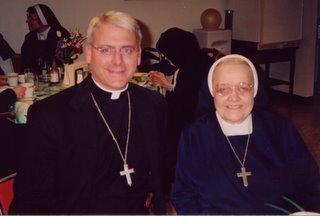
On 13 November 2005, Bishop Coakley received the cross of affiliation from our monastery, entitling him to all the spiritual benefits of a member of our Order. Pictured below is Bishop Coakley, sporting his Visitation cross, sitting with his aunt, Sister Mary Stanislaus.

To read more about Bishop Coakley, click here.

27 December 2005

St. John, the beloved

Today the Church celebrates the Feast of St. John, the beloved disciple who is credited with writing the fourth Gospel, esteemed for his fidelity in staying at the foot of the cross, and often depicted as laying his head on the heart of the Lord. In a reflection prepared for 6 January 1941 St. Teresa Benedicta of the Cross (Edith Stein) suggests that "We can learn from John how precious human souls are to the Divine Heart and how we can give him no greater joy than by being willing instruments on his shepherding way."

Surely St. John would know well what is pleasing to the Divine Heart. It was he who recorded Jesus' testimony about being the Good Shepherd. It was he who, upon seeing the shroud on the floor of the empty tomb, believed -- and trusted that the life of the good shepherd was not to end on a cross and in a borrowed grave.

As we celebrate this great disciple and evangelist, we can pray for the grace to imitate his example of being a willing instrument for the Good Shepherd. In the moments where we know well what is pleasing to God, let us act promptly and cheerfully. In moments where we have little control over circumstances which befall us -- be they troublesome or pleasing -- let us accept them for love of God alone. Our quiet acceptance is precious gift for the newborn child.

"We can receive the outcome of heaven's good pleasure with a most unalloyed tranquility of will that wills nothing whatsoever, but acquiesces absolutely in all that God wills to be done in us, on us or by us."
St. Francis de Sales
25 December 2005

One Little Iota

Can one little iota really make a big difference? Yes. In fact, it nearly ruined Christmas -- before Christmas was even a formal liturgical celebration.

In 325 at the Council of Niacea, the infamous Arian heresy was disputed and condemned. Arius, as well-intentioned as he was misled, had proposed that Jesus was neither God nor man; he was, rather, somewhere in between, something akin to the demi-gods of the classical world. Arius used the term 'omoiousios to describe this. The prefix 'omoi, is from a Greek adjective meaning "like" or "similar to" and ousios is from the participle of the Greek verb "to be." Literally, he asserted that Jesus was "similar in being, in substance" to God. The council fathers, insisting that Jesus is truly God, preferred the term 'omoousios, simply deleting the iota from Arius' term. This word is formed from another Greek adjective, 'omos which means "the same as." (Please note that this is not the same root as Latin word for man, "homo, hominis" though when transliterated into English, it looks very similar).

So why all the fuss about technical, headache-provoking, theological terms on Christmas day? Had it not been for the insight and perseverance of the fathers of the Council of Niacea, we would not be celebrating the Incarnation. One little iota could have obscured this precious truth of our faith; this most sacred of mysteries would have been lost in the annals of Church history. So as we kneel before the creche today, let us whisper a prayer of thanksgiving for those heroic defenders of our faith who kept alive the legacy of this great mystery amid much confusion and controversy.

A happy and holy Christmas from
the Sisters of the Visitation of Georgetown.

"When the magi kissed the feet of Jesus, they kissed the feet of God."
St. Francis de Sales
24 December 2005

O Virgin of Virgins

O Virgo Virginum quomodo fiet istud: quia nec primam similem visa es nec habere sequentem: filiae hierusalem quid me admiraninimi divinum est mysterium hoc quod cernitis.
---
O Virgin of Virgins, how shall this be? For neither before was there any like you nor will there be any to follow after: daughters of Jerusalem, why marvel at me? That which you believe is a divine mystery.

Yes, this is the disputed "eighth" O Antiphon, not currently in use in the Divine Office. Some scholars believe that it was originally included in a larger set of "O Antiphons" of which we currently only have and use seven. Other scholars argue that, despite the earliest records of the O Antiphons including O Virgo, due to the sacredness of the number seven, this antiphon is not indigenous to the seven that come down to us today. Perhaps the two most striking differences between this antiphon and the other seven are that this one is addressed to Mary and, due to this, it lacks the "Veni" clause.

Be it original or fabricated, this is a beautiful text. It points toward Our Lady at the very moment of the Incarnation and, at the same time, it points away from her -- "why marvel at me?" -- and it points toward him who is about to be born. Yes, that which we behold, which Mary carried in her womb, is a divine mystery. It is this for which we have been preparing our hearts and our homes: this grand mystery of God made man. Let him find us ready when he comes. Let him find in our hearts a place worthily prepared for him. And let us welcome anew this divine mystery, which Mary and Joseph were privileged to hold in their arms.

23 December 2005

O Emmanuel

O Emmanuel, Rex et legifer noster, expectatio gentium, et Salvator earum: Veni ad salvandum nos Domine Deus noster.
---
O Emmanuel, our King and law-giver, the desire of the nations and their Savior: come and save us Lord our God.

The six previous antiphons all herald the confession that this final antiphon makes: it calls Christ "Emmanuel" -- God with us. The Lord our God, is united with the Messiah who is called Emmanuel; the incarnation is pronounced in this antiphon. The title Emmanuel echoes the exchange between Ahaz and Yahweh: "Listen now, House of David: . . . The Lord himself, therefore, will give you a sign. It is this: the maiden is with child and will soon give birth to a son whom she will call Immanuel" (Is 7:13, 14). The title Emmanuel draws the connection to the royal line of David; it is but one of the four titles used in this antiphon. This sequence of appellations seems to come from Isaiah's description of what it will be like to be in the presence of Yahweh: "Yahweh is our judge, Yahweh is our lawgiver, Yahweh is our King and our Savior" (32:22). This list of titles encompasses the various nuances of the Old Testament symbols and their new, deeper, meaning in light of the Messiah's birth.

As the Church sings this last of the Great O Antiphons at Vespers, a time of fullness, we wait eagerly for the fulfillment of the great promises made in these antiphons. The lighting of the evening lamp, before Vespers, signals that the sun is soon to set; the signing of this last Great Antiphon signals that the Son is soon to rise. Let us wait in quiet stillness for the coming of the newborn King. Veni Emmanuel!

22 December 2005

O Rex Gentium

O Rex Gentium, et desideratus earum, lapisque angularis, qui facis utraque unum: Veni, et salve hominem, quem de limo formasti.
---
O King of the Nations, and their desire, the cornerstone, who makes both to be one: Come and save mankind, whom you formed from clay.

Christ is he whom the nations desire; he is no longer exclusive to the people of Israel and their heirs. This notion is continued in the relative clause which follows; it is he who makes both to be one. This is the only phrase in an O Antiphon which is traced exclusively to the New Testament; it appears to be a reference to St. Paul's letter to the Ephesians where he describes the reconciliation between the Jews and the Gentiles. That Christ came to bring salvation to all, not merely the people of Israel and their descendants, is indicated in this antiphon. Just as the previous antiphons show the clear relationship between the Old Testament covenant and Christ's fulfillment of that promise, this antiphon carries the fulfillment a step further as it is extended to those traditionally excluded from the promises made to the Israelites and their heirs.

As we intone this antiphon we draw ever closer to the manger in Bethlehem. Fellow travelers along the road ask us where we are going and we reply that the King awaits us. He does. The real question is, perhaps, do we believe that he is our King? Do we act as though he is the King of our hearts? Let us, these last days of Advent, make known that the desire of the nations is indeed the desire of our hearts. Let our actions and our words speak of him and let us invite others to journey with us as we approach the newborn King.

21 December 2005

O Oriens

O Oriens, splendor lucis aeternae et sol iustitiae: Veni, et illumina sedentes in tenebris et umbra mortis.
---
O Rising brightness of everlasting light and Sun of justice: come and enlighten those sitting in darkness and in the shadow of death.

As the calendar is currently arranged, this fifth antiphon is sung on the shortest day of the year. The rising sun, the Oriens, from the Latin verb orior is translated as the "Branch" in the book of Zechariah, which the angel of the Lord announces (3:12). The title Oriens as well as the two which follow, everlasting light and Sun of justice, all link Christ, present with God at the beginning of the world, to the sun which came to be on the fourth day of creation. This same light is experienced as the fulfillment of what Yahweh promised to the people of Israel; for Zechariah, father of St. John the Baptist, announces that God, "from on high will bring the rising Sun to visit us, to give light to those who live in darkness and the shadow of death" (Lk1:78-9).

Nature's brightest star is but a mere indication of the brightness of the light of Christ. To the people of Israel, the Branch, the one who rises from the stump of Jesse, is the longed-for-Messiah; to those preparing to celebrate the Incarnation of the second person of the Most Holy Trinity, the Branch is the Messiah who has come and who comes again each year, in the hearts of Christians. As we prepare our hearts to welcome the Lord, let us clothe ourselves in the light which flows from the Sun of justice. Let us seek justice in all our relationships. Justice is what we owe to one another; some relationships are equal -- marriage, siblings, peers, co-workers, etc.; in other relationships it is proper that it be "unequal" -- parents and children, teachers and students, employer and employees, etc. When we examine our relationships, we may find that we "owe" a little more to some people than we ordinarily give. Advent is a wonderful time to ask for the grace to be more generous in our relationships with one another. Let us thank the Lord for the different relationships in our lives and let us strive to be true sons and daughters of the Sun of justice. Come, Lord Jesus.

20 December 2005

O Clavis David

O Clavis David, et sceptrum domus Israel: qui aperis et nemo claudit; claudis et nemo aperit: Veni et educ vinctum de domo carceris sedentem in tenebris et umbra mortis.
---
O Key of David, and scepter of the house of Israel: who opens and none shall close, closes and none shall open: Come and lead out from the prison house the one in chains who sits in darkness and the shadow of death.

The Key of David is the six-pointed star which represents Yahweh and His sacred name to the Jewish people. This is the only title among the seven antiphons which is used as a title for the first time when it is applied to Jesus. Jesus is the Key of David. The promises made in the Old Testament are made in hope; Christ fulfills that hope. Christ himself is the connection between the kingdom of David and the kingdom of God. The petition in this antiphon recalls the epic following the second servant song in Isaiah, where Yahweh promises that he "will say to prisoners, 'Come out,' to those who are in darkness, 'Show yourselves" (Is 49:9). Here, too, the connection between David and Christ is clear: mankind awaits its freedom from the powers of sin and death. The revelation of the Old Testament is fulfilled in Christ, the six-pointed star.

The Lord is the one who opens and closes. He opens heaven for us at a great price; he opens our hearts for us, if we let him. How often we find that our hearts are closed to those around us. How often do we fail to make room for those around us who are in need? Sometimes it is a neighbor who is troublesome or a co-worker who leans on our nerves. It is far easier to avoid the lunchroom or the coffee pot if we see someone whose presence bothers us -- for whatever reason. At times, we may even feel justified in doing so -- lest we unsettle ourselves unnecessarily. These are precisely the moments when Christ can open our hearts for us. When we stretch ourselves beyond what is easy and comfortable and reach out to one whom we might ordinarily avoid, we suffer a little. We suffer some discomfort, a little anxiety and maybe even fear. But when we allow the six-pointed star to guide us, we unshackle ourselves from the chains of selfishness by allowing him to open our hearts. Come, Lord Jesus.

19 December 2005

O Radix Jesse

O Radix Jesse, qui stas in signum populorum, super quem continebunt os suum, quem gentes deprecabuntur: Veni ad liberandum nos, iam noli tardare.
---
O Root of Jesse, who stands as a sign for the peoples, before whom kings will fall silent, whom the nations will entreat: Come and free us now, do not tarry.

The title, Root of Jesse, is taken from Isaiah's description of the return of the exiles, "That day, the root of Jesse shall stand as a signal to the peoples" (Is 11:10). For the people of Israel, the exile has ended the possibility of the succession of David's royal line; the text from Isaiah, however, points directly to the annunciation, where the angel Gabriel tells Mary that "the Lord God will give him the throne of his ancestor David: he will rule over the House of Jacob and his reign will have no end" (Lk 1:32-4). The Root of Jesse, for the Israelites, is Yahweh, who will be faithful to his people Israel; for those of us ensconced in the preparations for Christmas, the Root of Jesse is the soon-to-be-born Messiah. The smallness of the "root" out of which the servant in Isaiah is born is not altogether unlike the humble origins of the Messiah who is the son of a carpenter.

The nations entreat this great descendant of David, before whom kings fall silent. They seek him; they await his saving help. How often do we actively seek God in the quotidian activities of our life? It can be a great temptation to seek God only when we feel that our human powers or talents are insufficient to complete an undertaking. Do we seek God and his will in the ordinary dealings of our day: in how we relate to those with whom we work or live, in the manner in which we apply ourselves to our job, in anticipating the need of a neighbor, etc.? Let us join the nations in seeking the Lord. Let us, as we draw closer to Christmas, set out for Bethlehem by our careful attention to the Lord's will in our daily encounters with others. Many of our students wear bracelets or carry key chains that say, "WWJD?" (short for "What would Jesus Do?"). Would that they knew just what a jewel they wear in sporting those bracelets!

18 December 2005

O Adonai

O Adonai, et Dux domus Israel, qui Moysi in igne flammae rubi apparuisti, et ei in Sina legem dedisti: Veni ad redimendum nos in brachio extento.
---
O Lord, and Leader of the house of Israel, who appeared to Moses in the red fire of flame and gave him the law on Sinai: Come and redeem us with outstretched arm.

This antiphon refers to two accounts, in the book of Exodus, where God reveals Himself to Moses. The second encounter, when God gave the Law to Moses, is a very poignant encounter. The old covenant is ratified and the exchange between God and man is filled with imagery of fire and light. The fire which the Israelites saw atop the mountain was but an indication of the light that was to come in Christ. The second part of the antiphon, "come and redeem us with outstretched arm," is an echo of Yahweh's promise to Moses that "I will free you from the burdens which the Egyptians lay on you. I will release you from slavery to them, and with my arm outstretched and my strokes of power I will deliver you" (Ex 6:6). The promise made to the people of Israel in the Old Testament is seen in its fullness when it is considered in light of Christ's redemptive death. As the people of Israel awaited freedom from their captors, so the Church awaits the birth of the Messiah.

The promise to be freed from one's captor may seem somewhat irrelevant in a society such as ours where "freedom" is hailed and protected as a sacred right. Idols, however, have a way of lurking where Christians least expect them. Sometimes the temptation to make a "good thing" the center of our lives -- be it our work, our ministry, a volunteer project etc., -- can seem harmless. It can seem almost impossible to be "tempted" by something good. We can pour all our energy and effort into a good and worthy cause; sometimes, however, this comes at a price. When we replace Christ as the central focus of our life we take a great risk of becoming a prisoner. This is not to imply that we should not apply ourselves diligently to our work, our play, our responsibilities. Indeed, we should. Whether we are religious men and women, parents with children, single Christians, etc., Christ is the end of all we do. He values and blesses anything we do in his name and for his glory -- it matters little whether it is sweeping a floor or changing a diaper. We are freed from becoming prisoners to our work, our responsibilities and our hobbies because of this great promise -- we have only to let him in when he comes, for he comes with arms outstretched.

17 December 2005

O Sapientia

O Sapientia, quae ex ore Altissimi prodiisti, attingens a fine usque ad finem, fortiter suaviterque disponens omnia: Veni ad docendum nos viam prudentiae.
----
O Wisdom, you who come forth from the mouth of the Most High, and reaching from end to end, mightily and sweetly ordering all things: Come and teach us the way of prudence.

This first of the Great O Antiphons highlights Christ's role in creation as divine Wisdom. This is a rich title for Jesus in that it represents not only the various passages from Wisdom literature which are quoted in the antiphon, but it points toward Wisdom literature as a whole where Christ Himself is seen as the Wisdom present at the creation of the world. This connects Jesus very closely to creation and, at the same time, takes on a new meaning when considered in light of the Advent season. In this antiphon, we see Christ as present throughout history. He transcends the limitations of the Old Testament tradition and hints at the new creation. Wisdom was with God at creation; Wisdom himself, as the person of Christ, renews this creation.

As this antiphon reminds us that the Lord is the one who reaches from "end to end" and orders all things "sweetly and mightily," it allows us to reflect upon our trust in His "order," our trust in his arrangements. It is easy to acquiesce to the Lord's ordering of circumstances when they are pleasing to us; it is a challenge to accept them when they interrupt our own order and our own plans. Let us, this day, pray for the grace to accept the circumstances that the Lord orders, trusting that his might and his sweetness will assist us. Let us entrust our day -- and our lives -- to his divine Wisdom.

16 December 2005

Faciendum Suum O!

Yes, the Great O Antiphons are upon us. Tomorrow begins the solemn waiting period of the privileged days which precede Christmas. Many people will recognize these antiphons as the historical basis for the popular Advent hymn O Come, O Come, Emmanuel. History tells us very little about the origins of Advent and even less about the origins of these haunting antiphons. One of the charming anecdotes about their discovery is from the ledger books of ancient monasteries, where large amounts of money were dispensed for food beginning on 17 December. This has suggested to students of history that the monasteries began their Christmas celebrations with the O Antiphons, nearly a week prior to Christmas.

The Great O Antiphons are sung at Vespers, a time of fullness and anticipation. All seven antiphons have the same structure: each antiphon begins with an apostrophe, addressing Jesus with a title from the Old Testament; each one has the imperative, "come!" which begins a short petition, to end the antiphon. Rich in symbolism and unknown in origin, the O Antiphons add solemnity to the Church's prayer on the seven days prior to Christmas Eve as they unite centuries of believers who have prayed the same words in anticipation of the same great feast.

14 December 2005

The Garden of Salvation

"Let the heavens rain down justice and let salvation bud forth from the earth."
Isaiah 45


Today's first reading, although leading us ever closer to the mystery of the Incarnation, hints at the great gift of our salvation. Isaiah speaks of justice from heaven which rains down upon the earth. Jesus is the Just One, who comes down from heaven, the Word of God who waters the earth. No other human -- just and righteous though he may be -- could have won salvation for us. For only because of his divinity did the sacrifice of Jesus reconcile us to the Father who is divine. And only on account of his humanity does this salvation extend to us mortal creatures.

Isaiah's words allow us to consider this great mystery. We cannot "rain down justice" ourselves and we cannot bring about our own salvation. We can, however, be good stewards of that precious garden where justice abounds and the Flower of Jesse's stem blooms anew each year during this sacred season of Advent. We can be good stewards by our own acts of justice. Few of us are in positions where we influence a great many people, but in our everyday relationships with friends, co-workers, family, etc., we can be people who are just. We can tend carefully the garden of our hearts by thinking kind thoughts, speaking well of others, encouraging the weak of heart and cheering those who are sad. In these simple ways we can become people of justice, after the Lord's own heart.

"A single one of His tears would have been enough to satisfy Divine Justice . . . rather, he willed to suffer a thousand pains and labors, paying in full rigor of justice for our faults." St. Francis de Sales
13 December 2005

Tradition and Legend

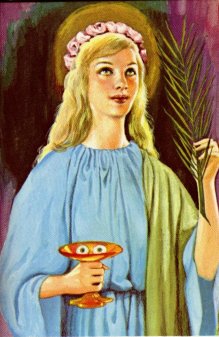
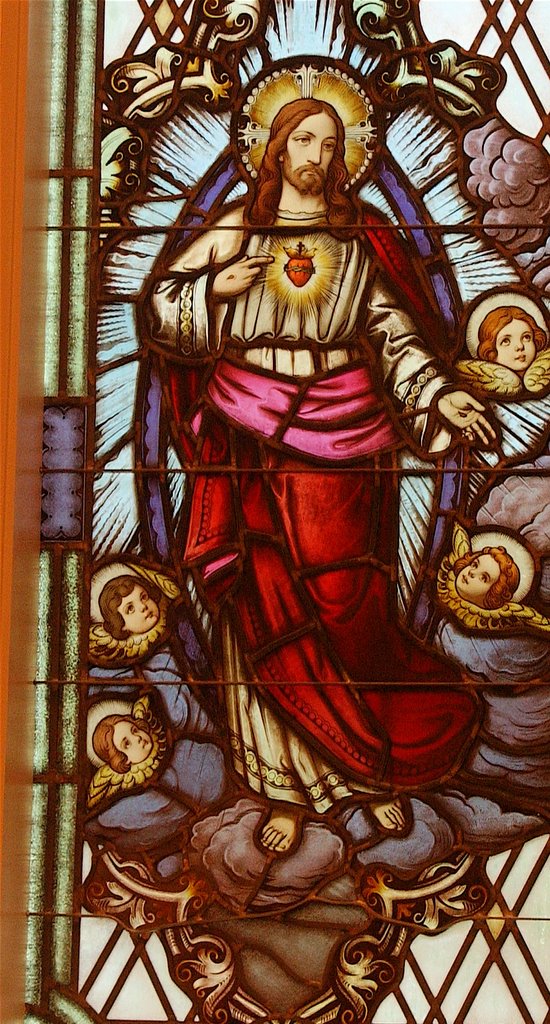
St. Lucy, whom the Church commemorates today, is perhaps best know as the patron saint of those whose eyes are in need of healing. She is often pictured holding her eyes in her hand or, in this case, in a dish. In her other hand, in this image, is the palm of martyrdom which she suffered during the reign of Diocletian.

The account of her martyrdom is one shrouded in uncertainty and sustained by popular legend -- most likely the oral tradition of the early Christians in Sicily. It is tempting to dismiss such an account as a story or a tale, too fanciful to be true. While it is true that on this side of eternity we shall not ever know the true story behind many such legends, we still stand to profit from these accounts. For each account of a martyr -- documented or speculated -- is an account not only of the martyr's faith, but of the faith of the Christian community as a whole. If St. Lucy, at an early age, did promise to consecrate herself to the Lord, it speaks volumes about the culture in which she lived and the faith of those who surrounded her.

This begs the question, for all of us: How do our lives reflect the Christian communities of which we are a part? St. Lucy, whose name means "light" inspired devotion for centuries after her death; she was a light in the darkness of persecution. This Advent, amid the hustle and bustle and busyness, let us be witnesses to something bigger and brighter. Let us, by our actions and our words -- in simple ways -- point toward the Light which is coming.

12 December 2005

Our Lady of Guadalupe

In 1993, on the hottest July day in years, Georgetown Visitation Preparatory School burned--from the top down. Beginning with the roof, floors crashed down upon each other until they reached the basement, 14 feet below ground level. The debris formed a mountain of rubble, in places more than 40 feet high.

Miraculously, no one was hurt. Almost as miraculously, most of our artwork was salvaged. Hand to hand, a human chain passed the pictures from one volunteer to another, in the dark, in the flames, in the drenching water and chemicals the fire department was using to quench the blaze.

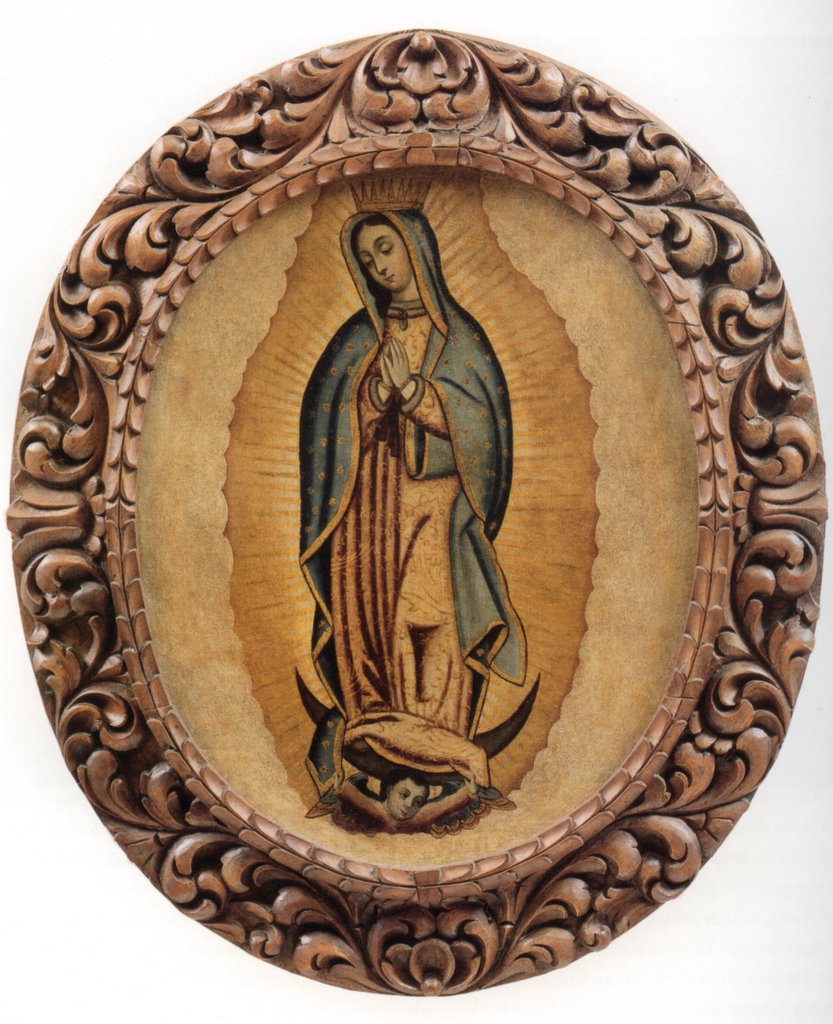
This image of Our Lady of Guadalupe which now hangs in the Chapel of the Sacred Heart was so rescued. It was painted on oxhide in 1601, only 69 years after the apparitions, and fastened to its rosewood frame with an animal glue so strong that when conservators attempted to remove the portrait from its rosewood frame, they were unable to do so. It is an old artifact, 405 years old, if the date on the back is to believed, so its colors are muted. This, according to Ann Bigley Robertson, author of An Enduring Legacy, this gives the painting " . . . a very soft quality and emphasizes the mysterious origins of the image."

It is interesting that images of Our Lady of Guadalupe are instantly recognizable, yet many of them vary significantly in detail. One image that remains a favorite hung over the oval glass insert of the front door of a house rented by migrant workers in Mount Angel, Oregon. It was cotton and had been placed facing outward, so the first greeting to anyone who stopped by the walk was Mary. Her cloak was not blue, but scarlet; she was enthroned on the hands of a Mexican Indian, not by a cherub. Yet one is able to recognize her instantly, the Mother of God who is the Author of all life.
At Guadalupe Mary had promised Juan Diego that she would "demonstrate, manifest, . . . all my love, all my compassion, through the protection of my people." And so she has, and we offer her our gratitude, placing her image right up front, in a chapel in a Visitation monastery, on a door in the Willamette Valley.

11 December 2005

Gaudete Omnes!

Once again we have St. John the Baptist put before us as an example. And again we can glean some insight from a homily of St. Francis de Sales which he delivered on the third Sunday of Advent, 13 December 1620.
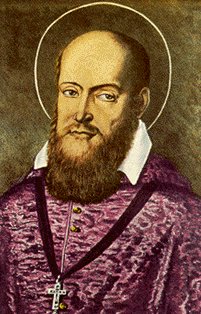
Assigning to St. John the Baptist the great virtue of humility and to Christ that of charity, St. Francis de Sales suggests that in our lives humility is to be the forerunner of charity in all that we do. Humility is the voice that cries, "Make straight the way. . ." And it is only when our hearts are emptied by humility that they can truly welcome Christ and receive the virtue of charity.

St. John the Baptist humbled himself by refusing the honor that rightly belonged to Christ: the title Messiah. His humility was in his honesty. When we ask for the grace of humility we ask for the grace to see ourselves as the Lord sees us: creatures loved by the Creator, despite our weaknesses and foibles. Very often it is only in light of our weaknesses that we see so clearly our need for the Lord's help. We see our "littleness" when we recognize our weaknesses. And, humbly asking for help, aware of our neediness, we prepare a welcome home for charity to dwell in our hearts. For it is only when we are empty that we have room to be filled by the Lord.

Let us empty our hearts of all that is unworthy of the coming of the Lord. Let draw up from our hearts and place before Him all our needs, all our desires, all our concerns. Let us trust that in emptying our hearts we shall be ready to receive Him at His coming. Gaude, veniet!

09 December 2005

The Reluctant Messenger

When Juan Diego Cuauhtlatoazin climbed Tepeyac, a hill 16 miles to the north of Mexico city on his way to Mass, he encountered a beautiful lady, who called him "Juanito," and asked him where he was going. The date was 9 December 1531, at that time, the Feast of the Immaculate Conception. She identified herself as " . . . The ever-Virgin Mary, the Mother of the true God" and charged him with messages to the Bishop, a request that a chapel be built on the spot where she had appeared. But Juan was a reluctant messenger. He tried to explain to Mary all the things that she already knew: "I am old (he was 57), I am without influence." He entreated her to send someone else, some member of the nobility, someone with clout.

Mary answered that she wanted him, Juan Diego, for the job. Indeed she did have other servants, more worthy or more fitted for the task, but she wanted him to take her message to the authorities. Reluctantly, without much hope of success, he followed her instructions -- and failed to make any impact on the Bishop. Three times Juan Diego met Our Lady, each time unable to report any success. Knowing he would encounter her again if he followed his usual route home, after the last failure, he found another path, seeking to avoid her. Our Lady, however, had other plans. She changed her route and intercepted him. "Where are you going, least of my sons? And what road is this you are taking?"

How many times, faced with the ordinary encounters of daily life, are we, like Juan Diego, tempted to avoid the issue -- that issue being God's call to recognize Him in every being, every situation we meet -- to allow the God who lives in us to inspire our words, and allow ourselves to risk doing the things that will call others to recognize his presence? "Where are you going?" is not such a difficult question to answer. "What road is this you are taking?" --now there's a query to consider! Juan Diego was called to the road of encounter, the road of disappointment, the road of faith in his own role as instrument of Our Lord and Our Lady. What road are we taking?

St. Francis de Sales tells us that God wants us to "be who we are, and to be it well." That is all He requires. We, the least of Mary's children, have each been given some task that will further the coming of God's kingdom. Only we can do it. Only we live in the particular circumstances that call forth its accomplishment. As Juan Diego said, we are the least, we are not powerful, there are many more efficient or more persuading messengers. It just happens that we have been chosen for the task.

We cannot possibly do it on our own, nor are we asked to. There is comfort in Mary's words to Juan Diego: "Am I not here who am your mother? Are you not under my shadow and protection? Are you not in the fold of my mantle? . . . Do you need anything else?"

Factual material on Juan Diego is from American Saints by John Fink, Alba House, New York, 2001.

08 December 2005

A Word from Mother

On Saturday evening, prior to Evening Prayer, Mother Philomena gave the community a little ferverino -- as is our house custom each week. Her brief reflection this week focused on Mary as we were anticipating today's Solemnity of her Immaculate Conception. Mother's words are here shared with our readers:

"The season of Advent is a wonderful time to renew our 'yes' to the Lord as we reflect on the life of our Blessed Mother. When she said 'yes' to the Angel's message, she handed over the privilege of shaping her own life. She allowed God to direct the events that would unfold, beginning with the Incarnation. She literally handed over any designs she might have had on shaping her own life. She gave God her heart and her will. Let us, this Advent season, renew our 'yes' to the Lord with Mary and let us allow Him to direct the course of our lives."
Saturday 3 December 2005

07 December 2005

All or Nothing

If St. Francis de Sales had to choose only one "holy snippet" from the Gospels, by which to identify his approach to living, praying and preaching, it is a safe bet that he would have chosen today's Gospel reading from Matthew 11.
When the Lord invites us to come to him and take upon our shoulders his yoke, we are invited to consider how we come before the Lord. It is easy, at times, to give into the temptation to give over to the Lord only some of what we have on our hearts and minds: "Here, Lord, you can take care of this and this and I'll take care of these other things over here." It may not seem to be a fair exchange, but the Lord wants all of us -- all of our troubles and burdens, all that makes us weary and tired. For only then, only when we lay at his feet all that burdens us can we free our shoulders to take up his yoke, which is easy and light. When we stop wresting with our cares and burdens and give them to the Lord, only then we can rest in Him.

06 December 2005

"Bone" Fete

Today is the Commemoration of St. Nicholas, from whose legacy we derive the common legends about Santa Claus. It is also the "feast day" of our noble guard dog, Nicholas. Nick arrived at the monastery on 22 December 2002 to try his vocation. He has proved to be a worthy "security guard" and an even more worthy companion.

Many people say that animals teach us about God -- we shall leave it to the Franciscans to expound on that assertion. It does seem true, however, that animals teach us about ourselves. For early one morning, Nicholas decided to empty the trash -- piece by piece. Catching him in the act, sister firmly scolded him for this (in a gentle way, of course) and returned inside. Nicholas looked forlorn and -- if possible -- even a bit contrite. A few minutes later she came out with a broom to clean up the mess and along came Nicholas with a tennis ball in his mouth. If he could talk, he would have said, "HI SISTER! Listen. I know you're really, really, really upset with me right now, but I was thinking that maybe you'd want to play ball with me now."

Surely, anyone who owns a dog has had similar experiences. They do, indeed, teach us something about ourselves. How often do we reach out to someone who is angry with us? How often do we take the initiative to show good will and forgiveness -- even if we are in need of forgiveness ourselves? How often do we allow our own shortcomings and mistakes to keep us from persevering in our good resolutions? Whether we are fond of dogs or afraid of dogs, we can glean from their attitude what a difference it would make if we bipeds followed their example.

05 December 2005

Advent Advice

As we look ahead to the Solemnity of Our Lady on Thursday, we are reminded of what a model she is, for each of us, during the Advent season. St. Jane de Chantal addressed some of our early sisters on 1 December 1629, exhorting them to take Our Lady as their model:

"Let us see, during this holy season, what are the actions and thoughts of our Lady, and strive to imitate her according to our small power. . . In imitation of her, who was continually occupied in looking at the Divine Word in her pure and chaste womb, we should also look at the Lord in our hearts. Let us talk with Him, stay at His feet." St. Jane de Chantal

May we find in Our Lady an example to imitate and, in doing so, may we find in our hearts, a place to visit frequently with Our Lord, during this sacred season of waiting.

04 December 2005

Holy Finger-Pointing

Finger-pointing isn't always a bad thing. In paintings and icons, St. John the Baptist is often depicted with his arm outstretched and his finger in a pointed position (when his is not busy baptizing, that is!) His whole posture, as he is "painted" in the Gospels is one of pointing: he points his disciples away from himself and toward Christ. Surely this intriguing figure could have amassed quite a group of followers, as the Gospels suggest. Instead, he directs them toward Christ. What a noble and worthy work! For many, Advent is a time of busyness, littered with deadlines and punctuated with an often too-short Christmas break from work or school. We can take our cue from this great herald and point others toward Christ. We can, by our words and deeds, show a posture of tranquil waiting, amid the inevitable busyness of this season; we can be heralds for those with whom we work, those in our family, those we encounter on a daily basis. Good things are contagious. Good posture is as good for the body as it is for the soul.
"True servants of God preach and teach those whom they guide only so as to lead them to God, as much by their words as by their works. This is what St. John does today."
St. Francis de Sales
(Sermon for the Second Sunday of Advent 6 December 1620 )

03 December 2005

Partners in Crime

As we celebrate the Memorial of St. Francis Xavier and pray for our brothers and sisters who serve the Church as missionaries, we stop to consider how we can participate in their work. St. Francis, known for the great numbers of people he baptized, is rightly hailed as a patron of missionaries. How many people, however, know with whom he shares this patronage? St. Therese of Lisieux, the cloistered Carmelite, is also a patron of missionaries. Although she never left Carmel to travel as a missionary, by her prayers and sacrifices on behalf of missionaries -- and priests, in particular, -- St. Therese shares the title, patron saint of missionaries, with St. Francis Xavier. Sometime around the 1950's it was suggested that the Rosary could be prayed in a special way for missionary work. Click here for more information on the mission rosary. Today, as we beg the harvest master to send laborers into his vineyard, let us also beg the harvest master to inspire men and women to pray for those who labor.

02 December 2005

25 Years and Counting

Many are aware that today is the 25th anniversary of the death of four American missionaries in El Salvador: Sister Ita Ford,MM Sister Maura Clarke,MM, Sister Dorothy Kazel, OSU, and Jean Donovan. As we remember them and the many men and women who have been persecuted for their faith and their fidelity to the Gospel, we Visitandines proudly remember that Sister Ita Ford, MM is a graduate of our Visitation Academy in Brooklyn. May their blood and their legacy be a source of renewal and growth for those among whom they served.

The King of Hearts

It seems that often we speak of "opening our hearts" -- either in prayer or in listening to someone or for some other worthy cause. How often, though, is it possible for us to open our hearts -- on our own. When Jesus asked the blind men in today's Gospel if they believed that he could heal them, the men confessed their faith. It was on accout of their faith that Jesus restored their sight. If we were to ask the Lord for the gift of an open heart this Advent season, as we prepare for his coming, what might he say to us? Perhaps he would point to his own heart, opened wide by the sufferings he bore. He might indicate that suffering is the lance that opens our hearts. Looking on us with love, he might then ask if we believe that he can open our hearts. And if we confess our faith that he can open our hearts, we might see that in the day to day sufferings which abound -- in the inconveniences, the difficulties, the irritations and interruptions -- the Lord is opening our hearts for us. For he is providing opportunities for us to grow ever more like him, gentle and humble in heart.
"His heart is the king of hearts, and he keeps his eyes fixed on our hearts."
St. Francis de Sales

01 December 2005

Patron Saint of Journalists

What would St. Francis de Sales have to say about his Visitation Sisters starting a blog? A great deal, most likely. For it is no accident that he is named the patron saint of journalists. During his time in the Chablais, St. Francis de Sales copied, by hand, many of his sermons and distributed them widely by slipping them under the doors of those who had strayed from the faith. These sermons later became known as "The Controversies" and, more recently, as "Meditations on the Church." His creativity in dissemination of information won him the patronage of journalists. It seems likely then that our Holy Founder would smile upon us beginning a blog. In fact, a modern iconic rendering, depicting him as patron of journalists, shows him seated at a computer with the Holy Spirit perched on his monitor. We may not be slipping sermons under anyone's door, but perhaps we can share our adventures and musings as we strive to Live Jesus in the footsteps of St. Francis de Sales and St. Jane de Chantal.